

The Social Architecture of Influence
Golden Hook & Introduction
SECTION
Nova: Most people think influence is about having all the answers, the loudest voice, or the biggest network. But what if the real secret to being a powerhouse leader and a genuine people magnet actually lies in embracing your own profound curiosity and inner calm?
Atlas: Oh, I love that. It’s so counterintuitive, Nova. My initial thought is, "Wait, where's the strategy in that? Where's the actionable growth lever?" It sounds… soft.
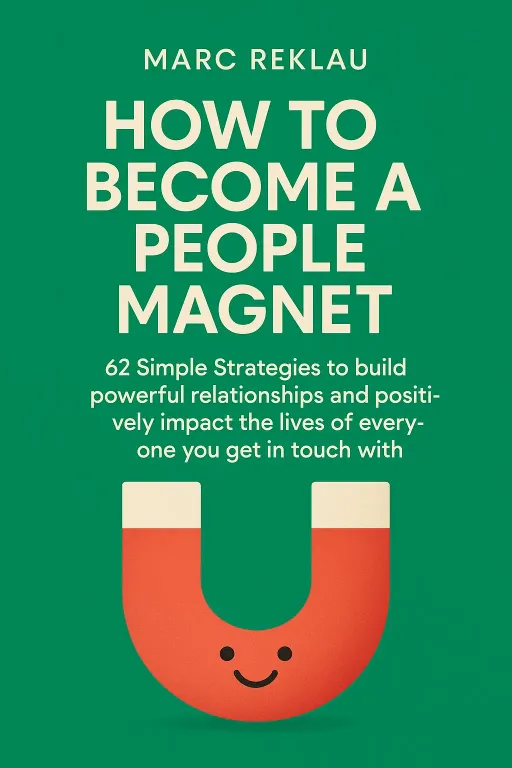
Nova: Exactly! And that’s the beautiful paradox we’re diving into today. We’re going beyond the surface-level tactics to explore the true social architecture of influence. We’ll be drawing insights from two brilliant minds: Marc Reklau, an international bestselling author known for distilling complex social dynamics into highly actionable, results-driven strategies, and Rick Hanson, a renowned neuropsychologist and Senior Fellow at UC Berkeley, who brings decades of scientific research to understanding human well-being and relationships.
Atlas: So, we’re talking about a blend of practical 'how-to' and deep, brain-level understanding. That’s intriguing. I’m curious how these seemingly disparate approaches weave together to create something truly impactful for someone who’s building, strategizing, or casting a vision.
Nova: They weave together brilliantly. Reklau helps us understand the external game—how to connect authentically. Hanson shows us the internal game—how to lead with grounded presence. And for a strategist, builder, or visionary, mastering both is like having a secret weapon. Let’s start with Reklau’s insights into becoming a "people magnet."
The Strategic Leverage of Genuine Curiosity
SECTION
Nova: Reklau’s core idea, especially highlighted in "How to Become a People Magnet," is to shift our social interactions from transactional to magnetic. Most of us approach networking or even daily conversations with a subtle agenda: "What can I get? What do I need to convey?" Reklau says, flip that script. Focus on genuine curiosity.
Atlas: Genuine curiosity. I mean, I I’m curious, but in a high-stakes meeting, my mind is usually racing with objectives, market data, and next steps. How do you cultivate curiosity when your brain is hardwired for strategic execution?
Nova: That’s where Reklau offers practical strategies. He outlines 62 of them, but the essence comes down to two things: asking open-ended questions and reflecting emotions. Think about it: when you ask "How was your weekend?" that’s a closed question, usually met with "Good." Transactional. But an open-ended question, like "What was the most surprising thing you learned last week?" or "What’s a current challenge you’re grappling with that truly excites you to solve?", opens a door.
Atlas: That makes sense. It bypasses the superficiality. But reflecting emotions? Like, just mirroring someone’s feelings? How does that move a business conversation forward?
Nova: It’s not about mirroring, it’s about acknowledging and validating. If someone says, "This project has been incredibly challenging," instead of jumping to "How can I help?" or "We have a solution for that," you might say, "It sounds like you’ve been under immense pressure, and you’re really feeling the weight of this." That’s reflecting. It shows you heard them, you understood the emotional layer. And that builds immediate, authentic rapport.
Atlas: I can see how that builds rapport. But for someone analyzing business models, looking at scalable success, how does this 'magnetic' rapport translate into a tangible asset? Is there an ROI on being genuinely curious?
Nova: Absolutely. Let me give you a scenario. Imagine Sarah, a new business development manager. Her usual approach was to walk into networking events, pitch her company’s innovative tech solution, and collect business cards. She was efficient, but her conversion rate was only average. It felt transactional. Then, she started applying Reklau’s techniques.
Nova: At a major industry conference, instead of immediately launching into her pitch, she approached a potential partner, a CEO known for being notoriously hard to reach. Sarah started by asking, "Beyond the buzzwords, what's the single biggest strategic headache keeping you up at night in this rapidly changing market?" She genuinely listened, letting the CEO talk for several minutes, asking follow-up questions that explored the nuances of his challenges, his frustrations, and even his underlying hopes for a solution. When he mentioned a particular pain point, she reflected, "It sounds like you’re feeling the pressure to innovate quickly, but also the frustration of limited resources to execute on those grand visions."
Atlas: So, she wasn't selling; she was understanding. That’s a subtle but powerful shift.
Nova: Precisely. By truly understanding his emotional landscape and strategic needs ever mentioning her solution, she built an immediate bond of trust. The CEO felt seen, heard, and understood. He then Sarah what her company did. When she finally presented, it wasn’t a generic pitch; it was a tailor-made response to his expressed pain points, framed in his own language. The outcome? Not just a business card exchange, but a follow-up meeting booked on the spot, leading to a multi-million-dollar partnership.
Atlas: That’s a powerful illustration. It shows how genuine connection can bypass typical sales resistance. But as a builder, I'm thinking, how do we systematize this? Can an analytical person who's maybe not naturally extroverted adopt this as a repeatable process, or is it just for natural "people persons"?
Nova: That’s the beauty of it. Reklau’s strategies are not about changing your personality, but refining your approach. It’s a skill. You can schedule 30 minutes weekly, as our growth recommendation suggests for deep work, to specifically practice crafting open-ended questions. You can observe interactions, consciously identify reflected emotions, and make it a deliberate part of your communication system. It’s about intentionality, not innate charisma.
Atlas: So, it's about building a better human-centric system for engagement. I like that framing. It shifts from a 'soft skill' to a 'strategic communication protocol.'
Cultivating Grounded Influence through Empathy and Calmness
SECTION
Nova: And that naturally leads us to the second key idea we need to talk about, which often acts as the internal anchor for that external magnetism: cultivating empathy and calmness. Rick Hanson, in "Making Great Relationships," provides fifty science-backed ways to do this, ensuring your leadership presence remains grounded and inviting.
Atlas: Okay, empathy and calmness. For someone driven by scalable success and financial acumen, these often feel like secondary considerations, or even luxuries, when the market is demanding aggressive growth. What's the value here? What's the scientific underpinning that makes this a non-negotiable for visionary leadership?
Nova: Hanson, as a neuropsychologist, grounds this deeply in brain science. He points out that our brains are constantly scanning for threat or safety. A leader who projects calmness and empathy—even under pressure—signals safety to their team. This isn’t just about being "nice"; it’s about activating the prefrontal cortex, the part of the brain responsible for higher-order thinking, creativity, and problem-solving, rather than the amygdala, which drives fear and reactivity.
Atlas: So, a calm leader literally helps their team think better, rather than just react. That’s a tangible benefit for innovation and problem-solving. But how do you, as a leader, that calm and empathy, especially when the quarterly reports are screaming, or a major project is derailing?
Nova: Hanson offers practical, science-backed methods. One core principle is what he calls "taking in the good"—consciously noticing and internalizing positive experiences, however small. This rewires the brain over time to have a more positive bias, building resilience. Another is practicing active listening, not just hearing words, but truly attempting to understand the speaker's perspective and emotional state. This isn’t just good manners; studies show it literally changes brain activity, fostering neural pathways for empathy.
Atlas: That’s fascinating. It’s about retraining your brain for leadership. Can you give me an example of a visionary leader applying this, especially when facing something like a market disruption?
Nova: Certainly. Consider Alex, a visionary CEO leading a tech startup that had just hit a critical inflection point. A major competitor launched a similar product, causing investor anxiety and internal team panic. The default reaction for many leaders might be to double down on aggression, demand longer hours, or project their own stress. But Alex, having internalized Hanson's principles, chose a different path.
Nova: Instead of an emergency, fear-driven mandate, Alex called a company-wide meeting. He didn’t just deliver a pep talk. He started by acknowledging the palpable anxiety in the room, reflecting, "I know many of you are feeling uncertainty right now, perhaps even a sense of threat to what we’ve built together." He then spent the majority of the meeting to concerns, fears, and ideas from every level of the organization. He maintained an incredibly calm, steady presence, even when faced with pointed questions or expressions of doubt.
Atlas: Wow, that’s powerful. It’s not just about what he said, but how he held the space.
Nova: Precisely. By embodying calmness and demonstrating genuine empathy for their fears, Alex didn't just calm the room; he activated their collective problem-solving capacity. He explicitly stated, "My role now is to create the space for us to think clearly and innovatively, not to dictate." The team, feeling secure and heard, rallied. They came up with creative solutions for market differentiation and product iteration that far exceeded what Alex could have devised alone. They avoided a talent exodus and turned a potential crisis into a strategic re-alignment, ultimately fueling sustainable growth.
Atlas: So, the ROI on a calm, empathetic CEO isn’t just a happier team; it’s a more resilient, innovative, and ultimately, more profitable organization. It prevents the kind of internal chaos that can derail even the best business models. How do you build a system where an entire leadership team consistently practices this, especially under intense pressure, to achieve resilient team dynamics?
Nova: It starts with leadership modeling and then integrating these practices into organizational culture. It’s about making mindfulness and empathetic communication part of leadership training, not just a suggestion. It means creating feedback loops that reward calm, considered responses over reactive ones. It's about building a system that fosters psychological safety, allowing everyone to contribute their best, even when the stakes are high. It becomes part of the social architecture itself.
Synthesis & Takeaways
SECTION
Nova: So, what we’ve explored today is that true influence, scalable success, and resilient organizations aren’t built on brute force or clever tactics alone. They're constructed on a foundation of profound human connection—driven by outward curiosity and inward calm.
Atlas: Absolutely. For a strategist, builder, or visionary, this isn’t about being "nice" for the sake of it. This is about building a robust social architecture that fuels innovation, fosters trust, and ensures sustainable growth. Genuine curiosity unlocks hidden opportunities and builds powerful networks. Grounded leadership, through empathy and calmness, creates the psychological safety and clarity needed for teams to perform at their peak, especially under pressure.
Nova: These are strategic levers, not soft skills. They are the difference between a transactional network and a magnetic ecosystem; between a reactive team and a resilient, innovative organization.
Atlas: So, the challenge isn’t just to understand these concepts, but to embody them. It's about designing your own internal operating system to reflect these principles.
Nova: Exactly. So, here’s one concrete action you can take this week: in your next important interaction, whether it’s a networking event, a client pitch, or a critical team meeting, pick just one technique. Either consciously ask an open-ended question and truly listen to the response, reflecting the emotions you hear, consciously bring a sense of calm and empathetic presence to your interactions. Observe the difference it makes.
Atlas: And reflect on how that seemingly small shift could impact your strategic challenges, your team dynamics, and ultimately, your vision for growth.
Nova: This is Aibrary. Congratulations on your growth!









