

The Science of Social Influence
Golden Hook & Introduction
SECTION
Nova: What if the biggest obstacle to your accelerated financial growth isn't market volatility, or fierce competition, or even your own skill set? What if it's something far more fundamental: your ability to influence the people around you?
Atlas: Whoa, Nova. That's a bold claim. For our listeners who are constantly seeking actionable paths to wealth and career optimization, it often feels like the game is about strategy, market timing, or sheer grit. Are you saying it's actually about... persuasion?
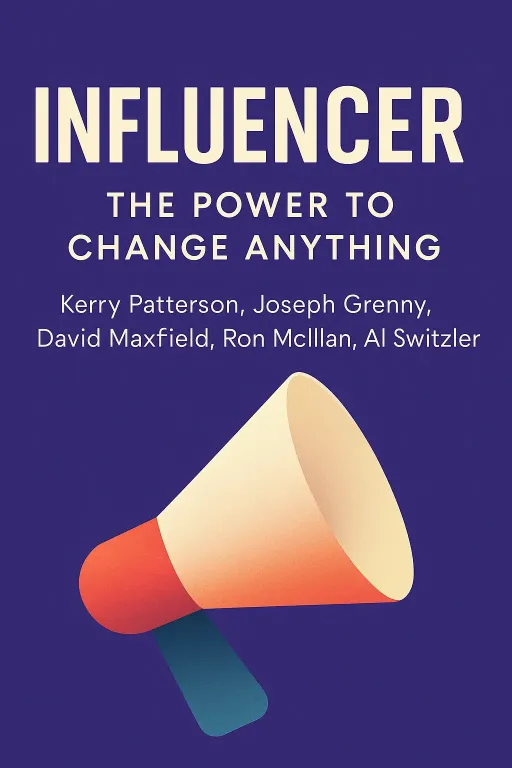
Nova: It’s not just persuasion, Atlas. It's a profound, systematic understanding of how human behavior truly shifts. Today, we're diving into two brilliant works that, when combined, offer a powerful blueprint for influence. We're talking about Kerry Patterson's seminal work, "Influencer: The Power to Change Anything," and Marc Reklau's incredibly practical guide, "How to Become a People Magnet."
Atlas: I’m curious. Patterson and his co-authors are renowned for their work on "Crucial Conversations" and "Crucial Accountability," which are staples for anyone in leadership. That suggests a very structured approach. And Reklau, his book sounds like it’s all about immediate connection. How do these two seemingly different approaches intertwine to create such a powerful strategy for driving change?
Nova: That’s the magic, Atlas. Patterson gives us the grand strategy – the multi-layered science of people do what they do, and how to identify the most impactful behaviors. Reklau gives us one of the most potent, yet often overlooked, tools for executing that strategy: authentic, magnetic rapport. Together, they form an unstoppable force for change, whether you're trying to shift an entire organization's culture or simply get your team to adopt a new, more efficient process.
Atlas: So we're talking about more than just charming people. This is strategic, almost like an engineering approach to human interaction, but with a heart.
The Six Sources of Influence: Why Change is Hard
SECTION
Nova: Precisely. Let's start with Patterson's "Influencer." Many of us, especially those driven by ambitious goals like financial growth, operate under a flawed assumption: that if we just present logical arguments, people will change. We assume a lack of willpower is the problem. But Patterson reveals that behavior change is never that simple. It’s influenced by distinct sources, which he categorizes across personal, social, and structural motivations and abilities.
Atlas: Six sources? That sounds like a lot to manage. For our listeners who are trying to optimize their careers and build a solid financial future, time is always a critical factor. How do you even begin to tackle something that complex, especially if you're trying to shift a whole team's approach to, say, a new, potentially disruptive, sales strategy or a more rigorous financial reporting system?
Nova: That’s the brilliance of it. You don't try to tackle all six sources for every single behavior. Instead, you focus on what Patterson calls "Vital Behaviors." These are the two or three high-leverage actions that, if consistently performed, lead to a disproportionate amount of the desired results.
Atlas: Ah, so it’s about identifying the critical few levers that generate maximum impact. That makes a lot of sense for someone focused on efficiency and accelerated growth. It’s like finding the 20% of actions that give you 80% of the results. But even with vital behaviors identified, how do you actually people to do them? Because often, those vital behaviors are new, they require effort, and they might even challenge existing comfort zones.
Nova: Exactly. Imagine a company trying to improve its safety record. Instead of a vague directive like "be safer," a vital behavior might be "wear hard hats in designated zones" and "report every near-miss incident immediately." Now, just telling people to do that, even if it's logical, often isn't enough. They might forget, they might feel it's inconvenient, or they might feel reporting a near-miss makes them look bad.
Atlas: So, the logic is there, the 'what' is clear, but the 'how'—the actual implementation—is where things often fall apart. I imagine a lot of our listeners have experienced this trying to implement new financial protocols or productivity tools within their teams. They see the vision, they understand the 'why,' but the daily adoption is a struggle.
Nova: That's where the six sources come in. You need to ask: What are the? Do they believe it's important? Do they feel to do it? Then, what are the? Do their peers support it? Do their leaders model it? And finally, what are the and? Are the tools available? Are incentives aligned? If you only hit one or two of those, change fizzles. If you hit all six, it becomes inevitable.
Atlas: That sounds like a very comprehensive diagnostic. It goes way beyond just a pep talk. It's about systematically removing roadblocks and building momentum across multiple dimensions. I can see how that would be powerful for someone trying to lead a team towards aggressive financial targets. You can't just mandate change; you have to engineer it.
Becoming a People Magnet: The Power of Authentic Connection
SECTION
Nova: And that naturally leads us to the second key idea, which often acts as the missing piece in activating those social sources of influence: becoming a 'People Magnet,' as Marc Reklau describes. We often think of influence as something grand, like a charismatic speech or a powerful presentation. But Reklau points to something far more fundamental and often overlooked: genuine connection through active listening and authentic interest.
Atlas: So it's not about a big, flashy performance, but about genuinely and people? For someone trying to lead a team towards aggressive financial targets, it might feel like a distraction to 'listen' when there's so much to. Isn't that just good manners, or is there a deeper strategic utility here?
Nova: It’s absolutely a strategic utility, Atlas. It's the magnet itself. Reklau argues that when you genuinely listen, when you show authentic interest in another person's perspective, their concerns, their ideas – even if you ultimately disagree – you disarm them. You build trust. You create psychological safety. This isn't about manipulation; it's about forming a connection that makes them to your influence.
Atlas: Okay, so it’s a strategic investment, not just a soft skill. It builds the social capital needed to implement those vital behaviors. It makes sense, you can't just mandate change, you have to enroll people. But how does that work in practice? Give us an example.
Nova: Consider a manager introducing a new, complex financial reporting system. Instead of just sending out an email with instructions, the manager takes the time to sit down with key team members, one-on-one. They don't just explain the new system; they ask about the team member's current challenges, listen to their fears about the new workload, and genuinely try to understand their perspective.
Atlas: I see. So, instead of just pushing information, the manager is pulling out insights and building a bridge. That’s a fundamentally different approach.
Nova: Exactly. By actively listening and showing authentic interest, that manager doesn't just get buy-in; they get. The team member feels valued, understood, and is far more likely to embrace the new vital behavior—the new reporting system—because they feel like a part of the solution, not just a cog in the machine. That rapport makes the new behavior socially desirable, because they respect and trust the person asking them to change. It's how you activate the social motivations and abilities in Patterson's framework.
Atlas: That’s fascinating. It turns out that the most powerful tool for influence isn't about having all the answers, but about asking the right questions and genuinely caring about the responses. It’s about creating an environment where people to be influenced.
Synthesis & Takeaways: Accelerating Influence for Growth
SECTION
Nova: Absolutely. And this is where the profound takeaway of our discussion comes into play: to truly drive change in your organization, or even just within your own team, you need to first identify the 'Vital Behaviors'—those few actions that yield massive results. Then, you use your rapport, your 'People Magnet' skills, to make those behaviors socially desirable.
Atlas: So for our listeners driven by financial growth and career optimization, this isn't just about understanding market trends or perfecting a business plan. It's about mastering the human equation. It’s about strategically identifying the few actions that truly matter, and then building the genuine connections that make those actions feel like a shared mission, not a top-down directive.
Nova: Exactly. It transforms mere compliance into enthusiastic commitment. It’s the difference between temporary adherence and sustainable, accelerated growth. It’s the profound insight that true influence isn't about wielding power, but about understanding and connecting with people on a genuine level.
Atlas: That's a powerful shift in perspective. It means dedicating those 20 minutes daily not just to market analysis or financial planning, but to understanding the human dynamics that drive your goals. It’s about investing in the social capital that makes all other strategies possible.
Nova: Absolutely. Because ultimately, whether it's achieving financial growth, optimizing your career, or building a solid future, it's all built on the collective actions of people. And influencing those actions, genuinely and strategically, is your greatest leverage.
Atlas: Profound. This is Aibrary. Congratulations on your growth!









