The Green Business Imperative
Golden Hook & Introduction
SECTION
Nova: Most people treat the climate crisis like an accounting error. They think if we just balance the books—offset this, tax that—the problem disappears. But what if the problem is actually the math itself?
Atlas: That is a dangerous way to look at it, Nova. Because if the math is wrong, no amount of creative accounting is going to fix the temperature of the planet.
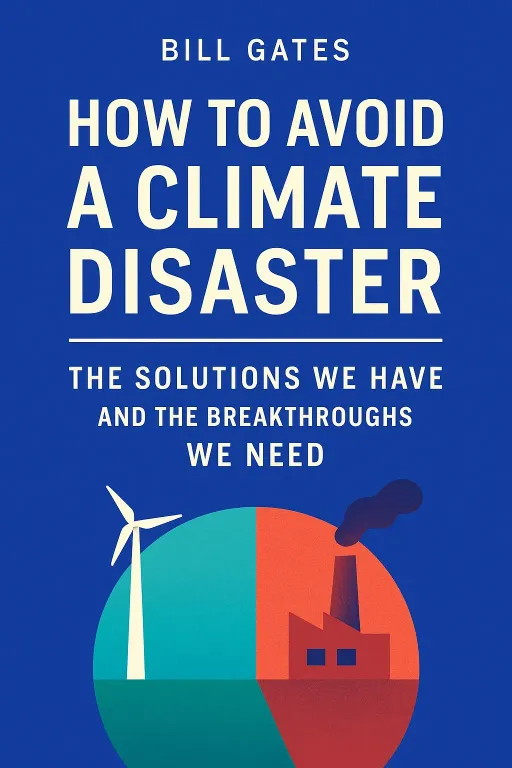
Nova: Exactly. And that is why we are diving into two seminal works today that try to rewrite that math. We are looking at How to Avoid a Climate Disaster by Bill Gates, and Net Positive by Paul Polman and Andrew Winston.
Atlas: It is a fascinating pairing. You have Gates, the technologist, coming at this with the cold, hard logic of a software engineer trying to debug a global operating system. And then you have Polman and Winston, who are looking at the corporate machine from the inside, arguing that the way we run our businesses is fundamentally misaligned with the reality of our environment.
Nova: Gates wrote his book after spending over a decade analyzing climate data, and he brought a very specific, engineering-first perspective to the table. He isn't just talking about policy; he is talking about the physics of the energy transition. On the other hand, Paul Polman, the former CEO of Unilever, and Andrew Winston, a sustainability strategist, wrote Net Positive to challenge the very definition of corporate success. They are asking: what if a company’s goal wasn't just to be the best in the world, but to be the best the world?
Atlas: It feels like the perfect bridge for our listeners who operate as strategic architects. We are moving from the macro-level physics of energy to the micro-level strategy of corporate governance. Let’s start with that Gatesian perspective. He has this concept that acts as a lens for everything else: the Green Premium.
The Economics of the Green Premium
SECTION
Nova: The Green Premium. It sounds like something you pay at a fancy coffee shop, but it is actually the central economic barrier to saving the planet.
Atlas: Right. So, if I am hearing you correctly, the Green Premium is essentially the difference in cost between a product that uses fossil fuels and a clean alternative.
Nova: That is the core of it. Think about it this way: if you have a gallon of jet fuel that costs a certain amount, and a gallon of sustainable aviation fuel that costs three times as much, that extra cost is the Green Premium. Gates argues that in almost every sector—steel, cement, electricity, agriculture—there is a premium we are currently paying to be green. And because that premium exists, the market naturally defaults to the cheaper, carbon-intensive option.
Atlas: That makes sense from a purely capitalistic standpoint. If I am running a company, I am looking at my bottom line. If the green version of my raw material is significantly more expensive, I am going to choose the cheaper one every single time. It is not malice; it is market reality.
Nova: Precisely. And Gates’s argument is that we have to drive that premium to zero. He illustrates this with the example of steel. We need steel for everything, but making it without fossil fuels is notoriously difficult and expensive. He suggests that we need to treat climate tech like a startup ecosystem. We need massive R&D, we need government policy to de-risk these investments, and we need to scale these technologies until the cost curves intersect.
Atlas: But let’s play devil’s advocate here. Scaling takes time. If we wait for the Green Premium to hit zero before we act, aren't we just kicking the can down the road while the climate keeps changing?
Nova: That is the tension. Gates acknowledges this. He talks about the concept of the "Valley of Death." It is that space where a new technology has been invented in a lab, it works, but it is not yet commercially viable. It is too expensive to mass-produce, but it is too promising to abandon. Private capital often steers clear of this valley because the returns are too uncertain and the timelines are too long.
Atlas: So, the solution isn't just "let the market handle it." The solution is to change the incentives.
Nova: Exactly. Gates advocates for government intervention that acts as a bridge across that valley. Think about things like carbon taxes, clean energy subsidies, and government-backed loan guarantees. These tools are designed to artificially lower the Green Premium, making it cheaper for companies to choose the green option today, even if the technology hasn't reached full scale yet.
Atlas: I see the strategy there. You are essentially shifting the cost of innovation from the individual company onto society, or at least spreading it out, so that the green option becomes the default choice sooner.
Nova: That is the goal. And it is a mindset shift. Instead of viewing green technology as a luxury add-on, we have to view it as the next essential infrastructure. When we look at the history of technology—the internet, the steam engine, electricity—they all started with massive premiums and low reliability. But through sustained investment and iterative improvement, they became the backbone of our economy.
Atlas: It is like the early days of the personal computer. They were slow, expensive, and useless to the average person. But the early adopters and the heavy government R&D funding for things like the transistor and the internet paved the way for the smartphone in your pocket.
Nova: That is a perfect analogy. And Gates is essentially saying, we need that same level of commitment for clean cement and green hydrogen.
The Shift to Net Positive
SECTION
Atlas: Okay, so we have the technological and economic framework established. We are trying to make clean tech the cheaper, easier option. But that brings us to the second piece of the puzzle. Even if we have the technology, we still have the corporate mindset to deal with. That is where Polman and Winston come in with Net Positive.
Nova: This is where we move from the "what" of technology to the "how" of leadership. Polman and Winston argue that for too long, businesses have operated on a "do less harm" principle. They call this "the less bad" trap. A company might say, "We have reduced our carbon footprint by 10 percent." And they celebrate that.
Atlas: But that is still a net negative.
Nova: Exactly. If you are still putting carbon into the atmosphere, you are still contributing to the problem. You are just doing it a little more slowly. Polman and Winston argue that a truly sustainable business needs to be "Net Positive." They need to give more to the world than they take.
Atlas: That sounds incredibly ambitious, almost to the point of being unrealistic for a publicly traded company that is beholden to quarterly earnings. How do you convince shareholders that "giving more than you take" is a viable business strategy?
Nova: That is the challenge. Polman and Winston suggest that the only way to do it is to change the definition of value. They propose that companies must take responsibility for their entire footprint—not just their direct operations, but their entire supply chain, and even the societal impact of their products.
Atlas: So, it is not just about your factory’s emissions; it is about the emissions of your suppliers, and the way your product is used by the consumer.
Nova: Yes. And they argue that this is actually a competitive advantage. If you are a company that is truly Net Positive, you are more resilient. You have stronger relationships with your suppliers because you are helping them improve. You have more loyal customers because they trust your brand. You are better at attracting top talent because people want to work for a company with a purpose.
Atlas: I can see how that would appeal to the "Strategic Architect" mindset. It is about building systems that are robust and regenerative, rather than extractive. But let’s be practical. If a company decides to go Net Positive, they are going to face higher costs in the short term. They are taking on responsibilities that their competitors are ignoring. Doesn't that make them vulnerable to being undercut on price?
Nova: That is where the two books collide. If you are a Net Positive company, you are likely adopting the green technologies Gates is talking about. So yes, you might have higher costs initially. But Polman and Winston would argue that the cost of inaction—the cost of climate risk, the cost of supply chain disruption, the cost of losing your social license to operate—is far higher in the long run.
Atlas: So, it is about risk management as much as it is about ethics.
Nova: Absolutely. They describe a business model where you are not trying to maximize profit at the expense of the world, but rather, you are maximizing value by aligning your success with the success of the planet. They talk about "multi-stakeholder" capitalism. It is not just about shareholders; it is about employees, customers, the environment, and the communities you operate in.
Atlas: That sounds like a fundamental rewrite of the corporate playbook. If you are a leader trying to implement this, where do you even start? It feels like you would have to tear down the entire organization and build it back up.
Nova: They don't suggest a total demolition. They suggest a transition. You start by measuring everything. You cannot manage what you do not measure. That means full transparency on your supply chain. It means setting science-based targets. And it means being honest about where you are failing.
Atlas: That transparency part is the hardest. Most companies are terrified of admitting they are not perfect.
Nova: And that is exactly what Polman and Winston say is the biggest barrier. The fear of vulnerability. But they argue that the companies that are open about their challenges are the ones that actually build the most trust. People know the world is complex. They respect honesty.
Atlas: This reminds me of the "Green Premium" concept again. If a company is honest about their Green Premium—if they say, "We want to use this sustainable material, but it is currently 20 percent more expensive, so we are working with our suppliers to bring that cost down"—that is a narrative that customers can get behind.
Nova: That is a brilliant connection. You are using the Gatesian framework of the Green Premium to execute the Polman-Winston strategy of Net Positive. You are being transparent about the cost of the transition, and you are inviting your customers and stakeholders into the process of solving it.
Synthesis & Takeaways
SECTION
Atlas: This has been a fascinating journey through the economics of transition and the philosophy of corporate responsibility. We have the macro view—the Green Premium—which tells us the hurdle we need to clear. And we have the micro view—Net Positive—which tells us the commitment we need to make.
Nova: And for our listeners, the challenge is to synthesize these two into their own reality. Whether you are leading a team, managing a household, or just trying to make sense of the news, the takeaway is the same: stop looking for the easy path and start looking for the strategic path.
Atlas: Which brings us back to our actionable step. We asked listeners to map out one Green Premium in their own life or business.
Nova: Exactly. And to do that, you have to be specific. Don't just say "I want to be green." Pick one thing. Maybe it is the energy source for your office. Maybe it is the materials you use for your packaging. Maybe it is the way you commute.
Atlas: And once you pick that one thing, you have to identify the barrier. Why is the green option more expensive or less convenient? Is it a lack of technology? Is it a lack of infrastructure? Is it just a lack of market scale?
Nova: And then, you have to look for the leverage point. What is the shift—technological, regulatory, or behavioral—that could reduce that barrier? Maybe you can’t change the whole industry, but maybe you can be the first in your local market to adopt a new standard. Maybe you can advocate for a policy change in your city.
Atlas: It is about changing the math. You are taking the "Green Premium" of your own life and working to drive it toward zero.
Nova: That is exactly right. And that is the essence of being a conscious leader. It is not about feeling guilty about the current state of the world. It is about proactively redesigning the systems you control so that the right choice becomes the easy choice.
Atlas: I love that. It turns the climate challenge from an overwhelming, abstract problem into a series of concrete, solvable engineering and management puzzles.
Nova: And that is how change happens. One premium at a time. One, Net Positive decision at a time. It is not about saving the world in a single stroke. It is about the cumulative impact of intentional, strategic action.
Atlas: This has been a great conversation, Nova. It feels like we have moved from the "what" of climate change to the "how" of our own future.
Nova: I am glad we could connect those dots. It is a massive challenge, but it is also the greatest creative opportunity of our time. We are essentially prototyping a new way of living and working.
Atlas: And that is a future worth building toward. Thank you for joining us on this exploration. This is Aibrary. Congratulations on your growth!