

Cognitive Agility for Disruptive Innovation
Golden Hook & Introduction
SECTION
Nova: What if the biggest barrier to your next breakthrough isn't a lack of ideas, but too many of the of thoughts? That feeling of being stuck, not because you're out of options, but because your brain is subtly tricking you into seeing only old ones.
Atlas: Whoa, that's a gut punch. So, you're saying it’s not about needing more coffee or another brainstorming session, but about some invisible mental sabotage happening in our own heads? Because honestly, that sounds like my Monday mornings trying to untangle a particularly stubborn tech problem.
Nova: Exactly! It's not about willpower; it's about wiring. Today, we're diving into how to systematically dismantle those mental roadblocks and then, crucially, how to build a strategic thinking framework that turns those cleared paths into superhighways for your long-term success.
Atlas: That sounds like a dream for anyone who values efficiency but struggles with time, like many of our listeners. We're all driven by impact, but sometimes the path feels cluttered.
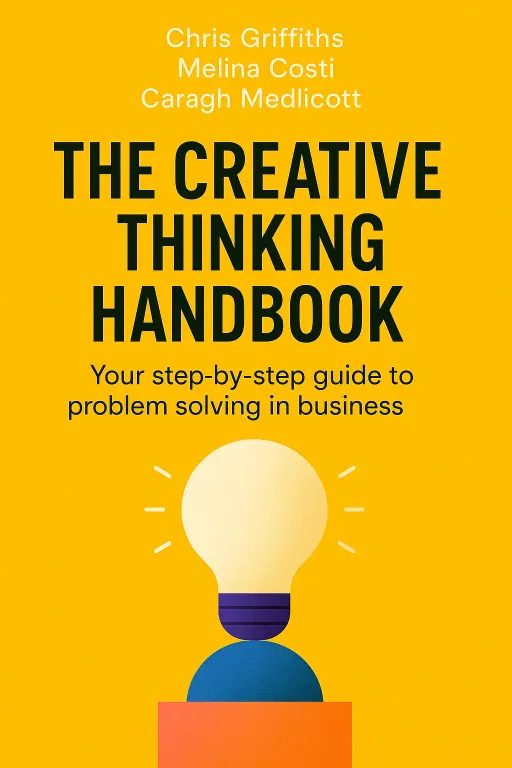
Nova: Well, we’re pulling insights from two powerhouses today. First up, we'll dissect Chris Griffiths’ "The Creative Thinking Handbook." Griffiths is renowned for his systematic approach to creativity, having worked with countless organizations to unlock innovative potential. His book isn't just theory; it's a blueprint.
Atlas: And the second? Because I imagine these two are going to build on each other.
Nova: Absolutely. Then we'll turn to John C. Maxwell’s "Thinking for a Change." Maxwell, with his decades of experience as a leadership expert and author of over a hundred books, distills success into eleven specific thinking habits. He argues that strategic thinking isn't a gift, but a learnable, daily practice.
Atlas: So, one helps us clear the fog, and the other helps us chart the course. I'm already seeing the connection for our listeners who are trying to master tech trends and scale ventures.
Unmasking Cognitive Biases in Innovation with Chris Griffiths
SECTION
Nova: Precisely. Let's start with Griffiths and those "mental blocks." He introduces something called the 'Solution Finder' method, which is essentially a systematic blueprint to bypass the cognitive biases that prevent innovative breakthroughs. Think of it like a diagnostic tool for your brain.
Atlas: A diagnostic tool for my brain? I like that. But how do you even know you're stuck in one of these 'mental blocks' when you're in the thick of it, trying to hit a deadline? It feels like you're just, not necessarily.
Nova: That’s the insidious nature of biases, isn’t it? They’re often invisible to us. Griffiths points out, for example, functional fixedness. Imagine a team trying to solve a complex coding issue. They’ve always used a specific algorithm, and even when it’s clearly failing, they keep trying to tweak it, or optimize it, rather than stepping back and asking, “Is there an entirely different approach here?”
Atlas: Oh, I've seen that play out! It’s like having a hammer and seeing every problem as a nail, even when you really need a screwdriver. So, the bias isn't about being bad at your job, it's about your brain defaulting to what's familiar.
Nova: Exactly. Or confirmation bias: a tech lead has a hypothesis about why a project is failing, and unconsciously, they only seek out data that confirms their initial idea, ignoring contradictory evidence. They're not being malicious; their brain is just trying to be efficient.
Atlas: That sounds rough, but how does Griffiths' 'Solution Finder' help? Does it just tell you "You're biased!" or does it give you actual tools?
Nova: It’s very much about actual tools. It’s a structured process that forces you to break down problems, challenge assumptions, and explore alternative perspectives. It’s not about waiting for a flash of genius; it’s about creating the conditions for innovative thought. It gets you to ask questions like, "What if the opposite were true?" or "How would someone completely outside our industry solve this?"
Atlas: So it’s almost like a forced perspective shift. For our listeners who are constantly dealing with complex tech projects, this could be invaluable for identifying those hidden snags that stall progress. It’s about being in your thinking, not just with it.
Nova: Absolutely. It’s about moving from reactive problem-solving to proactive problem. Griffiths provides these structured exercises that, when applied, can bypass those cognitive shortcuts our brains love to take. It helps you see the blind spots before they become massive potholes.
Atlas: That makes sense. It’s like having a checklist for your mental models. How many times have we been in a meeting where everyone agrees, but you just there’s a better way no one’s considering because they’re all looking through the same lens?
Cultivating Strategic Thinking for Long-Term Impact with John C. Maxwell
SECTION
Nova: Precisely. And once you’ve identified those mental blocks, once you’ve cleared the fog with Griffiths’ methods, the next crucial step is ensuring you’re building towards something meaningful. That’s where John C. Maxwell’s 'Big-Picture Thinking' comes in.
Atlas: Big-Picture Thinking sounds great on paper, but when you're trying to scale a venture or master rapidly changing tech trends, it's easy to get lost in the day-to-day grind. How do you keep the 'big picture' in focus daily, especially when time is always a factor?
Nova: Maxwell argues that thinking strategically isn't a grand, annual retreat. It’s a habit. One of his eleven thinking habits is 'Big-Picture Thinking,' and he frames it as something you practice daily. He says, "A leader is one who knows the way, goes the way, and shows the way." And that 'knowing the way' comes from consistent big-picture thinking.
Atlas: So it's not just about having a grand vision somewhere in a dusty binder, but consistently in a way that serves that vision, even in small steps? That aligns so well with our listener's desire for small steps building momentum.
Nova: Exactly. He gives an example of a CEO who spent 15 minutes every morning, not on emails, but simply asking: "What are the three most important things for our company's long-term success right now? And how does my day's agenda align with those?" This wasn't a luxury; it was a non-negotiable part of his routine.
Atlas: I like that – making strategic thinking a non-negotiable, almost like a productivity hack for your brain. It's like scheduling that 20 minutes daily for focused learning, treating it like an important meeting.
Nova: It absolutely is. Maxwell emphasizes that 'Big-Picture Thinking' allows you to see how all the pieces fit together. It helps you anticipate problems, identify opportunities, and ensure that your current tech projects, for example, aren't just busy work, but actually move you closer to your long-term wealth goals.
Atlas: That's powerful. Because it's easy to get caught in the cycle of "doing" without pausing to ask "why" or "where is this taking me?" Especially in fast-paced environments, the default is often just to react.
Nova: Right. And Maxwell’s point is that if you don't cultivate this habit, you'll be constantly reacting to symptoms rather than addressing root causes or proactively shaping your future. It's the difference between merely managing a project and a vision.
Atlas: It sounds like it gives you a sense of control, or at least direction, even when the external world feels chaotic. You're building a mental compass.
Synthesis & Takeaways
SECTION
Nova: That’s a perfect analogy, Atlas, a mental compass. So, when we bring Griffiths and Maxwell together, the message becomes incredibly clear for our driven innovators. First, you use Griffiths’ systematic approach to shine a light on those invisible cognitive biases that are subtly derailing your innovation efforts. You expose the 'mental blocks' in your tech projects.
Atlas: You figure out where your brain is tricking you, where you're stuck in a loop, or where you're not seeing the full picture. You get efficient about identifying the problem behind the problem.
Nova: Exactly. And once those blocks are identified and you have clearer pathways, you then apply Maxwell’s 'Big-Picture Thinking' as a daily, deliberate habit. This ensures that every step you take, every project you tackle, is not just productive in the short term, but strategically aligned with your long-term wealth goals and scaling ventures.
Atlas: So, it's about clearing the internal noise, then setting a very intentional, high-level course, and making sure your daily actions contribute to that. It’s about building a future, not just filling a schedule.
Nova: Absolutely. It’s about moving from struggling with time to truly optimizing it, from merely working your business to strategically working your future. For anyone looking to master tech trends and fuel business growth, this combination is non-negotiable.
Atlas: I love that. It’s a powerful one-two punch: diagnose the hidden thinking traps, then consciously build the thinking habits that lead to lasting impact. This isn't just about working smarter; it’s about thinking smarter, every single day.
Nova: Precisely. It’s about understanding that your most valuable asset isn't your time or your skills, but the quality of your thinking. And that quality can be systematically improved.
Atlas: That’s actually really inspiring. It means we’re not just at the mercy of our default mental patterns. We can actively shape them.
Nova: This is Aibrary. Congratulations on your growth!









