

The Intersection of Literature and Well-being
Golden Hook & Introduction
SECTION
Nova: When life throws a curveball, our first instinct is usually to fix it, to find a quick solution, to move on as fast as humanly possible, right? But what if the real power isn't in fixing, but in feeling? In truly, deeply, almost excruciatingly the mess?
Atlas: Whoa, feeling? That sounds… incredibly inefficient. For anyone who's ever had a major professional setback, the last thing they want to do is just sit there and it. They want a strategy, a comeback plan.
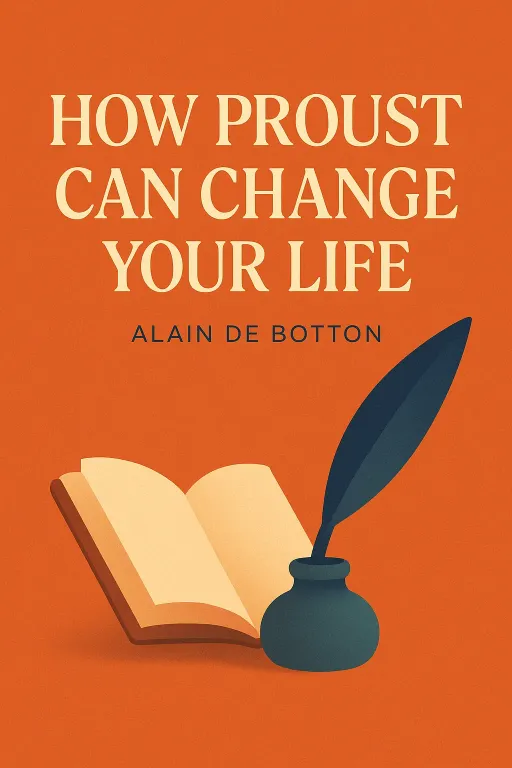
Nova: I know, it sounds counterintuitive to our modern, results-driven mindset. But that's exactly the provocative idea at the heart of our first book today: by the brilliant philosopher Alain de Botton.
Atlas: Ah, de Botton. He's known for making philosophy actually, which I appreciate. But Proust? The famously long, introspective novels? How does translate into practical life advice, especially for someone trying to navigate a fast-paced career?
Nova: That’s precisely his genius, Atlas. De Botton, who himself has this remarkable knack for translating complex philosophical ideas into accessible, relatable wisdom, doesn't just analyze Proust; he uses Proust's literary insights as a kind of operating manual for life. When the book first came out, it was lauded for its fresh, almost cheeky approach to literary criticism, showing how a seemingly esoteric author could offer profound tools for living. It challenged the notion that literature is purely for academic study or escapism. De Botton argues that literature, particularly Proust's meticulous observations, is actually a powerful tool for self-understanding and emotional intelligence, far beyond mere entertainment.
Atlas: So it's not about reading a book to find a solution, but to through the book? That’s a huge shift from our usual 'fix-it' mentality, especially in a professional context where time is scarce. I’m curious how that works in practice.
The Proustian Lens & Self-Understanding
SECTION
Nova: It's all about what de Botton calls the "Proustian lens of slow observation." Think about it: in our daily lives, especially after a setback, we tend to rush past uncomfortable emotions. We label them quickly – "failure," "disappointment," "stress" – and then try to suppress them or immediately pivot to problem-solving. Proust, through his character Marcel, does the opposite. He lingers. He dissects. He observes every minute detail of a feeling, a memory, a social interaction, no matter how small or painful.
Atlas: Okay, but how does that translate into, say, the aftermath of a project failing? My first thought isn't to meticulously catalog my feelings of inadequacy. It's to figure out what went wrong and how to fix it before the next deadline.
Nova: Exactly. And that's where the Proustian approach offers a unique kind of strength. Imagine this: you've poured months into a big project, and it crashes. Instead of immediately blaming yourself or others, or just trying to shake it off, the Proustian lens encourages you to pause. To observe the precise texture of your disappointment. Is it anger at external factors? Is it shame about your own perceived shortcomings? Is it a fear of future failure?
Atlas: So, instead of just a blanket "I feel bad," you're suggesting a forensic examination of "bad"?
Nova: Precisely. Proust shows us how to pay attention to the subtle nuances, the contradictory impulses within ourselves. He demonstrates how a seemingly simple emotion can be a complex tapestry of past experiences, unfulfilled desires, and unconscious fears. By slowing down, by giving language to these intricate inner states, you're not just wallowing; you're building a deeper understanding of your own emotional architecture. You’re identifying the true roots of your reaction.
Atlas: I guess that makes sense. If you don't truly understand the subtle layers of your disappointment, how can you address them effectively, or ensure they don't resurface in the next challenge? But for someone driven by impact and efficiency, isn't there a risk of getting lost in introspection without actionable steps? I mean, we still have to deliver results.
Nova: That's a crucial point. It's not about replacing action, but about informing it. This deep dive into the self, this meticulous observation, builds emotional intelligence. It cultivates empathy – for yourself and for others. When you understand the subtle motivations and reactions of human nature, which Proust so masterfully reveals, you become a more resilient, more insightful leader, negotiator, or team member. You learn to differentiate between a temporary setback and a fundamental flaw, between a misstep and a deep-seated pattern. It’s about building an internal framework that allows for more considered, effective external actions. It provides a kind of inner wisdom that quick fixes often bypass.
Atlas: That’s a great way to put it. Building an internal framework. It’s not just about what you, but how you when you’re doing it. I can see how that could be incredibly valuable for long-term health and career satisfaction, not just short-term problem-solving. It reminds me of how a seasoned chef doesn't just follow a recipe, but understands the of each ingredient.
Nova: What a brilliant analogy! And that deep understanding, that 'flavor profile' of your own inner world, is what literature helps you cultivate. It offers models for processing life's complexities that go beyond a simple "how-to" guide.
Clinical vs. Reflective Approaches to Well-being
SECTION
Nova: And that naturally leads us to a fascinating contrast and potential complement: the more direct, evidence-based approach of positive psychology, epitomized by someone like Christopher Peterson.
Atlas: Okay, now we're talking about actionable. Peterson sounds like he’s right up the alley for someone looking for measurable improvements.
Nova: Absolutely. Christopher Peterson, one of the founding fathers of positive psychology, dedicated his career to understanding what makes life worth living. His book,, distills his lifelong work into 100 concise reflections, all grounded in scientific research. His work, widely acclaimed in academic circles for its rigor, offers practical strategies for improving daily satisfaction and long-term health. Where de Botton offers a literary microscope for introspection, Peterson provides a scientific toolkit for cultivation.
Atlas: So, if I've just had that professional setback we talked about, what would a Peterson-esque clinical perspective suggest?
Nova: A clinical perspective, informed by positive psychology, would likely focus on identifying and leveraging your character strengths. For instance, if you're strong in perseverance, it would encourage you to double down on that. If you excel in optimism, it would guide you to reframe the setback as a learning opportunity rather than a catastrophic failure. It would also advocate for practices like gratitude journaling to shift focus from what went wrong to what's still going right, or setting small, achievable goals to rebuild a sense of competence and momentum. The emphasis is on measurable interventions and cognitive restructuring.
Atlas: So, Peterson gives you the "how-to" guide, the 100 reflections, the steps. De Botton gives you the "how-to-feel" guide, the deep dive into the human condition. It feels like two very different tools for the same goal: well-being. How do they actually intersect, or do they just run parallel?
Nova: That's the million-dollar question, isn't it? They intersect beautifully. Think of it this way: the 'Proustian' lens helps you the nuanced emotional landscape of your setback. It gives you the rich, descriptive language for what you're truly experiencing, beyond surface-level labels. It might reveal that your anger isn't just about the project, but about a deeper fear of not living up to your own high standards, or a pattern of feeling overlooked.
Atlas: And then Peterson steps in?
Nova: Exactly. Once you've gained that deeper, Proustian self-awareness – understanding the and the of your internal state – Peterson's positive psychology provides the. If your Proustian reflection reveals a struggle with self-compassion, Peterson might offer exercises in self-kindness or identifying positive self-attributes. If it's a fear of future failure, he might guide you toward building resilience through small, consistent wins and reframing challenges.
Atlas: Wow, that’s actually really inspiring. It’s like the deep emotional processing meets the strategic rebound. For someone who values self-growth but also needs to make their time count, this integrated approach feels incredibly valuable. It's not just about pushing through, but understanding what you're pushing through and why.
Nova: Precisely. The 'Proustian' lens allows you to sit with the complexity, to embrace imperfection, and to gain invaluable insights that a purely clinical, problem-solving approach might bypass. It helps you understand the element of your setback. Then, the 'clinical' lens provides the scaffolding, the actionable steps to build back stronger, grounded in that deeper understanding. It’s not either/or; it’s a powerful synergy.
Atlas: I guess that makes sense. It really reframes how we think about 'self-growth.' It's not just about optimization, but also about deep, sometimes uncomfortable, exploration. So, for our listeners who are navigating their own professional challenges, perhaps the advice isn't just to 'think positive,' but to also allow themselves to and their reactions, like a detective of their own inner world.
Synthesis & Takeaways
SECTION
Nova: Absolutely. The ultimate takeaway here is that true, robust well-being, especially when confronting professional setbacks, isn't found in a single, isolated method. It's in a rich, integrated approach that values both profound introspection and actionable strategies. It’s about cultivating both the inner observer and the pragmatic doer. The Proustian lens offers a unique kind of resilience born from deep understanding, preventing superficial fixes. The clinical lens offers practical pathways to cultivate positive states.
Atlas: That’s a beautiful way to put it. It’s about making our time count not just in output, but in depth of experience and truly strategic learning. It offers a way to synthesize information about ourselves in a way that cuts through the noise.
Nova: Exactly. So, the next time you face a challenge, a disappointment, or even just a moment of quiet discomfort, try this: before you rush to fix it, take 15 minutes. Don't just strategize. Observe your feelings, your thoughts, your reactions, like a character in a great, complex novel. And then, with that deeper understanding, apply your strategic mind.
Atlas: That’s a challenge I’m willing to take on. It sounds like a much richer path to self-growth.
Nova: This is Aibrary. Congratulations on your growth!









