Cultivating a Growth Mindset for Learning
Golden Hook & Introduction
SECTION
Nova: Alright, Atlas, let's play a game. I’m going to throw out a concept, and you give me your gut reaction, no filter. Ready?
Atlas: Oh, I like that. Hit me.
Nova: "Embrace failure. It's good for you."
Atlas: Oh, man. My gut reaction? My inner diligent scholar is screaming, "No, it is not! Failure is a grade on a transcript, and that grade is not good!" It’s like telling someone to intentionally trip themselves on a marathon.
Nova: Exactly! That’s the conventional wisdom, isn't it? We're taught to avoid failure at all costs, to get it right the first time. But what if that very avoidance is holding us back from truly understanding, truly mastering?
Atlas: Wait, are you saying that my instinct to perfectly understand something attempting it might actually be… counter-productive? That's a bit out there.
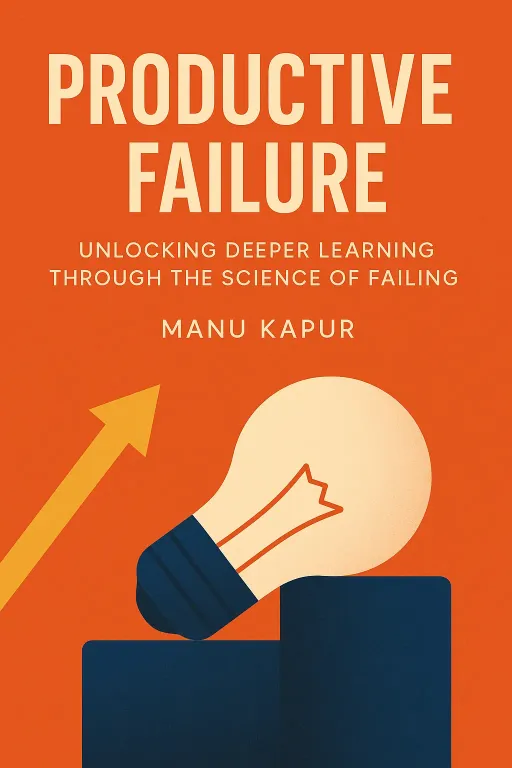
Nova: It sounds wild, I know. But today, we're diving into a fascinating, even revolutionary idea that challenges everything we think we know about learning. We’re exploring the power of what's called 'productive failure,' a concept championed by educational researcher Manu Kapur, and then we'll look at how to make that struggle effective, thanks to the insights of Scott H. Young from his work,.
Atlas: So you’re saying we should actively seek out failure? Kapur, what a provocateur! I'm curious how someone even comes up with that.
Nova: Kapur, a cognitive scientist, has spent years observing how students learn, and his research really flips the script on traditional teaching. He found that when learners grapple with complex problems and 'fail' receiving direct instruction, they develop a much deeper, more robust understanding. It's not about being bad at something; it's about the of struggling being beneficial. And Young, for his part, is famous for his self-experimentation, like learning MIT's computer science curriculum in a year. His work gives us the toolkit to make that struggle efficient.
Atlas: Okay, so it’s not just about flailing around aimlessly, it’s about a of failure. That makes me wonder, how exactly does this 'productive failure' work?
The Power of Productive Struggle
SECTION
Nova: Exactly. Let's dig into Kapur's idea of productive failure. Imagine a group of students. Instead of teaching them a new, complex math formula right away, you give them a really tricky problem that that formula to solve. They don't have the tools, they don't have the explicit instruction. What happens?
Atlas: Panic? Frustration? A lot of confused glances at each other, probably?
Nova: All of the above! They'll try different things. They'll make mistakes. They'll hit dead ends. They'll feel that mental friction, that struggle. But here’s the critical part: during that struggle, they're not just passively receiving information. They're actively generating hypotheses, exploring possibilities, identifying the constraints of the problem, and understanding their current methods aren't working.
Atlas: Right, like trying to open a locked door with a credit card, then a hairpin, then a rock, before someone finally hands you the key. You understand the for the key much better.
Nova: Precisely! When the teacher introduces the correct formula or method, it's not just another piece of information to memorize. It clicks into place because the students have already experienced the for it. They've built mental pathways, they've identified the gaps in their knowledge, and the new instruction directly addresses those gaps. The struggle makes them primed for understanding. It's like their brains are saying, "Aha! is what we were looking for!"
Atlas: That’s actually really inspiring. So, the initial frustration isn't a sign of failure, it's actually the brain doing its heavy lifting, preparing to absorb information more effectively. But hold on, what's the line between productive struggle and just being utterly lost and giving up? I imagine a lot of our student listeners might feel that frustration and think, "I'm just not getting this," and then disengage.
Nova: That’s a crucial distinction. Productive failure isn't about abandoning learners to their fate. It's about the learning experience so that initial struggle is a, not a bug. It requires careful scaffolding. The problems are complex enough to be challenging but not so impossible that they cause complete despair. And crucially, it's followed by timely instruction that helps consolidate the insights gained from that struggle. Kapur's framework is about fostering stronger – not just rote memorization. It’s about building a robust mental model rather than just stacking facts.
Atlas: So, it’s not just about failing, it’s about and then learning from that specific failure. That makes sense. It’s about being an active participant in your learning, even when it’s tough.
Strategies for Effective Struggle
SECTION
Nova: Absolutely. And if we accept that struggle is a necessary part of deep learning, the next logical question is: how do we make that struggle as efficient and effective as possible? This is where Scott H. Young's work on accelerating skill acquisition becomes incredibly powerful. He gives us actionable maxims to really leverage that productive failure.
Atlas: Okay, so Kapur tells us to embrace the struggle. Young tells us to do it well. What are some of his key strategies?
Nova: Young emphasizes deliberate practice, feedback loops, and identifying the core components of any skill. Think about learning to play a musical instrument, say, the guitar. Most beginners just strum chords they already know, or play songs they like. That's practice, but it's not necessarily practice.
Atlas: Right, like endlessly practicing the G chord when your real weakness is switching cleanly to C.
Nova: Exactly! Deliberate practice means intentionally focusing on your weaknesses, pushing just beyond your current capabilities, and seeking immediate, specific feedback. It's about breaking down the skill into its smallest components – maybe it's that tricky chord transition, or mastering a specific scale – and then relentlessly working on until it improves. It’s a very focused kind of struggle.
Atlas: I can see how that applies to a physical skill like an instrument. But how does a student apply 'deliberate practice' to, say, studying for a history exam, or understanding a complex philosophy text? For our listeners who are studying, this sounds like a powerful tool.
Nova: That’s a brilliant question. For a history exam, instead of just re-reading notes, deliberate practice might involve attempting to answer essay questions from past exams looking at your notes first. You're forcing yourself to recall, to synthesize, to identify the gaps in your knowledge. The 'struggle' here is the effort of recall and synthesis. Then, the 'feedback loop' comes when you check your answer against your notes or a rubric, identifying where your understanding was weak or your argument incomplete.
Atlas: That makes perfect sense! And that relates directly to the 'Tiny Step' advice from our reading: "When facing a new, difficult concept, try to solve it yourself first, even if you fail, before consulting resources. Observe where you struggled." It's designing a mini productive failure for yourself.
Nova: Precisely. And for a philosophy text, instead of just highlighting, you might try to explain the core argument of a complex chapter to an imaginary, skeptical friend. Or write a counter-argument. That forces you to engage, to struggle with the nuances, to articulate your understanding before you look up an expert's interpretation. You're observing where your explanation falters, where your understanding is fuzzy.
Atlas: So, the 'Deep Question' from our content, "How can you intentionally design 'productive failures' into your study routine?" isn't just a theoretical question. It's about actively integrating these strategies. It’s about identifying the parts of your learning that you usually avoid because they feel hard, and leaning into them with intention.
Synthesis & Takeaways
SECTION
Nova: What emerges is this powerful synergy: Kapur tells us that struggle, when properly structured, primes the brain for deeper learning. Young then provides the blueprint for making that struggle deliberate, focused, and ultimately, highly effective. It’s about shifting our mindset from "failure is bad" to "failure is information."
Atlas: That’s a great way to put it. It reframes the entire learning process. It’s not about avoiding mistakes; it’s about making mistakes and learning from them faster. For anyone striving for growth and a broader perspective, this is a fundamental shift. It turns the fear of the unknown into an exciting challenge.
Nova: Exactly. So, for our listeners, the actionable takeaway is this: next time you encounter a complex concept, resist the urge to immediately seek the answer or the easy explanation. First, give yourself permission to struggle with it. Try to solve it, explain it, or apply it on your own. Observe you get stuck, questions arise, and your initial attempts fall short.
Atlas: And then, once you've truly grappled with it, seek out the resources, the instruction, the feedback. You’ll find that information lands differently, sticks better, and integrates more deeply because you've prepared the ground for it. It's a powerful way to cultivate a true growth mindset for learning, where every challenge is an opportunity to strengthen your understanding, not just prove what you already know.
Nova: It’s about building that intellectual muscle, one productive struggle at a time. It’s a journey, not a destination, and every question really is a step forward.
Atlas: What a powerful thought to leave with. So, embrace the struggle, make it deliberate, and watch your understanding deepen.
Nova: This is Aibrary. Congratulations on your growth!