

The Mind's Deep Architecture: Unraveling Consciousness and Reality
Golden Hook & Introduction
SECTION
Nova: What if I told you the world you think you see, hear, and feel isn't actually 'out there' but is a vivid, elaborate hallucination crafted entirely by your own brain?
Atlas: Whoa, hold on. A hallucination? That sounds… intense. Are we talking about, like, a literal, clinical hallucination, or are you being poetic right now? Because my brain is already trying to process that.
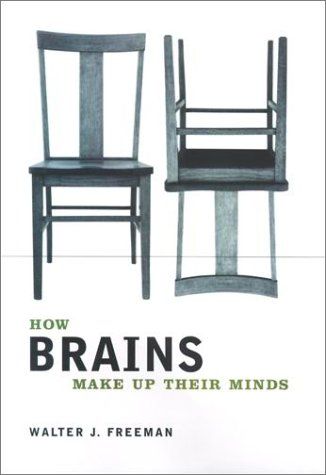
Nova: I am being quite literal, Atlas, in the most profound neuroscientific sense. Today, we're wrestling with that very idea, straight from Walter J. Freeman's groundbreaking work, "How Brains Make Up Their Minds." Freeman, a neuroscientist who pushed against conventional wisdom for decades, offered a truly radical view of consciousness, moving beyond simple input-output models to show us a brain that is a dynamic, chaotic, and self-organizing system.
Atlas: Okay, so it’s not just a catchy title; he’s actually arguing our brains are actively inventing our reality. That’s a huge claim! Where do we even begin to unpack something that mind-bending?
Nova: We begin by challenging the intuitive idea that we simply 'see what's there.' Freeman's work reveals how our subjective experience is a highly personalized construct, and that shapes everything from our daily decisions to our deepest beliefs.
The Brain's Active Construction of Reality
SECTION
Nova: So, let's dive into Freeman's core concept. For a long time, neuroscience largely operated on a 'stimulus-response' model. Think of it like a camera: light hits the lens, the image is captured. A smell enters the nose, the brain processes it. Simple, right?
Atlas: That’s certainly how I’ve always thought about it. You experience something, your brain reacts. What’s the alternative?
Nova: Freeman argued that the brain doesn't passively receive sensory input and then process it. Instead, it actively generates patterns of neural activity that our perceptions and intentions. It's not a camera, it's a composer. The brain is constantly running an internal model of the world, and sensory input merely updates or recalibrates that model.
Atlas: A composer, not a camera. That’s a great way to put it. So, how did he even discover this? What was he looking at that made him question the standard model?
Nova: His most critical insights came from studying the olfactory bulb in rabbits. Now, you’d expect that when a rabbit smells something, specific neurons would fire in response to that specific smell, right? Like a unique 'smell code' for carrots versus clover.
Atlas: That makes perfect sense. A direct, one-to-one correlation.
Nova: Exactly. But that’s not what Freeman observed. He attached electrodes to the rabbits' olfactory bulbs and watched the electrical activity. When a rabbit was presented with a familiar smell, he didn't see individual neurons lighting up like Christmas tree lights. Instead, he saw these incredibly complex, dynamic, almost chaotic, yet organized of electrical activity emerge across large populations of neurons.
Atlas: Oh, I like that. So it’s not just a switch going on, it’s a whole symphony?
Nova: Precisely! And here’s the kicker: these patterns would often the rabbit's conscious recognition of the smell, or even its behavioral response. This "pre-afferent" activity, this internal world-building, suggested the brain was actively to perceive, creating a context, rather than just reacting to an incoming signal.
Atlas: That’s a bit out there. Are you saying the brain almost 'predicts' what it's going to perceive? So, the rabbit’s brain is, in a sense, getting ready to smell a carrot before the carrot scent even fully registers?
Nova: In a way, yes! It’s constantly generating hypotheses about what's out there and then testing them against incoming data. Think of it like this: if you’re walking into a bakery, your brain is already anticipating the smell of bread and pastries. It’s not just waiting for the scent molecules to hit your nose; it’s primed, it’s constructing that reality internally.
Atlas: That makes me wonder about the 'chaotic' part you mentioned. How can something chaotic lead to such organized perception? That sounds almost contradictory.
Nova: That’s a brilliant question, and it’s central to Freeman’s work. He used the term 'chaos' not to mean random mess, but a specific type of complex, non-linear dynamic system. Think of a murmuration of starlings: individual birds move unpredictably, but together, they form these breathtaking, organized patterns. Or a jazz ensemble: individual musicians improvise, but the ensemble creates a cohesive, evolving piece of music. The brain operates similarly. It's complex and unpredictable in its fine details, but organized at a larger, functional scale.
Atlas: So it's not a random free-for-all, but a highly dynamic, self-organizing system that, through its own internal processes, sculpts our experience of the world. That's incredible. It completely upends the idea of a passive brain.
Nova: It does. And this isn't just about rabbits smelling. This fundamental mechanism, this active construction, applies to all our senses, all our thoughts, all our intentions. It’s the very architecture of our consciousness.
Subjective Experience, Art, and Culture as Brain Constructs
SECTION
Nova: Now, if our brains are doing all this internal world-building, and our perception is essentially a personalized, self-generated neural pattern, what does that mean for world-building – specifically our subjective experiences, our art, and our cultures?
Atlas: That’s a profound jump, but it makes sense. If my brain is creating my reality, then my reality is inherently unique to me. So, my experience of a song, for instance, is literally unique to me? Even if we're all hearing the same notes?
Nova: Absolutely. Your brain's unique history, your emotional state, even what you had for breakfast, all contribute to the dynamic patterns that construct your experience of that music. Two people can listen to the exact same piece of music, and one might feel exhilarated while the other feels melancholic. It’s not just 'taste'; it's their brains actively constructing different realities from the same auditory input.
Atlas: That’s a great way to put it. That connects to something I’ve been thinking about with philosophy of art and my musical passion. An artist isn't just depicting reality, then, are they? They’re externalizing their brain's unique constructive process.
Nova: Exactly! And when you, the viewer or listener, interact with that art, your brain is engaging in constructive process. You're not just passively receiving the artist's message; you're creating your own interpretation based on your internal neural dynamics. It’s a dance of constructed realities.
Atlas: That’s actually really inspiring. It means every act of creation and appreciation is a deeply personal, almost sacred, event. But what about cultural differences? Does this explain why some things are beautiful or meaningful in one culture and not another?
Nova: It absolutely does. Think about how language shapes our perception. Different languages categorize colors, emotions, or even time in distinct ways. These linguistic structures aren't just labels; they can influence the very neural patterns our brains generate when experiencing those concepts.
Atlas: So, collective beliefs, shared experiences, common language – they can shape similar neural patterns across a group, leading to shared cultural realities. But those are still realities, not objective truths.
Nova: Precisely. A culture isn't just a set of traditions; it's a collective agreement on how to construct reality, a shared framework for meaning-making. This explains why something considered deeply respectful in one culture might be seen as rude in another, or why certain artistic expressions resonate profoundly in one society but not elsewhere. Their brains are literally 'making up' different meanings from the same raw sensory data.
Atlas: Wow. That gives me chills. So is there no objective reality at all, then? Or is it just that our of it is always subjective? Because that feels like a philosophical rabbit hole we could go down forever.
Nova: It’s a critical distinction. Freeman isn't saying there's external world. The world out there provides the raw materials, the sensory input. But our brain is the sculptor. It’s the active agent that shapes those raw materials into the conscious, meaningful reality we inhabit. The external world provides the constraints, but our internal dynamics create the experience.
Synthesis & Takeaways
SECTION
Nova: So, to bring it all together, Walter J. Freeman's work profoundly shifts our understanding: our brains are not passive recipients of information. They are active, dynamic, self-organizing creators of our reality. Every perception, every intention, every thought is a unique, internally generated pattern.
Atlas: That’s a lot to take in. It makes you question everything you thought you knew about perception and even about yourself. For anyone trying to understand their own mind better, what's the one big takeaway here? What does this mean for us in our daily lives?
Nova: The biggest takeaway is the incredible power and responsibility this understanding brings. If your reality is a construct of your own brain, then you are not just an observer; you are a participant in the creation of your own conscious experience. This can foster greater empathy for differing perspectives, recognizing that someone else's 'reality' is just as valid a construct as your own.
Atlas: That makes sense. It really reinforces the idea of trusting your inner compass, as we often say, and embracing the unfolding of your unique journey. It’s about recognizing the incredible, dynamic process happening inside your own head.
Nova: Exactly. It invites us to look inward, to understand the incredible machinery of our own minds, and to appreciate the rich, subjective tapestry that each of us weaves. It makes you wonder, what reality are you actively constructing right now?
Atlas: That’s a fascinating question to leave our listeners with. It’s a powerful reminder of the depth and complexity within each of us.
Nova: Absolutely.
Nova: This is Aibrary. Congratulations on your growth!