From Silicon Valley Foundations to the Algorithmic Horizon
Golden Hook & Introduction
SECTION
Nova: Most people think the tech revolution started with a couple of guys in a garage, but that is like saying a forest fire started because a single leaf fell. The spark was real, but the fuel was already there, piled up for decades.
Atlas: Oh, I like that. It immediately makes me think about how much of our cultural narrative is built on the myth of the lone genius. We love the story of the founder in the hoodie, don't we?
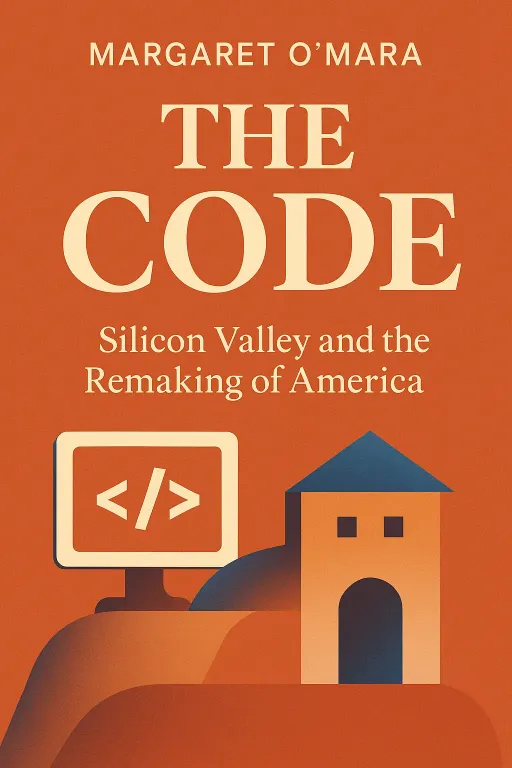
Nova: We absolutely do. It is the modern creation myth. But today we are going to peel back those layers. We are looking at the foundation of that revolution and where it is leading us next. We are diving into two essential books today: The Code by Margaret O’Mara, which gives us the history of how this ecosystem actually came to be, and Homo Deus by Yuval Noah Harari, which paints a rather startling picture of where we are headed.
Atlas: That is a massive span. You are basically taking us from the birth of the transistor to the potential obsolescence of the human decision-maker.
Nova: Exactly. O’Mara shows us the engine, and Harari shows us the destination. Margaret O’Mara is a historian who spent years tracking the actual paper trail of Silicon Valley, and she found that the reality is far more complex, and perhaps more interesting, than the garage myth. Then, Yuval Noah Harari, a historian and philosopher, takes that tech foundation and extrapolates it into a future where humanism might just be a quaint relic of the past.
Atlas: I am ready to dig into this. I have always been fascinated by the gap between the story we tell ourselves about tech—that it is all meritocracy and innovation—and the reality, which seems to involve a lot more institutional support and, let’s be honest, a lot more algorithmic control than we realize. Let’s start with the foundation. How did this engine actually get built?
The Silicon Valley Engine
SECTION
Nova: To understand the engine, we have to look at the intersection of three things: massive public funding, academic research, and private venture capital. O’Mara’s work is brilliant here because she dismantles the idea that Silicon Valley was some spontaneous, isolated event. It was, in many ways, a project of the Cold War.
Atlas: Wait, hold on. A project of the Cold War? That sounds like a stretch. How does the Cold War lead to the iPhone?
Nova: It is not a stretch at all. Think about the environment in the mid-20th century. You had the federal government pouring billions of dollars into research, specifically through the Department of Defense and agencies like DARPA. They needed advanced semiconductors, radar, and communication systems to stay ahead of the Soviet Union. Stanford University became the hub for this. Frederick Terman, who was the dean of engineering at Stanford, essentially created the blueprint. He encouraged his students not just to stay in academia, but to start companies that would feed back into that research ecosystem.
Atlas: So, it was a closed loop. The government funded the research, the university produced the talent, and the talent started companies that sold back to the government or built on that research. That sounds less like a free-market startup scene and more like a carefully managed industrial policy.
Nova: That is the crucial insight. We often think of Silicon Valley as this libertarian paradise where the government stays out of the way, but O’Mara reveals that the government was the first, and most important, venture capitalist. It provided the stability and the demand that allowed these companies to take the risks that private investors wouldn't touch yet. When you look at the history of companies like Fairchild Semiconductor or Intel, you see that they were deeply embedded in this federal research network.
Atlas: I can see how that would change everything. If you are a founder today, you might think your success depends entirely on your own grit and your pitch deck. But if you look at the history, you realize you are standing on a massive foundation of public investment that was laid before you were even born.
Nova: Precisely. And that creates a specific mindset. It creates a playbook. The Silicon Valley Playbook is built on this idea of rapid scale, disruption, and the belief that technology is the ultimate lever for societal change. But there is a flip side to that. When you optimize for that kind of growth, you tend to build systems that prioritize efficiency and speed above almost everything else.
Atlas: Which brings us to the danger zone. Because once you build a system that is perfectly optimized for growth and efficiency, you eventually stop asking whether that system is serving human needs and start asking how to make the system more efficient at whatever it is doing.
Nova: That is the perfect pivot to Harari. Because once you have the infrastructure—the internet, the algorithms, the data collection capabilities—you start to see a shift. We move from humanism, where human experience is the ultimate authority, to what Harari calls Dataism.
The Algorithmic Horizon
SECTION
Atlas: Okay, I have heard the term Dataism thrown around, but it usually sounds like buzzword soup. Can you break down what Harari actually means by that? It sounds a bit ominous.
Nova: It is meant to be a bit ominous. The core idea of Dataism is that the universe consists of data flows, and the value of any entity or phenomenon is determined by its contribution to data processing. In this view, humans are just biochemical algorithms. If an algorithm—a machine—can process data better, faster, and more accurately than a human, then the machine should be the one making the decisions.
Atlas: That is a chilling thought. So, instead of me deciding what career to pursue, or who to date, or what to buy, I am just an inefficient data processor, and I should outsource those decisions to a more efficient algorithm?
Nova: Exactly. Harari points out that we are already doing this. Think about your life. How often do you rely on Waze to tell you the fastest route, rather than your own intuition or a map? How often do you let Netflix or Spotify decide what you watch or listen to next? You are delegating your preferences to an algorithm because you trust that the algorithm knows your tastes better than you do.
Atlas: I do that every single day. And it feels like a convenience, not a surrender. But I see the point. If you scale that up—if you let algorithms decide who gets a loan, who gets hired, or even who gets medical treatment—you are essentially saying that human judgment is flawed and data-driven judgment is superior.
Nova: And that is the crux of the Dataism shift. It is the belief that there is no "soul" or "human essence" that can't be reduced to data. If you have enough data on a person—their heartbeat, their location, their purchase history, their social media interactions—you can predict their behavior better than they can predict it themselves. The algorithm becomes the new oracle.
Atlas: This makes me think about the "Silicon Valley Playbook" we just discussed. The infrastructure that O’Mara described—the internet, the massive server farms, the interconnected devices—that is the physical manifestation of the Dataism that Harari is warning about. We built the, for lack of a better term, "nervous system" of the planet, and now we are surprised that it is starting to think for itself.
Nova: That is a brilliant way to put it. We built the nervous system, but we didn't necessarily think about what kind of consciousness would emerge from it. The Silicon Valley Playbook was about building the. Dataism is about what flows through the pipes and who controls the flow.
Atlas: So, if I am a strategist or a builder—someone who is in the thick of this, maybe managing a team or trying to innovate—how do I navigate this? I don't want to just be a cog in the Dataism machine, but I also can't ignore the fact that these algorithmic tools are the reality of the market. How do I balance these two things?
Synthesis & Strategic Application
SECTION
Nova: This is where we get to the actionable part of our conversation. The "Tiny Step" we mentioned earlier is about analyzing your technical roadmap. Are you building for immediate market needs, or are you architecting for the long-term algorithmic shifts of the next decade?
Atlas: That feels like a heavy question. If I am building for immediate market needs, I am following the Silicon Valley Playbook—iterate fast, scale, disrupt. That is how you get funding. That is how you survive. But if I am building for the algorithmic shift, does that mean I have to slow down? Does that mean I have to sacrifice efficiency for the sake of human agency?
Nova: Not necessarily. It means being intentional. You can use the Silicon Valley Playbook to gain the resources and the scale you need, but you must be aware of the impact of what you are building. If you are a product manager, for example, are you designing features that manipulate user behavior to maximize engagement, or are you designing features that empower the user to make better decisions?
Atlas: That is the difference between building a casino and building a library. A casino is optimized for Dataism—keep them clicking, keep them engaged, extract the data. A library is optimized for human agency—give them the tools, let them explore, respect their autonomy.
Nova: That is a perfect analogy. And here is the challenge for the builders listening today: Can you build a business that is financially successful while also respecting the human element? It is not an either-or scenario. You can use data to improve human outcomes rather than just extracting value from human behavior.
Atlas: I like that. It is about using the technology as a tool for empowerment rather than a tool for control. So, for the strategist who wants to implement this, what does that look like in their daily life? You recommended 30 minutes of deep work. How does that connect to this grand, sweeping shift from Silicon Valley to Dataism?
Nova: It connects because you cannot think about the future of technology if you are constantly reacting to the present. The Silicon Valley Playbook is built on speed, on reaction, on the "now." If you are always in the "now," you are just part of the data stream. You are being processed.
Atlas: Wow. That hits home. If I am always reacting to emails, Slack messages, and the latest market trends, I am essentially operating like an algorithm—responding to stimuli.
Nova: Exactly. To be a true architect of the future, you need to step out of the stream. That 30 minutes of deep work is your time to be human. It is your time to reflect on the systems you are building, to question the assumptions of your industry, and to think about the long-term ethical implications of your work. It is the time where you reclaim your agency.
Atlas: That is a powerful reframing. It is not just about productivity; it is an act of resistance against becoming just another data point.
Nova: It really is. And that brings us back to the core of our discussion. The Silicon Valley Playbook gave us the tools to connect the world, but it also created the infrastructure for a world where we might be managed by the very systems we created. As a builder, you have a choice. You can continue to optimize the machine, or you can start to think about how to make the machine serve humanity again.
Atlas: I feel like I have a much clearer perspective now. We have the history, which shows us that this wasn't an accident—it was a planned evolution. And we have the future, which shows us that we are at a crossroads. We can continue down the path of Dataism, where we optimize for the sake of optimization, or we can use our strategic thinking to steer the technology back toward human-centered innovation.
Nova: That is the goal. And it starts with that small, daily commitment to deep work. It starts with asking yourself, "Am I just building for the next quarter, or am I building for the next century?"
Atlas: This has been a fantastic dive. I feel like we have moved from the history books to the future of our own careers. It is a lot to think about.
Nova: It is. And the most important thing is that the future is not something that just happens to us. It is something we build, one day, one decision, one line of code at a time.
Atlas: I love that. For all our listeners who are in the trenches of the tech world, remember that you are not just building software; you are building the architecture of the future. Make sure it is a future you want to live in.
Nova: That is a great note to end on. Thank you for joining us on this deep dive into the foundations and the horizon.
Atlas: This is Aibrary. Congratulations on your growth!
Synthesis & Takeaways
SECTION
Nova: Before we wrap up, let's distill this into one final thought. We started by looking at the "Code"—the environment that allowed the tech boom to happen. We saw that it wasn't just luck; it was a deliberate, layered system of public and private partnership. Then, we looked at the "Horizon"—the shift toward Dataism, where the systems we built are beginning to define us.
Atlas: And the synthesis is this: The Strategist is the one who understands both. You cannot build the future if you don't understand the past, and you cannot understand the present if you don't see the algorithmic forces shaping it.
Nova: So, your challenge for this week is simple but difficult. Take that 30 minutes of deep work—not to check your metrics, not to optimize your current sprint, but to think about the long-term impact of the systems you are managing. Are you building a casino, or are you building a library?
Atlas: That is a question that will stick with me all week. It changes how I look at my own projects.
Nova: I hope it does. Because the future is being written right now, and you are the one holding the pen.
Atlas: Thanks for listening, everyone. We will catch you in the next episode.
Nova: This is Aibrary. Congratulations on your growth!