

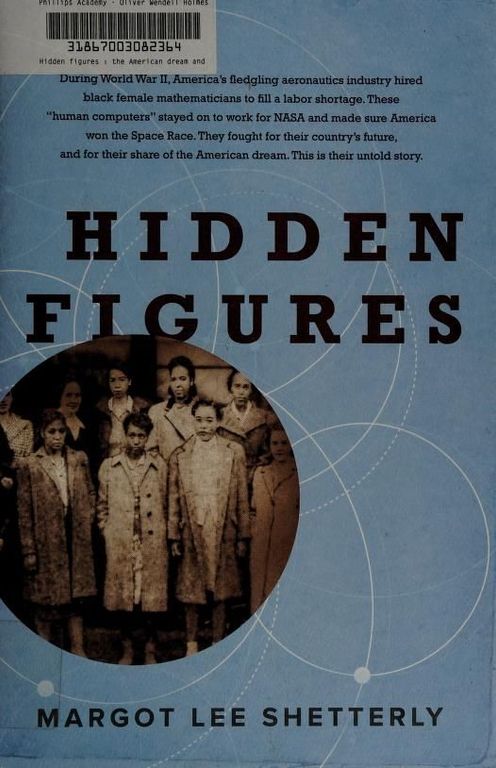
Hidden Figures
The True Story of Four Black Women and the Space Race
Introduction
Nova: Picture this: It's February 20, 1962. John Glenn is strapped into the Friendship 7 capsule, about to become the first American to orbit the Earth. The entire nation is holding its breath. But before the countdown begins, Glenn makes an unusual demand. He refuses to launch until one specific person has double-checked the computer's trajectory calculations by hand. That person was Katherine Johnson, a Black woman mathematician working in a segregated office at NASA. Welcome to Aibrary. I'm Nova.
Nova: : And I'm. So this is the story behind Hidden Figures, the book by Margot Lee Shetterly that uncovered the untold story of the Black women mathematicians who helped America win the space race.
Nova: Exactly. And here's what makes this book so remarkable. Shetterly grew up in Hampton, Virginia, where her father worked as a research scientist at NASA's Langley Research Center. She knew many of these women personally. They were part of her community. Yet it took her decades to realize that their story was not just local history, it was American history that had been almost entirely overlooked.
Nova: : That's the thing that gets me. These women were doing trajectory calculations that put astronauts into space and brought them home safely, and most Americans had never heard their names.
Nova: The book's full title says it all: Hidden Figures: The American Dream and the Untold Story of the Black Women Mathematicians Who Helped Win the Space Race. Published in 2016, it became a number one New York Times bestseller and inspired the Oscar-nominated film. But the book goes much deeper than the movie, tracing these women's lives from World War II through the Civil Rights era and into the age of Apollo.
Nova: : So today we're going to unpack the real story behind Hidden Figures, the three extraordinary women at its center, and why their legacy matters now more than ever.
How World War II Opened the Door
The World That Made Them
Nova: To understand Hidden Figures, you have to understand the moment that created the opportunity. It's 1943. World War II is raging, and the National Advisory Committee for Aeronautics, or NACA, the predecessor to NASA, is desperate for brainpower. Every available white male engineer is being drafted or enlisted. So NACA does something unprecedented: it starts hiring women with math degrees to work as human computers.
Nova: : Human computers. I love that term. These were literally people, mostly women, who performed complex mathematical calculations by hand, slide rule, and mechanical calculator before electronic computers existed.
Nova: Right. And here's where the story takes a crucial turn. In 1943, under pressure from civil rights leader A. Philip Randolph, who threatened a march on Washington, President Roosevelt issued Executive Order 8802, which prohibited racial discrimination in the national defense industry. This meant that for the first time, Black women with math degrees could apply for these computing jobs at NACA.
Nova: : So the war created both a labor shortage and, through political pressure, a crack in the door of segregation. And these women walked through it.
Nova: They did. But let's be clear about what they walked into. Langley Research Center was in Hampton, Virginia, the heart of the Jim Crow South. The Black women computers were assigned to a segregated unit called West Area Computing. They had separate bathrooms, separate dining facilities. There were colored signs designating where they could and could not go. Shetterly writes about how Dorothy Vaughan, one of the central figures, would walk past the white computers' bathroom every day to get to the colored bathroom on the other side of the campus.
Nova: : That daily indignity, while doing the same work, sometimes superior work. It's hard to fathom.
Nova: And yet, Shetterly's book doesn't just dwell on the oppression. It shows how these women built a community of excellence within those constraints. They mentored each other, they fought for promotions, they took night classes. They understood that their individual success would open doors for the women coming behind them.
Nova: : So the West Area Computing unit became almost like an incubator of talent.
Nova: Precisely. And the three women at the heart of the book, Dorothy Vaughan, Mary Jackson, and Katherine Johnson, each navigated this world in remarkably different ways. Let's start with Dorothy Vaughan.
The Visionary Leader Who Saw the Future
Dorothy Vaughan
Nova: Dorothy Vaughan arrived at Langley in 1943. She was a math teacher, a graduate of Wilberforce University, and a mother of four. She started as a temporary war worker, but she stayed for 28 years and became one of the most important figures in NASA's computing history.
Nova: : What made her so significant?
Nova: Two things. First, in 1949, she became NASA's first African American supervisor, taking charge of the West Area Computing unit. This was a huge deal. She was now managing a team of Black women mathematicians in an institution that was still deeply segregated. Shetterly describes her as a quiet but fierce advocate for her team. She fought for their raises, their promotions, their recognition.
Nova: : And the second thing?
Nova: This is where the story gets really fascinating. In the late 1950s, Dorothy Vaughan looked at the horizon and saw that electronic computers, those room-sized IBM machines, were going to make human computers obsolete. Most people might have panicked or resisted. Dorothy Vaughan did something brilliant: she taught herself FORTRAN, one of the earliest programming languages, and then she taught her entire team.
Nova: : She essentially retrained her workforce before anyone asked her to.
Nova: Exactly. She turned the West Area Computing unit into NASA's go-to team for electronic computing. When the IBM 7090 arrived at Langley, Dorothy and her team were ready. She had transformed herself and her colleagues from human computers into actual computer programmers. Shetterly writes that Vaughan understood something profound: the machine might replace the calculator, but it could never replace the mathematician who understood what the numbers meant.
Nova: : That's such a powerful lesson about adaptability and foresight. She didn't just survive technological disruption, she got ahead of it.
Nova: And she brought her entire team with her. That's leadership. Vaughan retired in 1971, having spent nearly three decades at NASA. She never sought the spotlight, but her impact rippled through every division she touched.
The Barrier Breaker Who Fought City Hall
Mary Jackson
Nova: Mary Jackson's story is one of sheer determination. She started at Langley in 1951, working in West Area Computing under Dorothy Vaughan. But her trajectory changed when she was assigned to work with an engineer named Kazimierz Czarnecki in the Supersonic Pressure Tunnel.
Nova: : What was that?
Nova: It was a wind tunnel used to test aircraft and spacecraft designs at supersonic speeds. Czarnecki recognized Jackson's extraordinary talent and encouraged her to become an engineer. But there was a catch. To qualify, she needed to take graduate-level math and physics courses offered by the University of Virginia. The classes were held at Hampton High School, which was, of course, segregated.
Nova: : So she couldn't just sign up.
Nova: She could not. Mary Jackson had to petition the city of Hampton for special permission to attend classes alongside white students. Shetterly describes how Jackson went before a judge and made her case. And she won. In 1958, Mary Jackson became NASA's first African American female engineer.
Nova: : She literally had to go to court just to be allowed to learn. That's the kind of barrier these women faced that went far beyond the math.
Nova: And once she became an engineer, Jackson excelled. She authored or co-authored around a dozen research papers on boundary layer effects on aerospace vehicles. She worked in several divisions, analyzing data from wind tunnel experiments and real-world flight tests. Her work contributed directly to the design of aircraft and spacecraft.
Nova: : But here's something interesting I've read. Later in her career, she actually took a demotion.
Nova: Yes, and this is one of the most moving parts of her story. After more than two decades as an engineer, Jackson noticed that women and minorities at NASA were hitting glass ceilings. So she voluntarily stepped down from her engineering position to become Langley's Federal Women's Program Manager. She spent the rest of her career fighting for the hiring and promotion of the next generation of female mathematicians, engineers, and scientists.
Nova: : She broke through the ceiling, then turned around and held the door open for everyone else.
Nova: That's exactly right. Shetterly captures this beautifully. Jackson understood that her individual achievement was meaningful, but systemic change required someone to stay and fight for the system itself.
The Genius Who Took Us to the Moon
Katherine Johnson
Nova: And then there's Katherine Johnson, the mathematical prodigy whose story became the emotional heart of both the book and the film. Born in 1918 in White Sulphur Springs, West Virginia, Katherine Coleman showed such extraordinary aptitude for mathematics that she started high school at age 10 and graduated from West Virginia State College at 18, summa cum laude, with degrees in mathematics and French.
Nova: : She was a child prodigy, essentially.
Nova: Absolutely. And here's a detail from Shetterly's book that I find staggering. At West Virginia State, the math department created entire courses just for Katherine because she had exhausted the existing curriculum. Her mentor, Dr. William Waldron Schieffelin Claytor, who was only the third African American to earn a PhD in mathematics, designed advanced courses specifically to challenge her.
Nova: : So she was being groomed for greatness from the very beginning.
Nova: She was. Johnson arrived at Langley in 1953 and was initially assigned to West Area Computing. But her talent was so obvious that she was quickly borrowed by the Flight Research Division, an all-male, all-white team of engineers working on the most pressing aeronautical problems of the day. Shetterly describes how Johnson simply refused to be intimidated. When she was told that women didn't attend the division's editorial meetings, she asked, Is there a law against it? When the answer was no, she started attending.
Nova: : She just asserted her right to be in the room.
Nova: And once she was in the room, she proved she belonged there. Johnson's work included calculating the trajectory for Alan Shepard's 1961 flight, the first American in space. She co-authored a research report on orbital spaceflight, becoming one of the first women in the Flight Research Division to receive author credit on a technical paper. But her most famous moment came in 1962.
Nova: : The John Glenn story.
Nova: The John Glenn story. Glenn was preparing for his orbital flight, and NASA had programmed the trajectory into the new IBM electronic computers. But Glenn didn't fully trust these new machines. He turned to the engineers and said, in Shetterly's telling, Get the girl to check the numbers. If she says they're good, I'm ready to go. The girl was Katherine Johnson, and she ran the same calculations by hand on her desktop mechanical calculator. It took her a day and a half. Her numbers matched the computer's. Glenn's flight was a success.
Nova: : That moment captures everything. The trust placed in her, the recognition of her singular ability, and also the irony that a Black woman's hand calculations were considered more reliable than a state-of-the-art IBM computer.
Nova: Johnson went on to contribute to the Apollo program, calculating the trajectories that took astronauts to the moon and back. She worked on the Apollo 11 mission, the Apollo 13 disaster recovery, and the Space Shuttle program. She retired in 1986 after 33 years at NASA. In 2015, at age 97, she received the Presidential Medal of Freedom from President Obama.
Nova: : She lived to see her story told. She passed away in 2020 at 101 years old. What a life.
The Broader Legacy and the Book's Deeper Message
Beyond the Big Three
Nova: One of the things that makes Shetterly's book so powerful is that it doesn't stop with Johnson, Vaughan, and Jackson. She introduces us to a whole constellation of Black women mathematicians whose names had been lost to history.
Nova: : Like who?
Nova: Women like Christine Darden, who came to Langley in 1967 and became one of NASA's leading experts on sonic boom research. She earned her PhD in mechanical engineering and authored more than 50 papers. Or Miriam Mann, who engaged in a quiet act of daily resistance by repeatedly removing the colored sign from the cafeteria table where the Black women were expected to sit. Every time the sign reappeared, she took it down again until eventually it stopped appearing.
Nova: : That's such a powerful image. Small acts of defiance that accumulate into real change.
Nova: Shetterly estimates that between 1943 and 1980, hundreds of women worked as mathematicians, engineers, and computer programmers at Langley. Many of them were Black women. They weren't just supporting players in the space race. They were essential to it. And yet, when Shetterly began her research, even people who had worked at Langley for decades didn't know the full scope of their contributions.
Nova: : That's the hidden part of Hidden Figures, isn't it? These women weren't hidden because they were doing secret work. They were hidden because nobody thought their story was worth telling.
Nova: Exactly. And Shetterly makes a broader argument that challenges how we think about scientific progress. The space race wasn't just won by a handful of heroic white men in mission control. It was won by thousands of people, including Black women working in segregated offices, whose collective labor made the impossible possible. The American triumph in space was, in a very real sense, a triumph of diversity, even if that diversity was achieved despite the system rather than because of it.
Nova: : The book also draws this fascinating parallel between the Civil Rights Movement and the space race. These two great American dramas were unfolding simultaneously, and these women were living at the intersection of both.
Nova: That's one of Shetterly's most insightful points. While Martin Luther King Jr. was leading marches and the Supreme Court was issuing Brown v. Board of Education, these women were quietly integrating one of the most advanced scientific institutions in the world. Their excellence was their argument. Every calculation they got right, every report they co-authored, every promotion they earned was a refutation of the logic of segregation.
Nova: : It's a different model of social change. Not confrontation, but demonstration through competence.
Nova: And Shetterly is careful not to romanticize this. These women faced constant indignities. They were paid less than their white counterparts. They were passed over for promotions. They had to be twice as good to get half the recognition. But they persisted, and in persisting, they transformed the institution from within.
Conclusion
Nova: So what do we take away from Hidden Figures? First, it's a reminder that history is full of people whose contributions have been erased or minimized, and recovering those stories isn't just about giving credit. It's about understanding how progress actually happens. The moon landing wasn't just Neil Armstrong's achievement. It was Katherine Johnson's, and Dorothy Vaughan's, and Mary Jackson's, and the achievement of hundreds of other women whose names we may never know.
Nova: : And second, the book is a testament to the power of education, mentorship, and community. These women succeeded not just because they were brilliant, but because they supported each other. Dorothy Vaughan taught her team programming. Mary Jackson mentored the next generation. They understood that lifting others was part of the work.
Nova: Third, Hidden Figures challenges us to think about who gets to be visible in our stories of scientific and technological achievement. Shetterly writes that her father, who worked at Langley for decades, knew these women as neighbors and friends. It took his daughter becoming a writer to realize that their everyday lives were actually extraordinary history. How many other hidden figures are there, in how many other fields, waiting for someone to tell their story?
Nova: : And finally, there's a lesson about resilience and adaptability. Dorothy Vaughan saw the future coming and prepared for it. Mary Jackson broke down barriers and then turned around to help others through. Katherine Johnson simply refused to accept that she didn't belong in the room. Each of them found a different way to navigate an unjust system and still produce work of enduring value.
Nova: Margot Lee Shetterly has said that she wrote Hidden Figures because she wanted her readers to see the face of American science and see a face that looked like Katherine Johnson's. She wanted us to understand that the story of American progress is richer and more complicated than the version most of us learned in school. And in doing so, she didn't just recover lost history. She expanded our understanding of what's possible.
Nova: : Hidden Figures reminds us that excellence has no race, no gender, no single story. The people who change the world don't always look the way we expect them to. Sometimes they're working in a segregated office in Virginia, doing math that will one day take humanity to the stars.
Nova: This is Aibrary. Congratulations on your growth!