

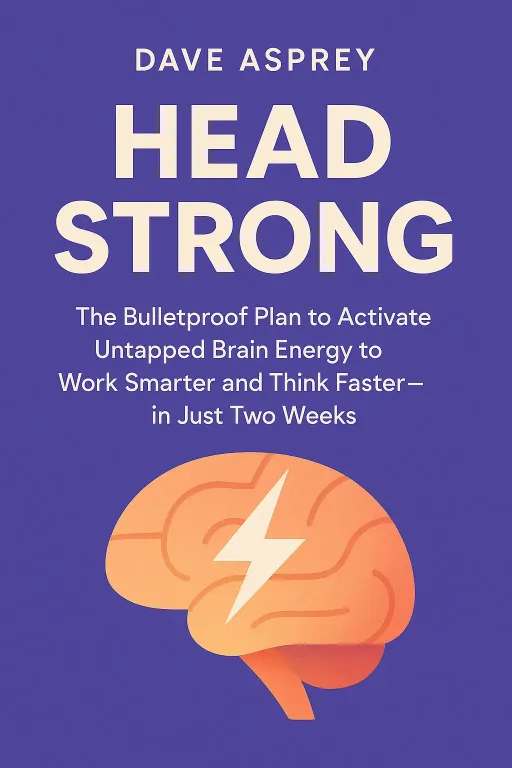
The Cell's Engine: Biohacking Your Brain for Creativity and Focus
Golden Hook & Introduction
SECTION
Albert Einstein: Have you ever had one of those days, Alicia, where you've had a full night's sleep, you've got your coffee, but your brain just feels... foggy? Like you're trying to run sophisticated software on a dial-up connection?
Alicia Liu: All the time. It’s that frustrating feeling where you know you have the capacity to think clearly, but there’s this static in the way. You just can't access your full processing power. It’s a huge barrier to creativity and deep work.
Albert Einstein: Precisely! It's a feeling the author of "Head Strong," Dave Asprey, knows all too well. He was a wildly successful tech entrepreneur in his twenties, making millions, but he felt like his brain was failing him. He was forgetful, moody, and exhausted. After a brain scan, a psychiatrist told him, and I quote, "Inside your brain is total chaos. You have the best camouflage I’ve ever seen."
Alicia Liu: Wow. So on the outside, he was the picture of success, but internally, his system was crashing.
Albert Einstein: Exactly. And that led to his core realization: his struggles weren't a moral failing or a lack of willpower. It was a hardware problem. And that's what we're exploring today. Today we'll dive deep into this from two perspectives. First, we'll become detectives and hunt down the hidden 'kryptonite' that's secretly draining your brain's energy. Then, we'll switch to being engineers, and explore how to upgrade your cellular power plants for maximum focus and creativity.
Deep Dive into Core Topic 1: The Hidden Drain: Identifying Your Brain's Kryptonite
SECTION
Albert Einstein: So let's start with that first idea: this 'brain kryptonite.' Asprey uses a fantastic analogy. Imagine Lex Luthor didn't have a giant chunk of kryptonite to use against Superman. Instead, he ground it into a fine dust and secretly sprinkled it in Superman's food every single day.
Alicia Liu: So Superman wouldn't drop out of the sky instantly. He'd just get a little weaker, a little slower, a little more tired each day, until he's operating at a fraction of his potential and thinks that’s his new normal.
Albert Einstein: You've captured it perfectly! That's the insidious nature of what Asprey calls brain kryptonite. It doesn't kill you, it just diminishes you. And the number one form of this kryptonite, he argues, is chronic inflammation. He tells this incredible story from when he was getting his MBA at Wharton.
Alicia Liu: The business school? High-pressure environment.
Albert Einstein: Extremely. He had a huge quantitative finance exam. He’d studied for weeks, he felt completely prepared, totally confident. A few hours before the test, he goes to the cafeteria and has a big salad with what he later realized were some overripe avocados. He sits down for the exam, and... nothing. His brain just wouldn't work. He couldn't focus, he couldn't recall the formulas he knew just hours before. He even felt physical symptoms, like blisters forming on his feet.
Alicia Liu: That’s terrifying. It’s like a silent software bug. You think the system is running perfectly, but one specific, seemingly harmless input causes a total system crash. So, the inflammation from that food essentially triggered a denial-of-service attack on his prefrontal cortex.
Albert Einstein: A denial-of-service attack! What a perfect modern analogy. That's exactly it. He says inflammation isn't just a swollen knee after an injury; it's a 'muffin top in your brain,' slowing down all your cognitive processing. And for you, Alicia, as someone interested in habits and nutrition, this is ground zero. He points to things we see every day: industrial seed oils like canola or soybean oil, processed grains, and even mycotoxins—which are basically mold toxins—on things like coffee, nuts, and corn.
Alicia Liu: And that's what makes it so difficult. It's insidious because you might just think, 'Oh, I'm just tired today,' or 'I'm just not a morning person.' You don't think, 'The vegetable oil in my salad dressing just downgraded my brain's operating system for the next six hours.'
Albert Einstein: Yes! It completely reframes our daily choices.
Alicia Liu: It really does. It shifts the focus of nutrition away from the long-term goal of weight management and toward the immediate, tangible outcome of cognitive performance. The question becomes not just 'Will this make me gain weight?' but 'Will this prevent me from thinking clearly this afternoon? Will it rob me of a creative idea?' That's a much more powerful motivator for building good habits.
Deep Dive into Core Topic 2: The Cellular Upgrade: Fueling and Hacking Your Mitochondria
SECTION
Albert Einstein: And that reframing is the perfect bridge to our second idea. If we stop putting in the bad stuff, how do we actively put in the stuff? This is where we go from defense to offense and talk about the power source: our mitochondria.
Alicia Liu: The powerhouses of the cell! I remember that from biology class, but I always pictured them as just a line in a textbook diagram.
Albert Einstein: Well, prepare to see them in a new light! Asprey describes them as ancient bacteria that took up residence in our cells billions of years ago. They are the engines that create ATP, our body's energy currency. And the brain is incredibly hungry for it. Get this: the book states that a single neuron in your brain can use up to 4.7 billion molecules of ATP... per second.
Alicia Liu: That number is incomprehensible. So if our mitochondria are weak or inefficient, our brain is literally starved for power.
Albert Einstein: Starved. And here's the engineering part. Our mitochondria can run on two main types of fuel: sugar, or glucose, and fat, which can be converted into something called ketones. Asprey argues that ketones are a far cleaner, more efficient fuel source. Think of it like putting standard gasoline versus high-octane racing fuel in a performance car. Both work, but one gives you much more power with less exhaust.
Alicia Liu: So a diet higher in healthy fats—like avocados, coconut oil, grass-fed butter—isn't just a diet, it's a direct fuel upgrade for your brain's energy production.
Albert Einstein: Precisely. But it's not just about fuel. This is where the tech angle comes in, which I think you'll find fascinating. Asprey says "junk light is as bad as junk food." He uses the analogy of a smartphone. When it's new, the battery lasts forever. But over time, you install all this bloatware, all these apps running in the background, and suddenly your battery drains by noon. He says that's what junk light, especially the high-frequency blue light from our screens and fluorescent bulbs, does to our mitochondria. It's a constant stressor, draining their energy.
Alicia Liu: That connects so many dots for me. It links nutrition and technology directly. The idea that the of light from my laptop could be just as impactful on my energy as the of food I eat is a huge paradigm shift. We obsess over organic food, but we don't think about 'organic light.'
Albert Einstein: 'Organic light!' A brilliant connection, I love that! And Asprey makes it practical. He tells a story about working in a windowless office with a glossy, bright Mac screen and feeling profoundly fatigued. His solution wasn't just more coffee; it was hacking his environment. He installed a free software called f. lux that warms the color of the screen at night, he got an anti-glare filter, and he made sure to take breaks to get actual sunlight.
Alicia Liu: So it's about creating a 'Head Strong' lifestyle through a series of small, deliberate habits. For someone my age, who is constantly surrounded by screens for school, work, and social life, this is incredibly relevant. It’s not about a radical, expensive overhaul. It could be as simple as changing my laptop settings and switching my breakfast from a sugary cereal to something with avocado and eggs.
Albert Einstein: You're not just eating for satiety; you're eating for ATP production. And you're not just looking at a screen; you're managing your light diet.
Alicia Liu: Exactly. You're consciously managing the inputs to your biological system to optimize the output, which in this case is focus, energy, and creativity. It’s the ultimate form of personal technology.
Synthesis & Takeaways
SECTION
Albert Einstein: So, when we put it all together, it's a powerful, two-pronged attack. First, you play detective: hunt down and eliminate your personal kryptonite—the inflammatory foods, the junk light, the toxins that are draining your battery without you even realizing it.
Alicia Liu: And second, you play engineer: actively upgrade your power source. Give your mitochondria the clean, high-octane fuel they crave, like healthy fats, and create an environment for them to thrive with things like natural light and better sleep.
Albert Einstein: It's a beautiful synthesis of ancient biology and modern, practical action. It's about taking back control.
Alicia Liu: Exactly. And it doesn't have to be overwhelming. The book suggests a two-week program, but I think the real takeaway for listeners is to start smaller. To conduct your own personal experiment.
Albert Einstein: A thought experiment made real! I love it. What's the protocol?
Alicia Liu: For just this weekend, try two things. First, when you wake up, get 15 minutes of morning sunlight before you look at your phone. Let that be the first light your brain sees. Second, make sure your breakfast is centered around healthy fat and protein, not sugar and refined carbs. So, eggs and avocado instead of a bagel. Don't change anything else. Just notice. Notice how your focus and energy feel on Sunday afternoon. It's your own personal n=1 experiment.
Albert Einstein: A perfect, actionable challenge. A small change to observe a potentially big result. That's the very heart of being Head Strong. Alicia, this has been an absolutely energizing conversation. Thank you.
Alicia Liu: Thank you, Albert. It's given me a lot to think about—and to try.









