

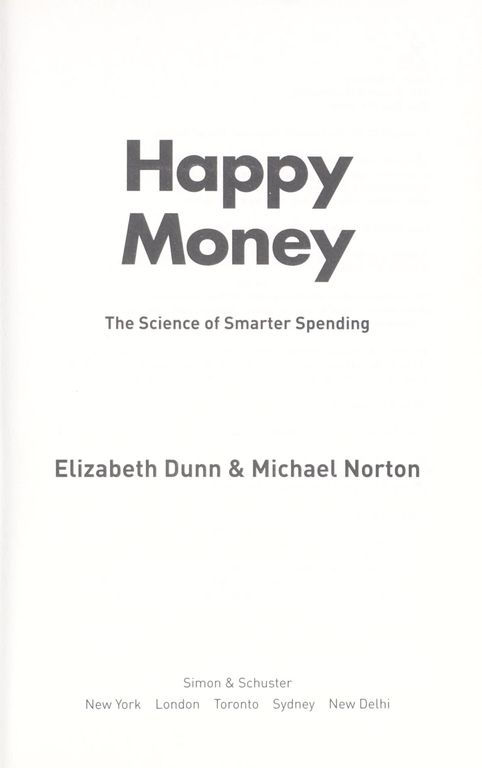
Happy money
Introduction
Nova: Picture this. You're handed a five-dollar bill on a university campus and told to spend it by the end of the day. The only catch is, some people are told to spend it on themselves, and others are told to spend it on someone else. Who do you think ends the day happier?
Nova: That's exactly the experiment Elizabeth Dunn and her colleagues ran at the University of British Columbia. And the results might flip everything you think you know about money and happiness. Welcome to Aibrary. I'm Nova.
Nova: And today we're diving into Happy Money: The Science of Happier Spending, a fascinating book by Elizabeth Dunn and Michael Norton that answers a question people have been debating forever: can money actually buy happiness?
Nova: The answer, it turns out, isn't yes or no. The answer is: it depends entirely on how you spend it. Dunn is a psychology professor at UBC, Norton is at Harvard Business School, and together they've spent years studying something most of us never think about, which is that we might all be spending our money wrong.
Nova: Their book lays out five research-backed principles for getting more joy out of every dollar. These aren't about making more money. They're about spending the money you already have in ways that actually move the needle on happiness.
Why memories outlast material goods
Principle 1: Buy Experiences, Not Things
Nova: Alright, let's kick things off with the first principle from Happy Money: buy experiences instead of material stuff. Now this one might sound familiar, you've probably heard it before, but the research behind it is genuinely compelling.
Nova: Here's the core idea. When you buy a new phone, a fancy pair of shoes, or even a bigger house, you adapt to it. Fast. Psychologists call this hedonic adaptation. At first it's thrilling. Then it's just your phone. Then you're eyeing the next model.
Nova: But experiences like concerts, trips, hiking a glacier, learning to cook Thai food with friends, these don't just fade into the background. They become part of your identity and your stories. Dunn and Norton point out that experiences actually get better with time in a way that material goods don't. You retell the story, you laugh about the mishaps, you romanticize the highlights.
Nova: There's also a social dimension here. When you buy a new couch, you don't typically gather your friends around it and say, Okay everyone, let's appreciate this couch together. But you absolutely share experiences. And sharing amplifies the happiness.
Nova: Exactly. And the research backs this up across cultures and income levels. Even when people look back on relatively modest experiences, a special meal out, a day trip, a live show, they report deeper and more lasting satisfaction than when they recall buying something tangible. The authors reference Mark Twain here. Twenty years from now you will be more disappointed by the things you didn't do than by the ones you did do. And the data agrees.
Nova: Here's a twist, though. Dunn's research also uncovered something surprising about how money itself can interfere with savoring experiences. In one experiment, her team showed people a photograph of a big stack of Canadian money right before handing them a piece of chocolate. Observers rated how much people enjoyed that chocolate. And the group that saw the money? They spent less time eating it and showed significantly less enjoyment. Just the reminder of wealth undermined their ability to savor a simple pleasure. Wild, right?
Nova: That is wild. So it's almost like having money or even just thinking about money puts you in this mindset of abundance where you don't feel the need to squeeze joy out of the moment. You can always buy more chocolate, so why savor this piece? It is one of the most counterintuitive findings in the whole book. Money can simultaneously give you access to amazing experiences and subtly rob you of the ability to fully enjoy them.
The science of strategic deprivation
Principle 2: Make It a Treat
Nova: Which brings us beautifully to principle number two: make it a treat. This one is all about restoring our ability to savor by not overindulging.
Nova: The authors talk about a really simple example. Imagine you love a particular latte from your favorite coffee shop. If you get it every single morning, it stops being special. It becomes background noise. But if you only get it on Fridays, suddenly Thursday night you're already looking forward to it. The anticipation builds. And when that Friday latte hits, it is genuinely delightful again.
Nova: This connects directly to that chocolate experiment we mentioned. When something feels abundant and always available, our brains basically stop paying attention to how good it is. Dunn found in her research that wealthier people actually report savoring life's small pleasures less. They have less reason to squeeze every drop of joy out of a moment because, well, there's always more where that came from.
Nova: So the prescription here is not about self-denial or asceticism. It's about strategic spacing. Take something you love and do it a little less often. Not never, just less. Turn it back into a treat.
Nova: The Forbes article we looked at had a great real-world example. The author went on a three-week trip to Argentina and fell in love with Malbec wine. A great bottle was cheaper than a single glass back home in LA. So they drank it every night. By the end of the trip, they didn't even want wine with dinner anymore. The treat had been diluted into routine. They actually had to take a break from wine entirely to reset their palate so that next glass would feel special again.
Nova: That's such a relatable example. You go on vacation, you think, I'm going to treat myself every day. And by day ten, the treat has lost all its power. It is the hedonic treadmill sped up to warp speed. The book's advice is to be intentional about scarcity. As the authors put it, they're not advocating self-denial. They're advocating looking for ways to view whatever we purchase as a special treat.
Why outsourcing chores might be the best money you ever spend
Principle 3: Buy Time
Nova: Now principle number three might be my personal favorite, and it's the one that people seem to resist the most: buy time.
Nova: The idea is simple. Use money to outsource the tasks you dread so you can spend more time on the things you love. Hire a housecleaner. Pay someone to mow the lawn. Get your groceries delivered. Take a slightly more expensive but more direct flight.
Nova: Dunn and her colleagues ran a massive study on this, surveying over 6,000 adults across the United States, Denmark, Canada, and the Netherlands. They found that people who spent money on time-saving purchases reported greater life satisfaction, and this held true across the entire income spectrum. It was not just a rich person thing.
Nova: Here's the mind-blowing part though. Even among a sample of 850 millionaires, almost half reported spending no money at all on outsourcing disliked tasks. Half of millionaires were still scrubbing their own toilets.
Nova: That is genuinely surprising. Why wouldn't they outsource?
Nova: The researchers think there's a guilt factor. People feel like hiring a housecleaner or paying the neighbor kid to mow the lawn makes them seem lazy. But the data says the opposite. Buying time had similar benefits for happiness as having more money. It is basically buying happiness by buying back your hours.
Nova: There was also a field experiment where 60 adults were given $40 to spend on a time-saving purchase one weekend and $40 on a material purchase another weekend. People were consistently happier after the time-saving purchase. And yet, in a separate survey, when 98 working adults were asked how they'd spend a surprise $40 windfall, only 2 percent said they'd use it to save time. Two percent!
Nova: So we know, intellectually, that time is more valuable than stuff. But when we actually have money in hand, we reach for the thing, not the freedom. It's a huge blind spot. The book recommends a simple mental shift. Before any purchase, ask yourself: how is this going to affect my use of time? When people focus on their time rather than their money, the authors write, they act like scientists of happiness, choosing activities that promote their well-being.
The happiness of anticipation versus the burden of debt
Principle 4: Pay Now, Consume Later
Nova: Alright, principle number four flips modern consumer behavior completely on its head: pay now, consume later.
Nova: This is basically the opposite of how most of us live. Credit cards have trained us to consume now and pay later. You want the thing, you get the thing, and the bill arrives weeks later, by which point the thrill is gone and all that's left is the accounting.
Nova: Dunn and Norton argue that reversing this sequence unlocks a huge source of happiness that most of us are leaving on the table: anticipation. There is actually a French verb for this, se réjouir, which means deriving pleasure in the present from anticipating the future. And research shows that anticipation itself can be more reliably joyful than the actual experience, which might come with delayed flights, bad weather, or a disappointing meal.
Nova: The classic example is a vacation. If you book a trip six months in advance, you get six months of daydreaming, planning, looking at photos of your destination, telling friends about your upcoming adventure. That is real happiness, happening now, before you've even packed a bag. If you put it all on a credit card and pay it off over the next six months, you've inverted the equation. Now the trip is over and you're still paying for it. The happiness has expired but the cost lingers.
Nova: And there's a practical benefit too. Paying upfront often means you spend less overall because the pain of payment is felt more acutely when it's immediate. You might downgrade from the luxury hotel to the perfectly nice one, and your actual trip experience might be just as good. Meanwhile, the anticipation is free.
Nova: There is one nuance the authors acknowledge. They are not saying anticipation is always better than the experience itself, though some studies do suggest vacations provide the most happiness before they occur. The point is that anticipation is an underutilized source of joy. We rush to consume when we could be savoring the wait. It is like wolfing down a great meal instead of enjoying each course.
Nova: It makes me think about how much of our economy is built on eliminating waiting. One-click buying, same-day delivery, instant streaming. We've engineered anticipation out of our lives and then we wonder why nothing feels special anymore.
Why giving your money away makes you richer in happiness
Principle 5: Invest in Others
Nova: And that brings us to the fifth and arguably most powerful principle in Happy Money: invest in others. Spend your money on other people rather than on yourself.
Nova: This is the finding that really put Dunn and Norton on the map. Their landmark 2008 study published in the journal Science showed something pretty remarkable. They handed people on campus either a five-dollar or twenty-dollar bill and randomly assigned them to spend it on themselves or on someone else. When they called everyone that evening, the people who spent money on others were significantly happier. And here's the kicker: the amount didn't matter. Five dollars or twenty, the happiness boost was the same.
Nova: So the happiness didn't scale with the dollar amount. It was the act of giving itself that mattered.
Nova: Exactly. And the researchers didn't stop there. They wondered if this was just a North American thing, so they replicated the study in Uganda, a much poorer country, and found the exact same pattern. When people reflected on a time they spent money on others, whether it was two dozen roses from Costco for mom in Canada or buying medication for a friend's ulcers in Uganda, they felt significantly happier than when they remembered spending on themselves.
Nova: The study also found that it's not the absolute amount you give but the percentage of your income that predicts happiness. A person making thirty thousand who gives away three thousand might get a bigger happiness boost than a millionaire giving away ten thousand if that ten thousand is a tiny sliver of their wealth.
Nova: And the benefits extend beyond personal happiness. Dunn and Norton studied teams, pharmaceutical sales teams in Belgium and dodgeball teams in Canada, and found that when team members were given money to spend on their teammates, the sales teams sold more drugs and the dodgeball teams won more games. Prosocial spending literally improved performance.
Nova: They also partnered with an organization called Karma Currency in Australia. A big bank wanted to make a charitable donation. Instead of writing one giant check, they divided the money among employees and gave each person a voucher to donate to the charity of their choice. The result? Employee job satisfaction went up significantly. The act of participating in generosity made people happier at work.
Nova: There's a great quote from Warren Buffett in the book. When asked about his decision to give away 99 percent of his wealth, he said, I couldn't be happier with the decision. Now most of us are not giving away billions, but the research shows that even tiny acts of financial generosity, buying a friend coffee, picking up a small gift, donating five bucks, shift our focus away from ourselves and toward connection with others. And connection, it turns out, is one of the strongest predictors of happiness there is.
Conclusion
Nova: So let's bring this all together. Five principles for happier spending. Buy experiences instead of things, because memories appreciate while stuff depreciates. Make it a treat by creating intentional scarcity so you can actually savor what you love. Buy time by outsourcing the tasks you hate to make space for what matters. Pay now and consume later to harvest the joy of anticipation. And invest in others, because giving your money away might be the most selfishly joyful thing you can do.
Nova: What I find so refreshing about Happy Money is that it's not a book about budgeting or deprivation or getting rich. It doesn't tell you to stop spending. It tells you to spend differently. The authors are essentially saying: you're already spending money. You might as well get more happiness per dollar.
Nova: And the research keeps reinforcing the same underlying theme. Happiness isn't about how much you have. Above about seventy-five thousand dollars a year, additional income barely moves the needle on day-to-day well-being. But how you deploy what you have can make a massive difference.
Nova: The chocolate experiment is the perfect metaphor for the whole book. Money is like that photograph of cash. It can be present without ruining anything. But if you stare at it too hard, if you let it become the point instead of the tool, you'll miss the sweetness right in front of you. You'll eat the chocolate without tasting it.
Nova: So here is a challenge for our listeners. This week, pick one of the five principles and try it. Buy a small experience instead of a small thing. Skip your daily indulgence so it feels special again on the weekend. Spend twenty bucks to save yourself two hours of a chore you hate. Prepay for something you'll enjoy next month. Or take five dollars and spend it on someone else and see how you feel.
Nova: The science is clear. Money can buy happiness. You just have to spend it on the right things. This is Aibrary. Congratulations on your growth.