

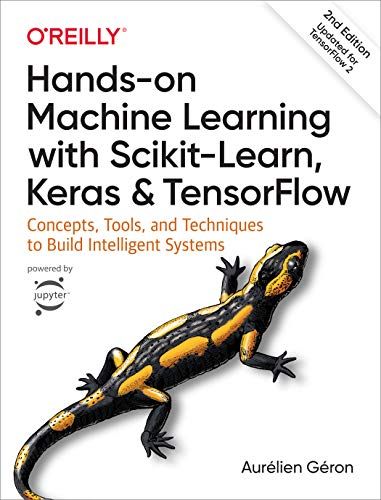
Hands-On Machine Learning with Scikit-Learn, Keras, and TensorFlow
The Machine Learning Bible
The Machine Learning Bible
Nova: If you have ever felt like you are drowning in the ocean of machine learning buzzwords, you are not alone. From neural networks to support vector machines, the field moves so fast it can make your head spin. But there is one book that has become the absolute North Star for developers trying to find their way. We are talking about Hands-On Machine Learning with Scikit-Learn, Keras, and TensorFlow by Aurélien Géron.
Nova: It is really about the perspective. Aurélien Géron isn't just an academic; he is a former Google employee who actually led the YouTube video classification team. He knows what it looks like when machine learning hits the real world. This book is famous because it manages to bridge that impossible gap between high-level theory and the gritty reality of production code.
Nova: Exactly. It uses a code-first approach. Instead of starting with three chapters of calculus, it starts with a problem and shows you how to solve it using Python. It is less about proving theorems and more about building systems that actually work. Today, we are going to dive into why this book is considered the developer's bible for AI.
Key Insight 1
Foundations Before the Hype
Nova: One of the most interesting things about the book is that it does not start with Deep Learning. In a world obsessed with ChatGPT and AI agents, Géron spends the entire first half of the book on what we call traditional machine learning using Scikit-Learn.
Nova: It is more like learning the rules of the road. Géron argues that you can solve about eighty percent of real-world business problems with traditional methods like Random Forests or Support Vector Machines. If you jump straight into a massive neural network for a simple problem, you are basically using a sledgehammer to crack a nut. It is inefficient and expensive.
Nova: Spot on. The book teaches you the landscape first. You learn about supervised versus unsupervised learning, and you get your hands dirty with the fundamental algorithms that still run most of the internet's recommendation engines today.
Nova: Not at all. He walks you through the intuition. For example, when he talks about Support Vector Machines, he uses this great analogy of trying to separate two classes of data points with the widest possible street. He makes you visualize the math before you ever type a line of code.
Nova: He does. In fact, Chapter 2 is legendary in the data science community. It is an end-to-end project where you have to predict housing prices in California. You don't just fit a model; you have to handle missing data, scale your features, and even deal with the geographical coordinates. It is a reality check for anyone who thinks ML is just one line of code.
Practical Project
The End-to-End Pipeline
Nova: He breaks it down into a checklist that every professional should follow. Most beginners think machine learning is ninety percent picking the model and ten percent everything else. Géron flips that. He shows you that picking the model is the easy part. The hard part is the data cleaning and the pipeline architecture.
Nova: Precisely. He introduces the concept of Pipelines in Scikit-Learn, which is a way to chain all your data transformations together. This is a huge takeaway from the book because it prevents one of the biggest sins in ML: data leakage. That is when your model accidentally sees the answer during training because you didn't separate your data correctly.
Nova: We have all been there. Géron spends a lot of time on cross-validation and fine-tuning. He teaches you how to use tools like Grid Search to automatically find the best settings for your model. It is about moving away from guessing and toward a scientific, repeatable process.
Nova: There is just enough math to understand why things work. If he mentions a cost function or a gradient descent step, he usually provides a footnote or a sidebar for the math-heavy version, but the main text stays focused on the implementation. He wants you to understand the objective, not necessarily derive the formula from scratch on a chalkboard.
Deep Dive
The Deep Learning Leap
Nova: Once you have mastered the basics, the book takes a massive leap into Part Two: Neural Networks and Deep Learning. This is where he introduces TensorFlow and Keras.
Nova: It is a common point of confusion. Basically, TensorFlow is the engine under the hood, and Keras is the steering wheel and dashboard. Keras is a high-level API that makes building neural networks feel almost like building with Legos. You just stack layers on top of each other.
Nova: The catch is understanding what those layers are actually doing. Géron spends a lot of time on the architecture. He doesn't just show you how to build a simple network; he dives into Convolutional Neural Networks for vision, and Recurrent Neural Networks for sequences like text or stock prices.
Nova: Yes, he has entire sections on things like Early Stopping, Batch Normalization, and Dropout. These are techniques to make training faster and more stable. He even gets into the really advanced stuff like Generative Adversarial Networks, or GANs, where you have two neural networks basically playing a game of cat and mouse to create realistic images.
Nova: That is the beauty of the 3rd edition. Aurélien actually updated it to include the Transformer architecture. That is the tech that makes things like GPT-4 possible. He also added content on the Hugging Face library, which is currently the center of the universe for pre-trained AI models.
Key Insight 2
Scaling and Production
Nova: That is exactly where Géron’s experience at Google shines. He includes chapters on how to deploy these models at scale. It is one thing to run a model in a Jupyter Notebook; it is a completely different beast to serve it to a million users using TensorFlow Serving or Google Cloud AI Platform.
Nova: He does. He talks about things like data parallelism and model parallelism—essentially how to split your training across multiple GPUs if your model is too big for just one. He also touches on TFLite for running models on mobile devices and even microcontrollers. It is about getting the AI out of the lab and into the pocket of the user.
Nova: Exactly. And he doesn't shy away from the ethics either. He discusses things like bias in your data and how a model can inadvertently learn to be unfair if you aren't careful. It is a holistic view of the profession.
Nova: If you know Python, yes. If you are still learning what a list or a dictionary is, you should probably start there first. But once you are comfortable with Python, there is simply no better roadmap than this lizard book.
Conclusion
Nova: We have covered a lot of ground today. From the fundamental building blocks of Scikit-Learn and the importance of a clean data pipeline, all the way to the cutting-edge world of Transformers and large-scale deployment. Hands-On Machine Learning is more than just a collection of code snippets; it is a philosophy of how to approach problem-solving in the age of AI.
Nova: That is the best way to describe it. Whether you are aiming to become a data scientist or just want to understand the technology that is reshaping our world, Aurélien Géron has provided the ultimate map. The biggest takeaway? Do not just read it. Type the code. Experiment with the parameters. Break the models and fix them. That is where the real learning happens.
Nova: That is the spirit. This is Aibrary. Congratulations on your growth!