

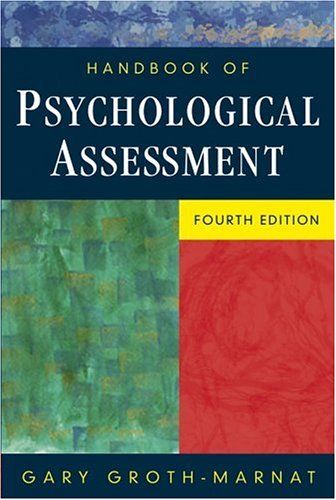
Handbook of psychological assessment
Introduction: The Unofficial Bible of Assessment
Introduction: The Unofficial Bible of Assessment
Nova: Welcome back to 'The Deep Dive,' the podcast where we excavate the foundational texts that shape modern practice. Today, we are cracking open a book that is less a textbook and more of a rite of passage for nearly every clinical psychology student: Gary Groth-Marnat's "Handbook of Psychological Assessment."
Nova: : That's right, Nova. If you've ever walked into a university psychology department, you've probably seen a copy of this thing, maybe dog-eared, maybe stained with coffee from an all-night study session. It’s ubiquitous. But what makes this handbook, now in its multiple editions, the go-to resource over everything else?
Nova: Exactly. It’s not just about listing tests; it’s about the. I was looking at the Sixth Edition description, and it emphasizes a "practical, skills-based manner." It sounds less like academic theory and more like a field manual for the mind.
Nova: : A field manual is the perfect analogy. When you’re sitting across from a client, you don't need abstract philosophy; you need to know, step-by-step, how to select the right instrument, how to administer it without bias, and most critically, how to integrate those disparate scores into a coherent narrative. That's the promise of Groth-Marnat.
Nova: And that narrative—the final report—is where so many clinicians stumble. The book promises guidance on report writing that is "client-oriented." That shift from technical jargon to usable feedback is huge. Why do you think this specific book has maintained such a dominant position for so long, surviving multiple updates?
Nova: : I think it boils down to its structure. It’s organized according to the typical assessment sequence that mental health professionals actually follow. It mirrors the workflow. You don't jump from the MMPI to the Rorschach and then to a cognitive battery randomly. Groth-Marnat lays out the logical, chronological path. It’s intuitive, which is why it’s so trusted.
Nova: So, we're not just reviewing a book; we're dissecting the blueprint for competent clinical assessment. We're going to explore its practical framework, its ethical backbone, and why it remains essential for everyone from interns to seasoned practitioners. Let's dive into the core structure that makes this handbook a classic.
Key Insight 1: The Sequential, Skills-Based Framework
The Clinician's Roadmap: Process Over Product
Nova: Let's start with that workflow you mentioned. When a referral comes in, what's the first thing Groth-Marnat insists you do? It’s not just grabbing the thickest manual off the shelf, is it?
Nova: : Absolutely not. The book drills down on the initial steps: understanding the referral question, selecting the appropriate instruments, and then administration. It treats assessment like a scientific investigation where every step must be justified. It’s about efficiency, too. The research highlighted that it guides users on the "most efficient methods" for selection and administration.
Nova: Efficiency is key when you’re billing by the hour! But I imagine the challenge for students is knowing test is efficient for problem. Does the handbook offer a clear decision tree for something like, say, differentiating between generalized anxiety and a specific phobia using objective measures?
Nova: : It does, by providing thorough coverage of the most commonly used instruments. We're talking about the heavy hitters: the Wechsler Intelligence Scales, the MMPI, various memory batteries. For each, it doesn't just give you the norms; it gives you the clinical utility. For example, when discussing the MMPI, it moves beyond just interpreting the validity scales to showing how to integrate those profile interpretations with, say, a measure of executive function.
Nova: : Think of it this way: If you’re a chef, other books give you recipes for individual dishes. Groth-Marnat gives you the entire kitchen layout, the safety protocols, and the sequence for a multi-course meal. It covers evaluation, referral, treatment planning, and then the final report.
Nova: That comprehensive scope is what separates it from a simple test manual. A test manual tells you how to score the Beck Depression Inventory. Groth-Marnat tells you to use the BDI, you might choose it over the Hamilton Rating Scale for Depression, and that score fits into a larger diagnostic picture that includes behavioral observations.
Nova: : And that integration piece is where the real art comes in. The book emphasizes integrating test scores, not just listing them. It moves past simple score reporting to showing how to synthesize data from different domains—cognitive, emotional, personality—to build a holistic picture of the client’s functioning.
Nova: I recall reading that one of its strengths is its focus on the of evaluation itself, which is often glossed over in favor of just the psychometrics. It forces the reader to slow down and consider the context before even opening the test booklet.
Nova: : Precisely. It’s about establishing a relationship conducive to obtaining the information. That’s a quote I saw referenced—it’s about the therapeutic alliance within the assessment context. If the client doesn't trust the process, the data is garbage, no matter how good the test is. That’s a foundational principle that students often forget when they are focused solely on achieving high scores.
Nova: So, Chapter One isn't just an introduction; it’s a mandate for professional conduct right from the start. It sets the stage for the entire assessment sequence, making sure the foundation is solid before we even look at the tools themselves. It’s about being a thoughtful clinician, not just a technician.
Key Insight 2: The Ethical and Cultural Backbone
Beyond the Numbers: Ethics and Cultural Competence
Nova: While the practical steps are crucial, I want to pivot to what I consider the book's most vital contribution in the modern era: its focus on ethics and cultural competence. The search results specifically pointed out that Groth-Marnat dedicates "substantial attention" to ethical considerations.
Nova: : That’s a massive differentiator. In the early days of psychological testing, the focus was heavily weighted toward psychometrics—reliability and validity coefficients. Groth-Marnat recognized early on that a perfectly valid test administered unethically or inappropriately for a specific cultural context is useless, or worse, harmful.
Nova: Harmful is the key word. When we talk about cultural competence, we aren't just talking about being polite. We're talking about test bias, interpretation bias, and the potential for misdiagnosis based on normative data that doesn't reflect the client’s background. What specific guidance does the book offer here?
Nova: : It addresses how cultural background influences test selection, administration, and interpretation. For instance, when discussing intelligence testing, it forces the reader to confront the limitations of standardized norms when assessing individuals from non-majority cultural or linguistic backgrounds. It pushes practitioners to look for alternative data sources or to use caution when interpreting scores that might be inflated or depressed due to cultural mismatch.
Nova: : Furthermore, the ethical discussions go deep into informed consent specific to testing—ensuring the client understands they are being tested, the results mean, and will see them. This is critical, especially when dealing with sensitive personality inventories.
Nova: It’s interesting because, historically, psychological assessment was often seen as a very objective, almost mathematical endeavor. Groth-Marnat seems to be arguing that assessment is inherently a human, relational, and ethical endeavor first. The numbers are just one piece of evidence.
Nova: : Exactly. It’s a constant reminder that the clinician holds significant power when interpreting these instruments. The book cautions against over-reliance on single measures. I saw a reference where Groth-Marnat warned against certain scales being "not particularly good" or "not particularly effective" on their own. This skepticism towards the infallibility of any single test score is a hallmark of good clinical judgment.
Nova: That skepticism is what separates a technician from a diagnostician. If a clinician relies solely on a high score on a specific scale to label someone, they are failing in their ethical duty. The handbook seems to advocate for triangulation—using the test data to inform, but not dictate, the final clinical impression.
Nova: : It’s about responsible test use, which is a core tenet of professional psychology. The book essentially provides the practical application for those ethical codes. It moves the concept of cultural humility from an abstract ideal into concrete steps: Do you have the appropriate normative data? Have you considered language barriers? Are you interpreting responses through a culturally relevant lens?
Nova: It sounds like the book serves as a necessary check against confirmation bias in the assessment room. It forces the clinician to actively search for disconfirming evidence, rather than just seeking data that validates the initial referral hypothesis. That’s a powerful ethical safeguard built right into the curriculum.
Key Insight 3: Staying Relevant Across Decades
The Enduring Legacy: Editions and Evolution
Nova: Let’s talk about longevity. This book has seen numerous editions, from the second edition back in 1990 up to the sixth, and likely beyond. How does a handbook on rapidly evolving testing technology manage to stay current across so many printings?
Nova: : That’s the testament to the author's commitment to revision. Psychological assessment is a moving target. New tests emerge, old ones are revised—think of the constant updates to the Wechsler batteries or the evolution of the MMPI. Each edition has to incorporate these changes, often replacing entire sections dedicated to older instruments with detailed guides on the latest versions.
Nova: So, when a new edition drops, it’s not just a minor polish; it’s a significant overhaul to reflect the current state of the art in psychometrics and clinical application. For example, what kind of updates might we see between, say, the Fourth Edition and the Sixth?
Nova: : You’d see the integration of newer, empirically supported measures, updates to normative data sets—which is huge for accuracy—and critically, the incorporation of new research regarding test validity and utility in different populations. The Sixth Edition, for instance, would have been heavily focused on refining the integration process and strengthening the cultural competence sections based on decades of feedback and evolving standards.
Nova: : It’s this continuous updating that keeps it a "trusted resource." If a student is using a 15-year-old edition, they might be administering tests based on outdated norms or completely missing instruments that are now standard practice, like certain modern neuropsychological screening tools.
Nova: It’s almost like a living document for the field. And because it’s used so widely in training programs across the United States and abroad, as Dr. Groth-Marnat’s bio suggests, that consistency in training materials creates a shared language among new clinicians.
Nova: : Absolutely. When a supervisor says, "Check the Groth-Marnat section on pattern analysis for the MMPI-3," everyone knows exactly what they mean and where to find the practical guidance. It standardizes the to assessment, even if the specific tests used vary slightly by setting.
Nova: That standardization of is invaluable. It means that whether you’re in a hospital setting, a private practice, or a school district, the fundamental steps of sound evaluation—from referral question to final integrated report—are rooted in the same well-vetted methodology.
Nova: : And this is why educators rely on it. It provides a comprehensive, single-source reference that covers the breadth of assessment techniques required for competency. It’s the bridge between the abstract statistical concepts learned in psychometrics class and the messy, real-world application of helping a person understand themselves better.
Key Insight 4: From Data Points to Actionable Insight
The Final Product: Writing the Client-Oriented Report
Nova: We’ve covered selection and interpretation, but let’s dedicate a moment to the final deliverable: the psychological report. The research highlighted that the book provides guidance on writing reports that are "client-oriented." This is often the most intimidating part for new assessors.
Nova: : It is the moment of truth. You’ve spent hours testing, scoring, and analyzing. Now you have to translate that into prose that is meaningful to the client, their family, or the referring physician. Groth-Marnat’s approach here is brilliant because it structures the report to tell a story, not just list scores.
Nova: What does "client-oriented" actually look like in practice, according to the handbook’s philosophy? Is it avoiding technical terms entirely?
Nova: : It’s more nuanced than just dumbing things down. It means framing findings in the context of the client’s life and the referral question. For example, instead of writing, "The patient scored 2 standard deviations below the mean on the Verbal Comprehension Index," a Groth-Marnat informed report might state, "The client demonstrated significant difficulty in understanding complex verbal instructions and abstract concepts, which likely impacts their ability to follow multi-step directions in their workplace."
Nova: : It connects the data point to the functional implication. It answers the 'So what?' question for the reader.
Nova: That functional translation is essential for treatment planning, which the book also covers extensively. If the report doesn't clearly articulate the functional deficits and strengths, how can anyone develop an effective intervention plan?
Nova: : Exactly. The report becomes the roadmap for therapy or intervention. The book emphasizes that the integration section—where you synthesize the cognitive, personality, and behavioral data—must lead directly to specific, testable recommendations. It’s not enough to say, 'Recommend therapy.' It needs to say, 'Recommend cognitive behavioral therapy focusing on restructuring automatic negative thoughts identified in the personality inventory, with a specific focus on social anxiety scenarios."
Nova: : This level of specificity, derived from the careful integration of multiple data streams, is what makes the handbook so powerful as a training tool. It teaches the reader to be an active problem-solver, not just a data collector.
Nova: It sounds like the entire book is designed to empower the clinician to be an effective consultant. You are not just delivering a diagnosis; you are delivering a comprehensive strategy for improvement, all supported by rigorous, ethically sound data collection.
Nova: : That’s the ultimate goal. The handbook is a masterclass in translating complex psychological constructs into actionable, human-centered language. It ensures that the assessment process, which can feel invasive to the client, ultimately serves to empower them with self-understanding and a clear path forward.
Conclusion: The Essential Toolkit for Psychological Practice
Conclusion: The Essential Toolkit for Psychological Practice
Nova: We’ve covered a lot of ground today, moving from the practical sequence of assessment to the deep ethical considerations that underpin the entire process, all through the lens of Gary Groth-Marnat’s "Handbook of Psychological Assessment."
Nova: : It’s clear that this book’s enduring success isn't accidental. It’s because it addresses the entire lifecycle of an assessment: from the initial referral question, through the careful selection and administration of gold-standard instruments, to the crucial, culturally sensitive interpretation, and finally, the creation of a functional, client-centered report.
Nova: The key takeaway for our listeners, whether they are students or seasoned pros, is that assessment is a skill set that requires constant refinement. Groth-Marnat provides the framework for that refinement, constantly pushing practitioners toward efficiency, ethical rigor, and clinical utility.
Nova: : If you take one thing away, let it be this: The best assessment is the one that answers the referral question clearly, ethically, and functionally. This handbook is the best guide we have for achieving that standard consistently.
Nova: It truly is the essential toolkit. It’s the reference you keep on your desk, not just on your shelf. Thank you for joining us for this deep dive into a cornerstone of clinical psychology.
Nova: : My pleasure, Nova. It’s always good to revisit the foundations that keep our practice sound.
Nova: This is Aibrary. Congratulations on your growth!