The Ultimate Upgrade: Prototyping Humanity 2.0
Golden Hook & Introduction
SECTION
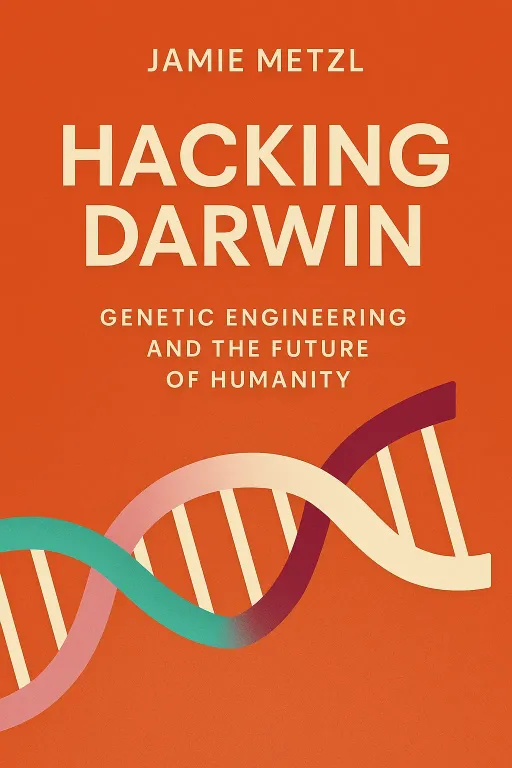
Orion: Imagine for a moment you're a product manager. Your new product isn't an app or a device. It's the next version of the human species. Your toolkit isn't code, it's CRISPR. Your 'users' are future generations. This isn't science fiction anymore. According to Jamie Metzl's 'Hacking Darwin,' we are standing at the threshold of actively engineering our own evolution. The question is no longer, but we'll manage this upgrade. And what happens when it triggers the most high-stakes arms race in history?
Orion: Today, we're going to tackle this from two critical angles, with the help of our guest, tech product manager Rico. First, we'll explore the surprisingly mature 'tech stack' that's making human genetic engineering a reality right now. Then, we'll discuss the powerful competitive 'market forces' that are creating an unavoidable arms race for genetic enhancement.
Orion: Rico, welcome. As someone who spends his days thinking about the future of technology, this must hit close to home.
rico: Absolutely, Orion. It's a pleasure to be here. And you're right, it's mind-bending. It feels like my entire career has been about shipping software, and now we're talking about shipping species. The ethical considerations and the potential for 'bugs' are just staggering.
Deep Dive into Core Topic 1: Humanity as an Information System
SECTION
Orion: Staggering is the right word. And to understand why this is so immediate, and not some far-off fantasy, Metzl uses a fantastic historical analogy in the book. He asks us to compare two different predictions about going to the moon.
rico: I'm listening.
Orion: On one hand, you have Jules Verne's novel from 1865, 'From the Earth to the Moon.' It was brilliant, imaginative... but it was pure fantasy. The technology to get there—advanced rocketry, life support, computers—simply didn't exist. It was a dream.
rico: Right, it was a concept, not a project plan.
Orion: Exactly. But then, fast forward to 1962. President John F. Kennedy stands up and says we'll put a man on the moon by the end of the decade. The key difference? By then, all the core technologies were already in place. It was no longer a fantasy; it was an incredibly complex engineering and integration challenge. Metzl's argument is that with human genetic engineering, we are at the JFK moment. We are not in the age of Jules Verne anymore.
rico: So what's the 'tech stack,' then? What are the components that are already on the table?
Orion: That's the crucial part. The 'rocket,' so to speak, is In Vitro Fertilization, or IVF. We've been successfully creating embryos in a lab for over forty years. The 'guidance system' is Preimplantation Genetic Testing, or PGT. This allows us to screen those embryos for hundreds, and soon thousands, of genetic diseases before they are ever implanted. And the 'engine upgrade,' the real game-changer, is CRISPR. It's a gene-editing tool that acts like a 'find and replace' function for DNA, allowing us to go in and theoretically correct the source code.
rico: Wow. So, from a product perspective, does this 'tech stack'—IVF, PGT, CRISPR—feel like it's ready for a 'v1.0' launch?
rico: That's the perfect and terrifying question. It sounds like the core components are out of their beta testing phase, but the integration is where the real risk lies. In product development, we'd call this a 'platform play.' You have these powerful, separate services. The revolution happens when you bundle them into a seamless user experience. But here, the 'user interface' is a human life. The risk of shipping a critical bug isn't a bad press cycle or a stock dip; it's a generational catastrophe.
Orion: Metzl has this key quote where he says our biology is becoming 'readable, writable, and hackable.' As a technologist, does that language resonate with you?
rico: One hundred percent. We think of everything as a system of information. That's how we build and scale things. But when you treat biology as code, you risk ignoring the emergent properties, the things you can't predict from the code alone. In software, we talk about 'technical debt'—the shortcuts you take now that you'll have to fix later. This sounds like we could be accumulating 'biological debt' or, even more profoundly, 'ethical debt' on a massive scale.
Deep Dive into Core Topic 2: The Inevitable Arms Race
SECTION
Orion: That concept of 'ethical debt' is the perfect bridge to our second point. Because even with all these risks we've just discussed, Metzl argues that the adoption of these technologies won't be driven by careful, slow, ethical consideration. It will be driven by something far more primal: raw, human competition. He predicts an arms race.
rico: A market driven by fear and ambition. That sounds familiar.
Orion: Painfully so. And the book provides a chilling case study that has nothing to do with genetics but serves as a perfect blueprint. He points to modern South Korea.
rico: Okay, tell me more.
Orion: Imagine a country that went from utter devastation after the war to a global economic powerhouse. That success was built on an obsession with education and competition. Today, 75% of primary schoolers are enrolled in intense after-school 'cram schools.' The pressure is so immense that the government had to enforce a 10 PM curfew on these schools to combat student anxiety and suicide rates.
rico: That's an incredible level of societal pressure.
Orion: It gets more intense. This drive for a competitive edge extends to appearance. South Korea has the highest per-capita rate of plastic surgery in the world. It's so normalized that parents often pay for their children to get procedures like double-eyelid surgery as a high school graduation gift. One poll suggested around half of all women in their twenties have had some work done.
rico: So the point is, this isn't about health or well-being. It's about gaining an advantage in a hyper-competitive job and marriage market.
Orion: Precisely. And Metzl uses this to ask a powerful question: in a society like that, if you could choose an embryo that had a genetic predisposition for a 10-point higher IQ, or was less prone to anxiety, or had a faster metabolism... would you do it? In that environment, giving your child every possible advantage could start to be seen as a form of parental negligence.
rico: And you've just described a classic 'feature treadmill,' but for humans. In the tech world, if your competitor releases a killer feature, you have to match it, or you risk becoming obsolete. Here, the 'features' are intelligence, height, longevity. The market isn't just individuals; it's nation-states. The book mentions China's national strategy to lead in genetics. This is geopolitical product strategy. The 'total addressable market' is the entire human species.
Orion: And this creates a terrifying equity problem, right? The book talks about the genetically enhanced 'haves' and the 'have-nots.'
rico: Exactly. It's the ultimate pay-to-win model. We already see a digital divide based on access to technology and the internet. This would create a permanent, hard-coded divide. As a product manager, you're always thinking about accessibility. How do you design a product that serves everyone? But this technology, at least in its early stages, will be the absolute opposite of accessible. It could hard-code inequality into our very DNA for generations.
Synthesis & Takeaways
SECTION
Orion: So, to bring it all together: we have a technology that is essentially ready for deployment, and a competitive, global market that will create an almost irresistible pressure to use it, despite the enormous risks and ethical debt we talked about.
rico: It's a perfect storm. The tech is moving faster than our ability to create the ethical and regulatory frameworks to manage it. It's a classic case of the Silicon Valley ethos of 'move fast and break things' being applied to the one thing we absolutely cannot afford to break: the human genome.
Orion: Metzl's final plea in the book is for a global, species-wide conversation. He says we need to talk about this now, while we still can. So, Rico, I'll leave you with this. As a product leader, if you were tasked with writing the 'Product Requirements Document' for the first mainstream human genetic enhancement service, what's the one ethical principle you would write at the very top, as a non-negotiable?
rico: That's a heavy question. I think... it would have to be 'Do No Harm, and Prioritize Reversibility.' Can we undo it? If the answer is no, we have to seriously question if we should be doing it at all. In software, you can roll back a bad update. You can patch a bug. You can't roll back a generation. If a change is permanent and heritable, the bar for safety and certainty has to be astronomically high.
Orion: A powerful and sobering thought. And a perfect place to end. Rico, thank you for bringing your unique and insightful perspective to this.
rico: Thanks for having me, Orion. It's a lot to think about.