

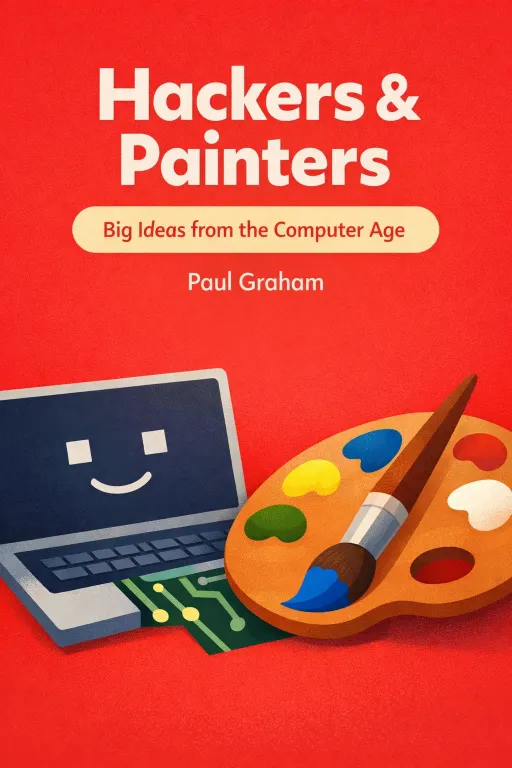
Hackers & Painters
Introduction
Nova: Have you ever wondered why the smartest kids in school were often the most unpopular? Or why some of the most successful people in the world today seem to view computer programming as a form of art rather than just math?
Nova: That is exactly the stereotype Paul Graham dismantles in his classic book, Hackers and Painters. Published in 2004, this collection of essays has become something of a sacred text in Silicon Valley. It is not just about computers; it is a manifesto on creativity, wealth, and how to think for yourself in a world full of conventional wisdom.
Nova: Exactly. But before he was a kingmaker for startups, he was a hacker and a painter. Literally. He studied painting at the Rhode Island School of Design and the Accademia di Belle Arti in Florence. This book is where he bridges those two worlds, arguing that hackers are actually makers, just like painters, architects, or writers.
Key Insight 1
The Maker's Mindset
Nova: Let us start with that central comparison. Graham argues that the term computer science is actually a bit of a misnomer. He says that what hackers do is not really science, and it is not really math. It is building things.
Nova: You need math the way a painter needs to understand the chemistry of pigments. It is a tool, but it is not the goal. Graham points out that in science, you are trying to discover laws that already exist. In hacking, you are creating something new from scratch. He says hackers and painters are both makers. They are trying to create something beautiful or useful through a process of trial and error.
Nova: That is the big misconception. Graham says that just as a painter might start with a sketch and then paint over it, a hacker starts with a rough version of a program and refines it. You do not know exactly what you are building until you start building it. He actually hates the way most big companies try to force programmers to write detailed specifications before they even touch a keyboard. To him, that is like telling a painter exactly where every brushstroke should go before they even see the canvas.
Nova: This is one of the most famous parts of the book. Graham argues that nerds are unpopular in school not because they are socially awkward by nature, but because they are busy. They are focused on being smart or building things, while the popular kids are focused on the incredibly complex and demanding task of being popular.
Nova: Exactly. Graham says that for a nerd, the payoff for being popular is not worth the effort. They would rather spend their time learning how a rocket works or how to write a better compiler. He views the social structure of high school as a sort of artificial bubble that does not reflect the real world. In the real world, your value is based on what you can create, not how many people like your outfit.
Key Insight 2
The Wealth Equation
Nova: That focus on creating value leads directly into Graham's philosophy on wealth. This is probably the most influential essay in the book, titled How to Make Wealth. He starts by making a very important distinction: wealth is not the same thing as money.
Nova: Graham defines wealth as stuff people want. It is the value created by work. If you fix a broken car, you have created wealth. If you write a piece of software that saves people time, you have created wealth. Money is just a medium of exchange, a way to move that wealth around.
Nova: He says the secret is two things: measurement and leverage. In a big company, it is hard to measure how much wealth any one person is creating. You are just a cog in a giant machine. Your salary is basically the average of everyone's productivity. But in a startup, you have measurement because the team is so small that your individual contribution actually moves the needle.
Nova: Precisely. Leverage means that the work you do can be scaled to millions of people. If you are a carpenter, you can only build so many chairs. But if you are a hacker, you can write a piece of software once and it can be used by the entire world. That is the 100 to 1 rule Graham talks about. A great programmer can be a hundred times more productive than a mediocre one because their code can solve problems for a hundred times more people.
Nova: Right. He says that if you want to get rich, you should look for a problem that is hard to solve. Hard problems are like a barrier to entry. If it were easy, everyone would do it and the value would be competed away. Hackers thrive on hard problems because they have the skills to solve them and the leverage to profit from them.
Nova: That is a core tenet of his philosophy. He believes that the more wealth people create, the better off society is as a whole. It is a very optimistic, builder-centric view of capitalism.
Key Insight 3
The Blub Paradox
Nova: Now, to build those great things, you need the right tools. This brings us to one of Graham's most famous technical concepts: the Blub Paradox. It is a bit of a deep dive into programming languages, but the lesson applies to almost everything.
Nova: Blub is a hypothetical, middle-of-the-road programming language. Graham uses it to explain why people often fail to see the value in more powerful tools. Imagine a programmer who knows Blub. They look at a less powerful language and think, why would anyone use that? It is missing all these features I have in Blub.
Nova: But here is the paradox. When that same programmer looks at a more powerful language, like Lisp, they do not see the power. They just see a weird language with a bunch of parentheses. They think, I can do everything I need in Blub, so why bother with this other thing? They are blind to the features they do not have because they do not have a way to describe them or use them.
Nova: Exactly! Graham argues that this is why some startups fail and others succeed. If you are using a more powerful language than your competitors, you can build things faster and with less code. You have a secret weapon that they do not even recognize as a weapon. For Graham, that language was Lisp. He used it to build Viaweb, which was the first web-based store builder, and it gave them a massive advantage because they could add features in days that would take their competitors months.
Nova: That is the broader takeaway. It is about being aware of your own blind spots. Whether it is a programming language, a business strategy, or a personal belief, we tend to think our current level of understanding is the ceiling. Graham is constantly pushing us to look for the tools and ideas that seem weird or unnecessary at first, because that is often where the real power lies.
Key Insight 4
Thinking the Unthinkable
Nova: This leads us to one of the most provocative essays in the book: What You Can't Say. Graham explores the idea of moral fashions and how they restrict our thinking.
Nova: Precisely. He points out that every era in history had beliefs that everyone thought were obviously true, but that we now find ridiculous or even evil. Think about the way people viewed the earth as the center of the universe, or the way they justified slavery. People in those times were not necessarily stupider than us; they were just following the fashions of their day.
Nova: Exactly. And Graham's point is that if you want to be a great thinker or a great innovator, you have to be able to step outside those fashions. You have to be able to entertain heretical thoughts without necessarily shouting them from the rooftops. He calls this thinking the unthinkable.
Nova: Not at all. He is saying we should be intellectually honest. If you cannot even think a thought because it is socially unacceptable, then you have a blind spot in your brain. And in the world of startups and technology, those blind spots are where the big opportunities are hidden. If everyone agrees that something is impossible or wrong, the person who dares to question that assumption is the one who finds the breakthrough.
Nova: Right. He suggests a few exercises to find these hidden ideas. For example, ask yourself: what are things that people were allowed to say fifty years ago that they are not allowed to say now? Or, what are things that are considered common sense in one culture but are totally taboo in another? By doing this, you start to see the boundaries of your own thinking.
Nova: He is very pragmatic. He says you should have a mind that is open to everything, but a mouth that is often shut. The goal is not to be a martyr for every unpopular opinion; the goal is to have the clarity of thought to see the world as it really is, not just as people want it to be. That clarity is what allows you to design better products, build better companies, and ultimately, create more wealth.
Conclusion
Nova: As we wrap up our look at Hackers and Painters, it is clear that Paul Graham's influence goes far beyond just a few essays. He helped define the very identity of the modern hacker—not as a criminal or a loner, but as a creative force, a maker of the digital age.
Nova: The book is a reminder that the most important tool any of us has is our own mind. Whether you are writing code, painting a canvas, or starting a business, the principles remain the same: focus on creating value, stay curious about more powerful tools, and never be afraid to think for yourself, even when the rest of the world is looking the other way.
Nova: That is the spirit. Graham's work continues to inspire a new generation of makers to build things that matter. If you want to dive deeper, I highly recommend reading the original essays on his website—they are as relevant today as they were twenty years ago.
Nova: This is Aibrary. Congratulations on your growth!