

The Hacker's Secret Weapon
Introduction
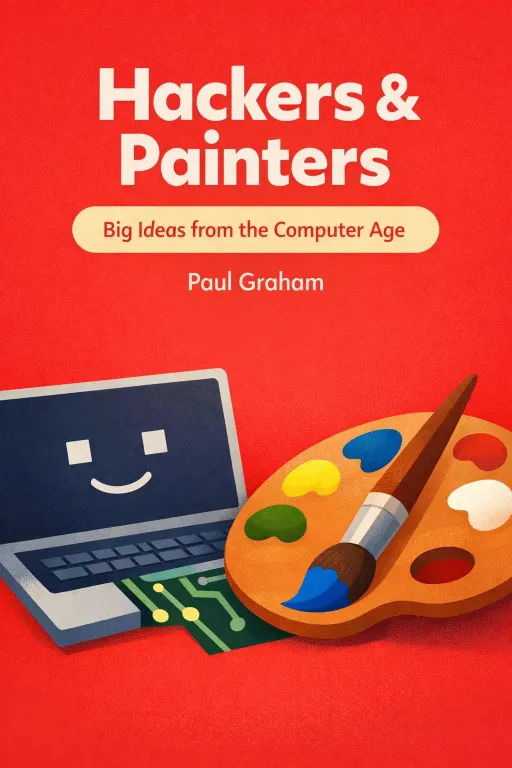
Narrator: What if a tiny startup could build a better product, faster, than all its competitors, not because of more money or marketing, but because of a single, misunderstood technological choice? In the mid-1990s, a small company called Viaweb did just that. While rivals struggled for months to release new features for their e-commerce software, Viaweb’s team could often replicate those same features in a matter of days. It seemed like they had a secret weapon, some kind of unfair advantage. This mystery of how small, creative teams can outmaneuver giants is at the heart of Paul Graham’s collection of essays, Hackers and Painters: Big Ideas from the Computer Age. The book argues that to understand the modern world, one must first understand the minds of the people building it, the hackers, and the powerful, often-overlooked tools they use to create the future.
The Hacker is a Maker, Not a Scientist
Key Insight 1
Narrator: To understand the world of hackers, one must first discard the high-school stereotype of the unpopular nerd. In his essay “Why Nerds Are Unpopular,” Paul Graham argues that smart kids aren’t disliked for their intelligence, but because they are fundamentally obsessed with a different goal. While their peers are engaged in the full-time job of being popular, nerds are consumed by the desire to make great things—to design rockets, write elegant programs, or understand the world. They are, at their core, makers.
This reframing is central to the book’s title essay, “Hackers and Painters.” Graham posits that the work of a great programmer has far more in common with painting or architecture than it does with science. A scientist seeks to uncover existing truths, but a hacker, like a painter, strives to create something new and beautiful from nothing. This creative process is not a linear, pre-planned execution of a rigid blueprint. Instead, it’s an iterative dance of sketching, refining, and discovery. A painter doesn’t just execute a perfect image they had in their head; they start with a rough sketch and build upon it, letting the work itself guide them. Similarly, great hackers don't write a program from start to finish. They build a prototype, test it, and rewrite it, a process Graham likens to “debugging-as-programming.”
This devotion to creation extends to a fanatical attention to detail, even in parts no one will ever see. Graham points to Leonardo da Vinci’s portrait of Ginevra de' Benci, where Leonardo meticulously painted every single leaf on a background juniper bush. This relentless craftsmanship, this pursuit of beauty for its own sake, is what separates good work from great work. For hackers, this means crafting elegant, clean code, not just functional code. This mindset—seeing programming as a creative art of making—is the foundation upon which their entire world is built.
Wealth is Created, Not Distributed
Key Insight 2
Narrator: A common misconception, which Graham calls the “Daddy Model,” is that wealth is a fixed pie distributed by some authority figure. If someone has a large slice, it must mean someone else has a smaller one. Graham argues this is fundamentally wrong. Wealth, he explains, isn't money; it's the stuff we actually want—food, cars, houses, and useful software. And this wealth can be created.
To illustrate this, he uses a simple example: restoring an old car. If you take a rusty, broken-down car and spend your time fixing it, you have created wealth. The world now has one more functional, beautiful car than it did before, and you are richer for it, but no one else has been made poorer in the process. This is the engine of a healthy economy.
So, how does one get rich by creating wealth? Graham identifies two essential conditions: measurement and leverage. You need to be in a role where your individual contribution can be measured, and you need leverage, where your decisions have a large-scale impact. A typical job in a large corporation fails on both counts. An individual’s work is averaged out among thousands of employees, making it impossible to measure their specific contribution. Graham uses the analogy of a giant galley ship with a thousand rowers. No single rower feels their effort makes a difference. A startup, however, is like a small racing boat. Every person’s contribution is visible and critical.
This smallness provides the measurement. The leverage comes from technology. By creating a useful technique or piece of software, a small team’s work can be multiplied to serve millions of users. This combination of a small, measurable team working on a problem with technological leverage is the formula for a startup, which Graham describes as a machine for compressing an entire working life’s worth of wealth creation into just a few intense years.
The Blub Paradox and the Secret Weapon of Language
Key Insight 3
Narrator: If startups are the vehicle for wealth creation, what is the fuel? Graham’s most controversial and powerful claim is that it’s the choice of programming language. He argues that languages are not all equal; they exist on a continuum of power. However, most people, including many managers, can't see this. This is due to what he calls the “Blub Paradox.”
Imagine a hypothetical, average programming language called Blub. A programmer who only knows Blub can look at a less powerful language, like Cobol, and see that it’s missing features. But when they look at a more powerful language, like Lisp, they don't see its advantages. They only see its "weird" features and conclude it's roughly equivalent to Blub, just with some strange, unnecessary additions. Their thinking is constrained by the concepts available in Blub. Only a programmer who understands the more powerful language can see the full spectrum.
This paradox explains why companies consistently choose "industry standard" languages like Java or C++, which are often just Blub. It’s a safe choice, but it’s an average choice. And for a startup, being average means failing. Graham’s own company, Viaweb, was a testament to this. They built their software in Lisp, a language considered academic and strange. Their competitors used mainstream languages like C++ and Perl. The result was that Viaweb had a secret weapon. They could develop sophisticated features in a day or two that took their competitors months, if they could build them at all. One line of Lisp, Graham notes, can often do the work of twenty lines of C. This isn't just a 20% improvement; it’s a 20x improvement, a totally different class of advantage. The secret weapon wasn't magic; it was simply a more powerful tool that their competitors, trapped in the Blub paradox, couldn't even recognize.
The Future of Software is on the Web
Key Insight 4
Narrator: The hacker mindset, combined with powerful tools, doesn't just create wealth; it reshapes entire industries. In the essay “The Other Road Ahead,” written in 2001, Graham accurately predicted the massive shift from desktop software to web-based applications. He argued that the whole idea of "your computer" was becoming obsolete, replaced by the idea of "your data," which should be accessible from anywhere.
Desktop software, he analogized, is like early car ownership. Users are forced to become amateur mechanics, dealing with installations, patches, viruses, and operating system updates. His own company, Viaweb, was a pioneer of the alternative: software that runs on a server and is accessed through a web browser. For the user, the benefits were enormous. There was nothing to install. The software was always up-to-date. Bugs, when found, could be fixed for everyone instantly.
For developers, this model was equally transformative. Instead of massive, high-stakes annual releases, Viaweb deployed new code three to five times a day. This continuous, incremental process meant bugs were rare and, when they occurred, could be fixed in minutes. It also created an incredibly tight feedback loop with users. By analyzing click-trails, developers could see exactly where users were getting confused and fix the interface on the fly. This shift to web-based software wasn't just a technical change; it was a fundamental re-architecting of how software is built, sold, and used, paving the way for the cloud-based world we live in today.
Conclusion
Narrator: The single most important takeaway from Hackers and Painters is that the computer age is driven by a specific kind of creative person—the hacker—whose greatest leverage comes from using tools that are more powerful, not just more popular. Paul Graham demystifies the world of programming, recasting it as an art form where taste, simplicity, and a relentless desire to make good things are the keys to innovation. He argues that wealth is a positive-sum game, created by solving problems for people, and that startups are the most potent engines for this creation.
Ultimately, the book leaves us with a profound challenge, encapsulated by the Blub Paradox. It forces us to ask: in our own work, in our own lives, what is our "Blub"? What is the comfortable, average tool or conventional way of thinking that we use every day, which prevents us from seeing a more powerful, more elegant, and perhaps "weirder" way of solving problems? Recognizing our own Blub is the first step toward truly beating the averages.