

The Hacker's Gospel
Golden Hook & Introduction
SECTION
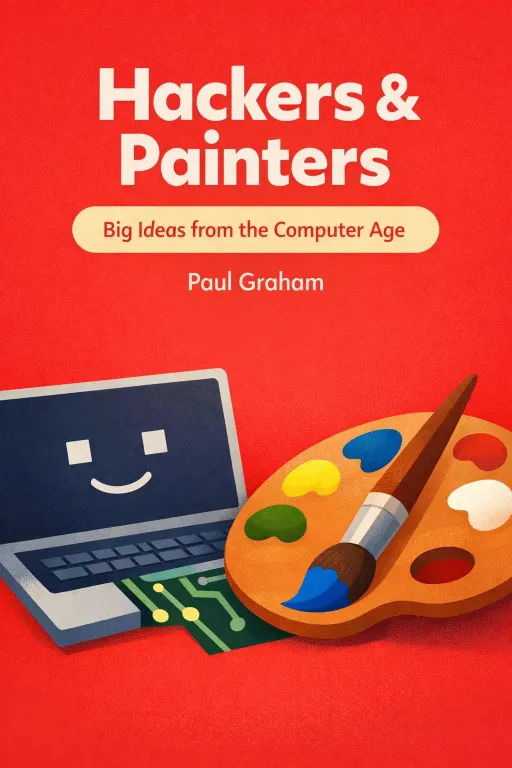
Joe: Here’s a thought for you, Lewis. What if the growing gap between the rich and the poor is actually a sign that our society is getting healthier? Lewis: Okay, that's a bold start. That feels like an idea that could get you in a lot of trouble at a dinner party. I feel like we need to unpack that one very carefully. Joe: We will, because that's one of the bombshells we're defusing today from the book Hackers & Painters: Big Ideas from the Computer Age by Paul Graham. Lewis: Ah, Paul Graham. I know that name. Joe: You should. And this isn't just some philosopher in an armchair. Graham is the real deal—a programmer, a Lisp expert, and the co-founder of Viaweb, which was the very first web-based application. It later became Yahoo Store. So when he talks, it's from the trenches. Lewis: Right, so he’s lived these ideas. He’s not just theorizing. Joe: Exactly. And to understand that bombshell idea about wealth, we first have to understand Graham's definition of a 'hacker.' And it all starts, funnily enough, in high school.
The Hacker as a Maker: Redefining the Nerd
SECTION
Lewis: High school? I’m already having flashbacks. Don’t tell me this is another book about how tough it is to be a nerd. Joe: It is, but with a twist. The first essay is called "Why Nerds Are Unpopular," and his argument is fascinating. He says smart kids aren't unpopular because other kids are jealous or because they're socially awkward. They're unpopular because they have other things to think about. Lewis: What, like they're too busy being brilliant to make friends? Joe: In a way, yes. Graham says that in a typical American high school, being popular is a full-time job. It requires constant attention to fashion, social alliances, and parties. Nerds, on the other hand, are distracted. They're obsessed with designing rockets, or writing, or understanding how to program computers. He says they serve two masters: they want to be popular, sure, but they want to be smart even more. And in the fierce competition of high school, you can't do popularity in your spare time. Lewis: Okay, but a lot of critics found this chapter a bit... self-serving, didn't they? Like it paints this black-and-white world where nerds are the noble heroes and everyone else is just playing a 'stupid game.' Is it really that simple? Joe: That's a fair point, and he's definitely extrapolating from his own life. The book is highly praised but also gets dinged for that kind of grating, maverick-hacker tone at times. But the real value of that essay is what it leads to: his central analogy for the entire book. He argues we should stop thinking of hackers as scientists and start thinking of them as painters or architects. Lewis: Hackers and Painters. The title of the book. Joe: Exactly. He says what hackers and painters have in common is that they're both makers. They're trying to make good things. They start with a blank canvas or a blank screen. They have an idea, they make a sketch, they refine it, they step back, they notice a flaw, and they fix it. It's a creative, iterative process. Lewis: I love that. So a beautifully written piece of code isn't just functional, it has an aesthetic quality, an elegance, like a well-designed chair or a beautiful mathematical proof. It's about craftsmanship. Joe: Precisely. He says great software requires a "fanatical devotion to beauty," even in the parts no one will ever see. It’s about having good taste. And that redefines the hacker. They're not just some anti-social technician in a basement; they're a creator, an artist, whose medium happens to be code. Lewis: That’s a much more romantic image than the stereotype. It makes them sound… cool. Joe: Which is what many people love about the book. It makes nerds look super cool. And this idea of craftsmanship and choosing the right tools has huge real-world consequences. This brings us to Graham's own story, which is the ultimate case study for this book: how he used a 'secret weapon' to build his company, Viaweb.
The Secret Weapon: How to Beat the Averages
SECTION
Lewis: A secret weapon? Okay, now you've got my attention. What was it? Some kind of revolutionary algorithm? Joe: It was a programming language. An old, obscure, but incredibly powerful one called Lisp. When he and his co-founder started Viaweb in 1995, they were up against 20 or 30 other companies trying to do the same thing—build software for online stores. Most of their competitors were using what you'd call 'industry standard' languages like C++ or Perl. Lewis: The safe choices. The ones the pointy-haired boss would approve of. Joe: Exactly. But Graham knew Lisp was more powerful. It allowed them to write code so much faster and build features so much more complex than their competitors that, as he puts it, "it must have seemed to our competitors that we had some kind of secret weapon—that we were decoding their Enigma traffic or something." They could see a competitor announce a new feature and sometimes replicate it in a single day. Lewis: That’s an insane advantage. But why didn't everyone just use Lisp then, if it was so great? This feels like the part of the book where it gets a bit esoteric for non-programmers. Joe: Perfect question. And Graham has a brilliant explanation for this, which applies to way more than just programming. He calls it the 'Blub Paradox.' Lewis: The Blub Paradox. Sounds like a creature from a sci-fi movie. Joe: It’s a fantastic mental model. Imagine all programming languages exist on a power continuum, from the least powerful at the bottom to the most powerful at the top. Now, picture a programmer who is an expert in a hypothetical, average-power language called 'Blub'. Lewis: Okay, I'm a Blub programmer. I love Blub. Joe: Right. When you, the Blub programmer, look down the power continuum at a less powerful language like Cobol, you immediately see its flaws. You think, 'Ugh, Cobol doesn't even have feature X that I use all the time in Blub. It's obviously inferior.' Lewis: Makes sense. I feel superior to the Cobol programmers. Joe: But here's the paradox. When you look up the power continuum at a language like Lisp, which is more powerful than Blub, you don't see its superiority. Because your brain is trained to think in Blub, the more advanced features of Lisp just look... weird. You think, 'Okay, Lisp has all the features of Blub, but it also has this strange, complicated stuff. What's the point? It seems needlessly complex.' You can't perceive the power of features that solve problems you don't even know you have. Lewis: Ah, I get it! It's like someone who only plays checkers looking at a game of chess. They see the pieces move, but they don't understand the deep strategy. They just think, 'Why are there so many weird rules? My checkers game is so much simpler.' They can't see the power. Joe: That is the perfect analogy. And it explains so much. It explains why big companies get disrupted. They're run by Blub programmers, metaphorically speaking. They stick with the 'industry standard' because it's safe and familiar, and they dismiss the weird, powerful new thing as a niche toy. Meanwhile, a startup in a garage is using that 'weird' thing to build the future, 20 times faster. Lewis: And that’s what Graham did with Lisp. He chose the more powerful, 'weirder' language and ran circles around the Blub companies. Joe: Exactly! And that inability to see a more powerful way of doing things connects directly to his most controversial ideas about the economy. If hackers using powerful tools are massively more productive, what does that do to society?
The Controversial Gospel of Wealth: Mind the Gap
SECTION
Lewis: Right, this is where we get back to your opening bombshell. The idea that a growing wealth gap is... good? Let's be honest, Joe, this is the chapter that gets him labeled an 'unreflective apologist for anarcho-capitalism.' How does he possibly justify this? Joe: He does it by first redefining wealth. He says most of us operate on what he calls the 'Daddy Model' of wealth. As kids, we think wealth is a fixed resource—like the cookies in a jar—that a parent, or the government, 'distributes.' If someone gets a bigger cookie, it feels 'unfair.' Lewis: That sounds familiar. The pie fallacy. There's a limited pie, and if you have a huge slice, I get less. Joe: Exactly. Graham argues this is fundamentally wrong. Wealth isn't money; wealth is the stuff we actually want—food, houses, cars, medicine. And wealth isn't a fixed pie; it is created. When Jobs and Wozniak built Apple, they didn't take money from anyone. They took a pile of cheap components and, through their skill, created something new and valuable that people wanted. They made the pie bigger. Lewis: Okay, creating wealth, I can get behind that. It’s a positive-sum game. But that still doesn't explain why the gap between the creators and everyone else should get wider. Joe: His argument is that technology is a lever. It massively amplifies the productivity of the most skilled people. A hundred years ago, the most productive farmer could maybe produce ten times more than an average one. Today, a single great programmer with the right tools can write a piece of software that creates a billion dollars of value for millions of people, while an average programmer might create very little. The gap in their income, Graham argues, simply reflects the massive gap in the value they created. Lewis: So the astronomical wealth of someone like a Bill Gates or a Jeff Bezos is just a reflection of the astronomical value they created with the lever of technology? Joe: That's his position. And here's the controversial conclusion: if you try to suppress that income variation—if you tax away 98% of the wealth they create—you remove the incentive for them to do the hard, grueling work of creating it in the first place. He says you need to let the nerds keep their lunch money, because in the process of getting rich, they're the ones building the tractors, the software, the vaccines that make society as a whole richer and more powerful. Lewis: So the argument is, don't punish the creators, because their creations are what pull everyone up. Even if it means some people get astronomically wealthy. It's a choice between a society that is more equal but poorer overall, and one that is less equal but richer overall. Joe: That's the uncomfortable trade-off he puts on the table. He says we should focus on eliminating absolute poverty, not relative poverty. It's better to be the poorest person in a modern city with clean water and internet access than to be a medieval king.
Synthesis & Takeaways
SECTION
Lewis: Wow. It’s a lot to take in. It’s a whole worldview built from the ground up. Joe: It is. The book is a chain of logic: Hackers are creative makers, not just technicians. The best makers use the most powerful and often unconventional tools to gain an edge. And a society that allows these makers to reap the rewards of their creations will, in the long run, become the most prosperous and powerful, even if it looks unequal on a spreadsheet. Lewis: It really makes you question what we value. Do we value the appearance of equality more than we value the engine of creation? It's a deeply uncomfortable but powerful question. It forces you to look at the world not as a static pie to be divided, but as something that is constantly being built. Joe: And that's the genius of the book. Even if you disagree with his conclusions—and many, many people do—he forces you to re-examine your fundamental assumptions about creativity, technology, and wealth. It's one of those reads that sticks with you, whether you love it or hate it. Lewis: Absolutely. And we'd love to hear what you think. Is Paul Graham a visionary explaining the engine of progress, or is he just out of touch? Let us know your thoughts on our social channels. We’re always curious to see where the conversation goes. Joe: A truly thought-provoking read. This is Aibrary, signing off.