The Specific Shift: Stop Misinterpreting History, Start Seeing Its Living Legacy.
10 minGolden Hook & Introduction
SECTION
Nova: Forget everything you think you know about history. It’s not a dusty collection of dates and dead kings. It’s the invisible architect of your morning coffee, your social media feed, and even your deepest beliefs. But only if you know how to see it.
Atlas: Whoa, that's a bold claim, Nova. I mean, history feels like something that, not something that's actively to me right now. How can something so abstract be so present in my everyday life?
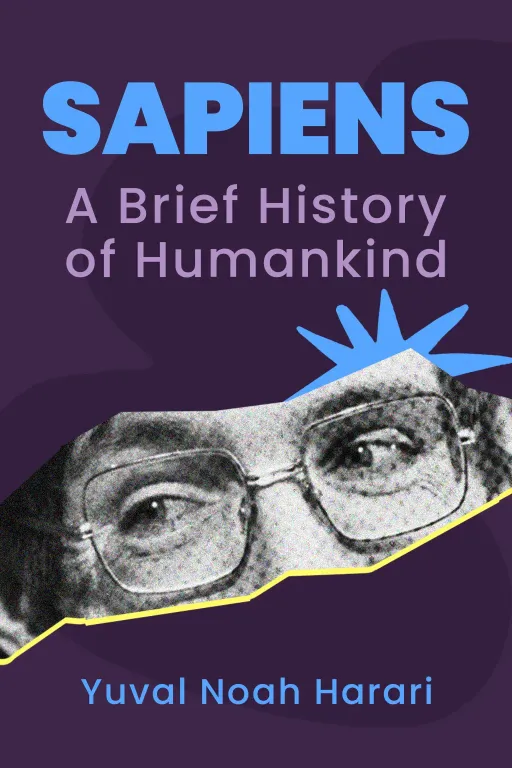
Nova: That's exactly the blind spot many of us have, Atlas. And it’s what two truly groundbreaking books illuminate so powerfully. We're talking about by Yuval Noah Harari, and by Jared Diamond.
Atlas: Ah, Harari and Diamond. Both massive, influential reads.
Nova: Absolutely. Harari, originally a medieval historian, actually developed the ideas for from a world history course he taught to undergraduates. Its unexpected global success, translated into over 60 languages, shows how a fresh, interdisciplinary perspective can completely revolutionize our understanding of vast subjects. It’s not just for academics; it changed how millions thought about humanity.
Atlas: That’s amazing. And Diamond, too, isn't he a physiologist?
Nova: He is! Jared Diamond, a physiologist and ornithologist, was prompted to write by a direct question from a local politician in Papua New Guinea: "Why is it that you white people developed so much cargo and brought it to New Guinea, but we black people had little cargo of our own?" That personal, direct question fueled his decades-long quest to understand the deep historical roots of societal differences, making his book a powerful example of interdisciplinary inquiry driven by real-world curiosity.
Atlas: That’s a fantastic origin story for both books, honestly. It grounds them. So, these aren't just history books in the traditional sense, then? They're more about understanding the that shape us?
Nova: Exactly. They reveal that our present culture is a direct, often unconscious, product of these historical forces. And when you start seeing history this way, it offers a richer context for everything, including how we understand modern cultural phenomena, visual narratives, and even our own creative work.
Shared Fictions & Cultural Constructs (Inspired by Sapiens)
SECTION
Nova: Let's start with Harari's concept of "shared fictions" from. He argues that what truly allowed humans to dominate the planet isn't our individual intelligence, but our unique ability to believe in collective myths. These aren't lies; they're stories we all agree to believe, and they become incredibly powerful.
Atlas: Shared fictions? Like, a collective hallucination? That sounds a bit cynical for something that builds societies.
Nova: Not cynical, just deeply insightful. Think about money, for example. What is a dollar bill, or a digital number in a bank account? It's just paper, or pixels. It has no inherent value. But because billions of people it has value, because we've all agreed to this shared story, it enables complex global trade, massive construction projects, and entire economies.
Atlas: Okay, I see what you mean. We all just collectively decide it’s worth something, and poof, it is.
Nova: Precisely. Harari details how money's evolution, from ancient Mesopotamian barley receipts to modern cryptocurrencies, is a testament to this power. It’s a story where the value isn't intrinsic, but. It exists in the shared consciousness between people. This fiction allowed strangers to cooperate on a scale that no other species can manage. Without it, you couldn't have global supply chains or even a large city.
Atlas: That’s wild. So, it's not even about the physical object, but the we tell about it. That resonates with me as someone who thinks about visual narratives. If money is a fiction, what about something like a nation?
Nova: Nations are another prime example. A country isn't a biological entity; you can't point to "France" and say, "There it is, a natural organism." It's an imagined community, a story we tell ourselves about shared heritage, values, and destiny. Yet, we create flags, anthems, national holidays – all these symbols and rituals to reinforce this powerful, invisible bond. People will fight and die for these fictions.
Atlas: That's incredible. The power of a story, even an imagined one, to command such loyalty. But if it's all "fiction," why do we fight wars over it? What does that mean for how we perceive "truth" in our visual world, when things like national identity are so deeply ingrained?
Nova: It means the power of these fictions is immense, Atlas. They have tangible, sometimes brutal, impacts because they shape our reality. They dictate who we trust, who we go to war with, and how resources are distributed. For a visual storyteller, understanding this means recognizing that many of the powerful symbols and narratives we encounter daily – from brand loyalty to political iconography – are built upon these deep historical layers of shared belief. It’s about seeing the invisible architecture behind the visible.
Geographical & Environmental Determinants (Inspired by Guns, Germs, and Steel)
SECTION
Nova: Now, while Harari shows us the power of human-created fictions, Diamond, in, pivots to the profound, often unconscious, influence of the physical world itself. He argues that the fates of human societies were largely shaped by geography and environment, not inherent racial superiority or intelligence.
Atlas: Hold on. So, are you saying human ingenuity doesn't matter as much as where you were born? That feels like a radical claim.
Nova: It's not about denying human ingenuity, but about understanding the stage upon which that ingenuity plays out. Diamond’s core argument is that disparities in development across continents stemmed from differences in domesticable plants and animals, and the geographical ease with which these innovations could spread.
Atlas: Can you give an example? That sounds a bit abstract.
Nova: Think about Eurasia versus the Americas. Eurasia has a vast east-west axis, with similar climates and ecosystems stretching across thousands of miles. This allowed crops like wheat and barley, and animals like cattle and horses, to spread rapidly across the continent. Innovations in agriculture, technology, and writing could be adopted quickly from one end to the other.
Atlas: Right, so if you had a good idea in Persia, it could easily get to Spain.
Nova: Exactly. Now compare that to the Americas, which have a north-south axis. Spreading crops from, say, Mexico to the Andes involved traversing vastly different climates – deserts, jungles, mountains. It was a much slower, more difficult process. The llama, for instance, never made it out of the Andes to the North American plains. This geographical difference laid the groundwork for vastly different societal developments and power dynamics over millennia.
Atlas: That’s a bit mind-blowing. I never considered how the of a continent could have such a profound impact on history. So, it’s not just about what resources you have, but how easily you can share and build upon them?
Nova: Exactly. And this leads to another brutal, often unconscious, historical advantage: disease. Long exposure to domesticated animals in Eurasia meant populations developed immunities to diseases like smallpox and measles. When Europeans arrived in the Americas, these diseases, carried by settlers and their animals, absolutely devastated indigenous populations who had no prior exposure or immunity.
Atlas: Wow, that’s heartbreaking. So, conquest wasn't just about superior weapons, but also about invisible biological advantages rooted in thousands of years of geographical and environmental factors. It makes you realize how deep the layers of context go.
Nova: It does. It shows that even events we perceive as purely human-driven often have these immense, invisible backdrops shaped by environmental forces that were set in motion long before any human even conceived of a nation or a dollar. It means that when we look at a modern cultural phenomenon, say, global inequalities, we're not just looking at recent history, but millennia of geographical luck and environmental constraints.
Synthesis & Takeaways
SECTION
Nova: So, when we combine Harari's insights into our shared fictions with Diamond's understanding of geographical determinants, a powerful picture emerges. Our current cultural phenomena – from the global spread of a particular cuisine to the enduring power of national identities – are a product of both the stories we've collectively agreed upon and the physical stage we inherited.
Atlas: That’s a really elegant synthesis. It’s like, we build our elaborate cultural narratives, but we build them on a foundation that geography laid down thousands of years ago. So, when we look at something like the global spread of a particular cuisine, we're not just looking at taste or marketing. We're seeing centuries of trade routes, the availability of certain crops, and the cultural fictions that made certain ingredients desirable.
Nova: Absolutely. Recognizing these invisible forces gives us a much richer context for understanding everything. It helps us see that the "living legacy" of history isn't just about what happened, but about how those past events and conditions are actively shaping our present beliefs, structures, and even our visual narratives. It empowers us to understand the deep "why" behind the "what."
Atlas: That's a profound shift in perspective. It means we're not just passive observers of history, but active participants in its ongoing story, and our current creations are part of that living legacy.
Nova: Precisely. And that's our challenge to you, our listeners. Consider a modern cultural phenomenon you find fascinating—maybe it's a social media trend, a specific artistic movement, or even a culinary tradition. How might its roots trace back to these ancient historical developments, to the shared fictions we believe, or the geographical stage on which humanity evolved?
Atlas: We'd love to hear your insights! Share your observations with us on social media. Let's start a conversation about how we can all become better at seeing the living legacy of history in our everyday lives.
Nova: This is Aibrary. Congratulations on your growth!