The 'History Repeats' Trap: Why You Need to See Patterns, Not Just Events.
8 minGolden Hook & Introduction
SECTION
Nova: "History repeats itself." We hear it all the time. It’s practically a cliché. But what if that phrase is actually a trap, a blind spot that prevents us from truly understanding the world around us?
Atlas: Wait, hold on. Are you saying history repeat itself, or that we're just really bad at spotting the reruns? Because my credit card statement feels like a very persistent rerun.
Nova: Exactly! It’s not that history repeat, it’s that we often fail to recognize the that cause the repetition. We see the events, but we miss the underlying forces. And that, Atlas, makes us incredibly vulnerable.
Atlas: That makes me curious. I’m picturing myself constantly tripping over the same rug and blaming the rug, instead of realizing I always walk that path with my eyes glued to my phone.
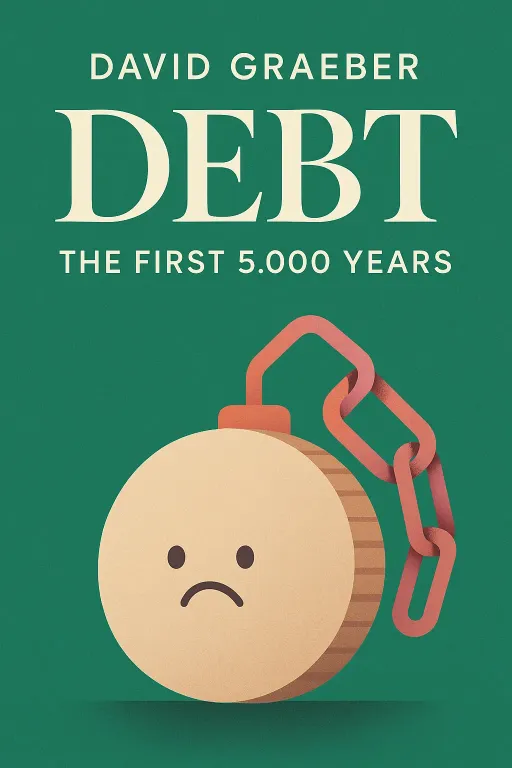
Nova: A perfect analogy! And that’s exactly the kind of shift in perspective we’re talking about today. We’re going to look at how two truly groundbreaking books help us make that shift: David Graeber’s monumental, and Jared Diamond’s Pulitzer Prize-winning.
Atlas: Graeber’s work is fascinating because he was an anthropologist, right? He looked at economic history through such a unique lens, and the book was practically a lifetime's culmination, published not long before his passing. Diamond, on the other hand, just completely reframed how we think about civilization itself.
Nova: Absolutely. Both authors force us to move beyond surface-level events and see the profound, often hidden, drivers of historical and current events. They’re like pattern-recognition machines for the human story.
The 'History Repeats' Blind Spot: Why We Miss the Patterns
SECTION
Nova: So, let’s dig into this blind spot first. Why are we so prone to seeing history as just "one darn thing after another," as that famous quote goes, instead of a tapestry of interconnected patterns?
Atlas: I mean, it feels natural, doesn't it? News cycles focus on today’s headlines, not the deep historical currents that led to them. It's hard to zoom out when you're caught in the daily grind.
Nova: It is. Our brains are incredibly good at processing immediate, discrete events. It’s what kept our ancestors alive, reacting to the rustle in the bushes. But that same wiring can make it difficult to perceive the slow-moving, systemic forces that shape our lives over decades, centuries, even millennia.
Atlas: So it's like, I notice my car tire is flat. And then it's flat again next month, but I just see two separate flat tires, not the recurring pattern that I keep driving over the same pothole on Oak Street.
Nova: Exactly! You're focused on the of the flat tire, not the of your route and road conditions. In history, this means we might see a financial crisis as an isolated incident, or a war as a unique conflict, without recognizing the recurring economic cycles, geopolitical pressures, or social inequalities that have fueled similar events throughout time.
Atlas: That makes me wonder. If these patterns are so fundamental, why don't we see them more clearly? Is it a lack of information, or something deeper about how we interpret it?
Nova: I think it's a bit of both, but primarily about the interpretation. We're given mountains of data, but often without the framework to connect the dots. These books offer that framework. They provide the lens to look the events and the patterns. It's like being given a treasure map but never told to look for the X.
Unveiling Deep Patterns: Debt, Geography, and the Forces Shaping Our World
SECTION
Nova: And this is where those books we mentioned come in, acting like pattern-recognition machines for history. Let’s start with David Graeber’s. He profoundly challenges how we understand debt.
Atlas: I’ve always thought of debt as a pretty straightforward economic concept: I borrow money, I owe money. What’s Graeber’s big pattern revelation there?
Nova: He flips that on its head. Graeber argues that debt isn't just an economic transaction; it’s a moral and social relationship that has shaped societies for millennia. He shows that many of our modern economic systems are rooted in ancient patterns, not just recent innovations. He argues that the very concept of money often arose debt, not the other way around.
Atlas: Whoa. So basically, the idea of "I owe you" is older and more fundamental than the idea of "I'll pay you"? That’s a huge reframing.
Nova: It is. And he illustrates this with incredible detail. For instance, he delves into ancient Mesopotamia, where debt wasn't just a personal burden, but a societal one. Kings would periodically declare "debt jubilees," wiping the slate clean for everyone, especially farmers, to prevent widespread social collapse and rebellion.
Atlas: A debt jubilee? That sounds almost utopian compared to modern debt crises. So, the pattern he’s highlighting is a cyclical one: debt accumulates, causes social tension, and then societies find ways to reset, often violently or through these jubilees, only for the cycle to begin anew?
Nova: Exactly! He shows this isn't a one-off event. It’s a recurring pattern where the accumulation of unpayable debts leads to social unrest, and societies either find a way to forgive those debts or face violent upheaval. It makes you look at student loan debt or national debt in a completely different light, doesn't it? It's not just numbers on a ledger; it's a deeply ingrained social dynamic.
Atlas: That’s actually really inspiring, in a strange way. It suggests there are historical precedents for large-scale debt forgiveness. And that naturally leads us to another master of pattern recognition, Jared Diamond, with. How does he reveal deep patterns, but from a completely different angle?
Nova: Diamond takes a sweeping, macro view, looking at why some civilizations developed "guns, germs, and steel" and others didn’t. His core argument is that it wasn't about inherent superiority of any people, but about geographic and environmental factors. He reveals deep historical forces that continue to influence global power dynamics today.
Atlas: So, less about human choices and more about, like, continental real estate?
Nova: Precisely. Take the differing fates of Eurasia and the Americas. Eurasia, with its expansive East-West axis, allowed for the rapid spread of domesticated crops, animals, and technologies because climates and day lengths were similar across vast distances.
Atlas: Right, so a crop that thrives in Spain could easily be grown in China, because they're on roughly the same latitude.
Nova: Exactly. But in the Americas, the North-South axis meant vastly different climates as you moved from, say, Peru to Mexico. This made it much harder for crops like corn to spread quickly, slowing agricultural development and, by extension, the rise of complex societies capable of supporting large populations and specialized labor.
Atlas: Wow. So something as seemingly simple as the orientation of a continent had this profound, long-term impact on everything from food production to technological innovation, shaping power dynamics for thousands of years. It completely reframes the narrative of "conquest" and "dominance."
Nova: It does. Both Graeber and Diamond, in their own ways, are saying: stop looking at the trees, look at the forest. Stop fixating on individual battles or economic crises, and start tracing the lines of debt, geography, and environment that create the conditions for those events to happen again and again.
Synthesis & Takeaways
SECTION
Nova: So, what both of these incredible books teach us, despite their vastly different subjects, is to look for the invisible threads connecting events. They reveal that many of our "new" problems are actually echoes of ancient patterns. Understanding those patterns isn't just academic; it’s crucial for navigating our present and shaping our future.
Atlas: It’s empowering, really. It means we’re not just victims of random historical quirks. If we can identify the patterns – whether it's the cyclical nature of debt or the enduring influence of geography – we can start to anticipate, and perhaps even deliberately alter, the outcomes. It gives us agency.
Nova: Exactly. It's about transcending the "history repeats" trap by understanding it repeats, and then using that knowledge to build a more resilient and equitable future. It's the ultimate form of critical thinking.
Atlas: That makes me wonder: what contemporary challenge are facing, personally or globally, that might reveal its true nature if you looked beyond the events and started searching for the patterns?
Nova: That’s a powerful question for all of us. This is Aibrary. Congratulations on your growth!