

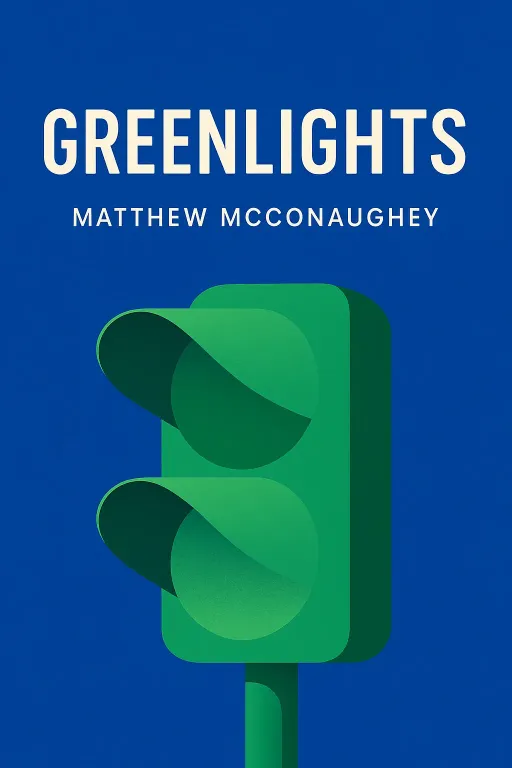
** Needs to be specific, engaging, and connect the book's philosophy with the guest's design/growth mindset. "Designing Your Greenlights: An Outlaw's Guide to Personal Growth" captures this. It uses book-specific terms ("Greenlights," "Outlaw") and connec
Golden Hook & Introduction
SECTION
Nova: xp7df6ryd4, as a UX designer, you spend your days making experiences more intuitive and satisfying for others. But what if we could apply that same design thinking to our own lives? What if life's biggest setbacks—the red lights—aren't bugs, but features in disguise, just waiting for us to understand their purpose?
xp7df6ryd4: That’s a fascinating question, Nova. It reframes everything. We’re so used to seeing obstacles as failures, but in design, an obstacle is just a problem statement. It’s the starting point for innovation.
Nova: Exactly! And that's the core idea of Matthew McConaughey's unconventional memoir,. He calls it an "approach book," which I love. It's not just stories; it's a philosophy built on 35 years of his personal journals—a massive dataset of life experiences. Today we'll dive deep into this from two perspectives. First, we'll explore his 'Greenlight' system as a design framework for navigating life's journey.
xp7df6ryd4: I'm already intrigued. A framework is something I can work with.
Nova: Then, we'll discuss the counter-intuitive power of 'Outlaw Logic' and how strategically pivoting, or even 'un-branding' yourself, can lead to your greatest breakthroughs. It’s all about learning to live with greater satisfaction.
Deep Dive into Core Topic 1: The 'Greenlight' System
SECTION
Nova: So let's start with this core concept. What exactly a greenlight? In McConaughey's world, greenlights are affirmations. They're signs that say 'yes,' 'proceed,' 'more, please.' They can be successes, moments of joy, or even just a feeling of being on the right path. But the real genius of his system is how he treats yellow and red lights.
xp7df6ryd4: The cautions and the full stops.
Nova: Right. He doesn't see them as just negative. He has this incredible quote: "The problems we face today eventually turn into blessings in the rearview mirror of life. In time, yesterday’s red light leads us to a greenlight." He believes red and yellow lights are often future greenlights in disguise. A crisis, a failure, a delay—they all contain lessons that, if learned, can propel you forward later.
xp7df6ryd4: That's so true in design. A user complaint—a 'red light'—is frustrating in the moment, but it's also invaluable data. It shows you exactly where the system is broken and gives you a clear problem to solve. You can't design a better product without understanding where the current one fails. Reframing it that way is key.
Nova: It really is. And he argues that catching greenlights isn't just about luck. He says it's a combination of skill, timing, and fate. And when we hit a red light, we have a choice. He lays out a simple decision tree: persist, pivot, or concede. You can try to power through it, you can change direction, or you can accept it and move on.
xp7df6ryd4: I appreciate that framework. It's a logical decision tree, which appeals to my ISTJ side. But the hard part is knowing which to choose, right? How do you know if you should persist through a red light or pivot? Is there a metric for that, or is it just intuition?
Nova: That's the million-dollar question. I think for him, the answer lies in the data collection. He kept journals for 35 years, and he has this amazing quote about it: "I never wrote things down to remember; I always wrote things down so I could forget."
xp7df6ryd4: Oh, I love that.
Nova: Isn't it great? It’s not about creating an archive of grievances. It’s about processing. By writing it down, he's externalizing the problem, looking at it objectively, and then letting it go. It's like running a diagnostic on your own life. Over time, you start to see patterns in the data. You learn to recognize which red lights are temporary roadblocks and which are signs you're on the wrong highway entirely.
xp7df6ryd4: So the journal is his personal analytics dashboard. He's tracking the user journey of his own life. That makes so much sense. You build an intuitive understanding over time by consistently reviewing the data. It’s not just a feeling; it’s an informed intuition.
Nova: Exactly. It's a design process. You test, you get feedback, you analyze, and you iterate. And that idea of pivoting when the data tells you to is the perfect bridge to his next big concept.
Deep Dive into Core Topic 2: Outlaw Logic & The Power of the Pivot
SECTION
Nova: This next idea is what he calls 'Outlaw Logic.' It's about knowing when the rules—even your own successful rules—no longer serve you. And the best story to illustrate this is his own career pivot.
xp7df6ryd4: I'm ready.
Nova: So, by the late 2000s, McConaughey is the undisputed king of romantic comedies. He's making millions, he's a huge star, and he's got a formula that works. But he feels empty. The work isn't feeding his soul anymore. So he makes a terrifying decision. He calls his agent and says, "I'm not doing any more romantic comedies."
xp7df6ryd4: He’s choosing to stop what’s making him successful. That takes guts.
Nova: More than you can imagine. Soon after, he gets an offer for a new rom-com. The pay is five million dollars. He says no. The studio comes back. Eight million. He says no. They keep raising the offer... ten million, twelve million... until they finally offer him fourteen and a half million dollars for one movie.
xp7df6ryd4: Fourteen and a half million. And he said no?
Nova: He said no. And for the next twenty months, almost two years, his phone doesn't ring. Hollywood thinks he's ungrateful, or crazy, or has just quit the business. He becomes invisible.
xp7df6ryd4: Wow. That's not just saying 'no.' That's a deliberate act of un-branding. He's making himself anonymous in one category to become available for another. In the design world, that's like a company discontinuing its most popular, profitable product to force the market to see its new, more innovative line. It's incredibly risky, but if it works, it can completely redefine your identity.
Nova: And it worked! He has this perfect line for it: "The target drew the arrow. I was remembered by being forgotten." Because after that period of silence, when Hollywood had finally forgotten "shirtless rom-com guy," he started getting different kinds of calls. Calls for roles in,, and the script he'd been holding onto for years,. He completely changed his own algorithm by starving the old one.
xp7df6ryd4: That is such a powerful lesson in strategic patience. It also speaks to the importance of defining your own success metrics. The industry's metric was clearly box office revenue. His became personal and artistic fulfillment. He had to be 'self-ish,' as he puts it in the book, to realign his actions with his own values, not the market's. He was designing for a different user: himself.
Nova: That’s it exactly. He had to be willing to face a massive, long-term red light—no work, no income, being forgotten—because he knew it was the only way to get to the greenlight he truly wanted on the other side.
Synthesis & Takeaways
SECTION
Nova: So when we put it all together, we have these two powerful, interconnected ideas. First, building a system to interpret life's signals—the green, yellow, and red lights—and treating them as data, not just fate.
xp7df6ryd4: Right, becoming the lead designer of your own life's journey.
Nova: And second, having the 'outlaw' courage to pivot—to un-brand yourself—when your current, even successful, path no longer leads to fulfillment. It’s about having the clarity to know what you want and the guts to say no to everything that isn't it.
xp7df6ryd4: It really makes me think about my own life and work. What's one 'rom-com' in my life—a comfortable success or a familiar habit that might be holding me back from a more challenging, 'dramatic' role I could be playing?
Nova: That's a powerful question.
xp7df6ryd4: I think it's a question for anyone interested in growth. The book makes it clear that it's not just about passively catching greenlights that life throws at you. It’s about having the courage to create your own greenlights by choosing a different road, even if it means driving through a few red ones to get there.
Nova: Beautifully put. A perfect place to end. Thanks for designing this conversation with me, xp7df6ryd4.
xp7df6ryd4: My pleasure, Nova. Alright, alright, alright.









