

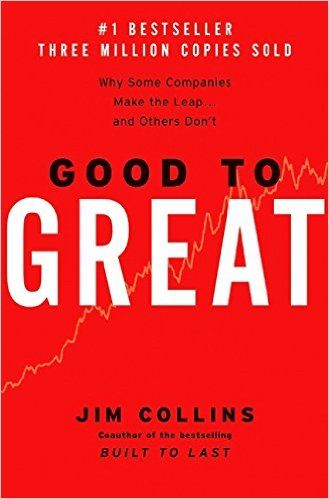
Good to Great
Why Some Companies Make the Leap... and Others Don't
Introduction
Nova: What if I told you that the most successful CEOs in American history are not the charismatic, larger-than-life personalities you see on magazine covers? What if the real secret to building a truly great company is neither a dramatic turnaround program, nor a revolutionary new technology, nor a crisis that lights a fire under everyone?
Nova: : Wait, that goes against basically everything we hear in business media. So what is the secret?
Nova: That's exactly what Jim Collins and his research team spent five years trying to figure out. They started with 1,435 companies. They combed through 40 years of financial data. And they found only 11 companies that made the leap from being good—just average—to being truly great, sustaining returns at least three times the stock market for 15 years. And the findings were so counterintuitive that Collins opens the book by saying he wants to give readers a lobotomy about change.
Nova: : A lobotomy about change? That's a strong opening. But I've heard of this book—Good to Great came out in 2001, sold over four million copies, and became one of the most influential business books of all time. Time magazine named it one of the 25 most influential management books. But I also heard some of those great companies didn't stay great.
Nova: We'll get to that. But first, let me hit you with the central finding: greatness is not a function of circumstance. It's a function of conscious choices and discipline. The 11 companies that made the leap—names like Abbott Laboratories, Kimberly-Clark, Kroger, Nucor, and Wells Fargo—didn't have miracle moments. They had something else entirely.
Nova: : Alright, I'm intrigued. Let's unpack this. What made these 11 companies different?
Level 5 Leadership and the Anti-Celebrity CEO
The Quiet Giants
Nova: So here's the first bombshell from the research. Every single one of the 11 good-to-great companies had what Collins calls Level 5 Leadership at the helm during their pivotal transition. And the profile of these leaders is nothing like what you'd expect.
Nova: : Level 5—that sounds like a ranking. What are the levels?
Nova: Collins defines a hierarchy. Level 1 is a highly capable individual. Level 2 is a contributing team member. Level 3 is a competent manager. Level 4 is an effective leader who catalyzes commitment to a clear vision. And Level 5—this is the top—is the executive who blends extreme personal humility with intense professional will.
Nova: : Humility and will? Those seem like opposites. How does that work in practice?
Nova: Think of it as a paradox. These leaders are incredibly ambitious, but their ambition is for the company, not for themselves. They're often self-effacing, quiet, reserved, even shy. Collins writes that when things go well, a Level 5 leader looks out the window and gives credit to others. When things go badly, they look in the mirror and take responsibility.
Nova: : That's the opposite of what we usually see. Most CEOs take credit for success and blame the economy or their team for failure.
Nova: Exactly. Collins uses the example of Darwin Smith at Kimberly-Clark. When Smith became CEO, the company was a stodgy paper company that had lost ground to competitors for decades. He made the audacious decision to sell the company's mills—including the very first mill in Kimberly, Wisconsin—and bet everything on consumer brands like Kleenex and Huggies. The result? Kimberly-Clark outperformed the market by 4.1 times and crushed rivals like Scott Paper and Procter and Gamble. But when asked about his success, Smith simply said he was just trying to be qualified for the job.
Nova: : That's remarkable. So these aren't the celebrity CEOs with private jets and book deals.
Nova: Not at all. Collins says that when he interviewed the good-to-great CEOs, they would talk about the company and the contributions of other executives, but they'd deflect questions about their own role. One CEO, Colman Mockler at Gillette, faced down three hostile takeover attempts and never once gave a press interview. He just quietly ran the company. And under his watch, Gillette's stock returns beat the market by 7.39 times.
Nova: : So the takeaway is: stop looking for the charismatic savior CEO. But what if you're not naturally humble? Can you learn to become Level 5?
Nova: That's the million-dollar question. Collins says some people have the seed of Level 5 and some don't. But for those who do, it can be developed through self-reflection, mentorship, significant life experiences, or even a Level 5 boss. It's not about becoming a different person—it's about evolving. And the data suggests it's worth the effort.
Getting the Right People on the Bus
Who Before What
Nova: Alright, so you've got a Level 5 leader. What's the first thing they do? Unveil a bold new strategy? Rally the troops with a vision statement?
Nova: : I'm guessing the answer is no, based on how this conversation is going.
Nova: You're learning fast. Collins found that good-to-great leaders start with who, not what. They get the right people on the bus, the wrong people off the bus, and the right people in the right seats—and then they figure out where to drive.
Nova: : That seems backwards. Don't you need to know where you're going before you decide who to bring?
Nova: Collins argues the opposite. If you start with where, you're in trouble when the world changes and you need to pivot. But if you've got the right people—people who are self-motivated, who thrive on being part of a winning team—they'll adapt to whatever direction you need to go. The book gives a powerful example: David Maxwell at Fannie Mae.
Nova: : What happened at Fannie Mae?
Nova: In 1981, when Maxwell took over, Fannie Mae was losing a million dollars every single business day. The board wanted to know his turnaround plan. Maxwell told them they were asking the wrong question. He interviewed every executive on his team and told them all the same thing: this is going to be a grueling ride, and if you don't want to be on this bus, now is the time to get off—no hard feelings. Fourteen of 26 executives left. He replaced them with top-tier talent. Then, and only then, did they figure out the strategy. The result? They went from losing a million a day to earning four million a day.
Nova: : That's a stunning turnaround. But it raises a question—how do you know who the right people are?
Nova: Collins says the right people don't need to be tightly managed. They're self-motivated by the inner drive to produce the best results. The key is rigorous hiring—not ruthless, but rigorous. The good-to-great companies were comfortable with long searches to find exactly the right person rather than rushing to fill a seat. And they were equally rigorous about moving people out when it became clear they weren't the right fit.
Nova: : But that's also where the Stockdale Paradox comes in, right? Confronting reality?
Nova: Exactly. And that's our next chapter.
Confronting Brutal Facts While Keeping Faith
The Stockdale Paradox
Nova: Let me tell you about Admiral Jim Stockdale. He was the highest-ranking American officer held in the Hanoi Hilton prison camp during the Vietnam War. He was tortured over 20 times. He spent eight years there, with no prisoner's rights, no release date, and no certainty he'd survive.
Nova: : That's a harrowing story. What does this have to do with business?
Nova: Collins met Stockdale and asked him how he survived. Stockdale said: I never lost faith that I would prevail in the end. But then Collins asked who didn't survive. And Stockdale's answer is chilling: the optimists.
Nova: : The optimists? That makes no sense.
Nova: Stockdale explained that the optimists were the ones who kept saying, we'll be out by Christmas. And Christmas would come and go. Then Easter. Then Thanksgiving. Then Christmas again. And they died of a broken heart. Stockdale's lesson: you must never confuse faith that you will prevail in the end with the discipline to confront the most brutal facts of your current reality.
Nova: : So you need both things simultaneously—unwavering faith and brutal honesty. That's a real psychological balancing act.
Nova: It is. And every good-to-great company faced significant adversity. Collins found that these companies created a climate where the truth was heard. They led with questions, not answers. They engaged in dialogue and debate, not coercion. They conducted autopsies without blame. And they built what Collins calls red flag mechanisms—systems that turn information into information that cannot be ignored.
Nova: : Can you give me an example of confronting brutal facts in a business context?
Nova: One of the best examples is Kroger. For 80 years, Kroger was an average grocery chain. Then a new CEO started asking a brutally honest question: why have we sucked for 100 years? That question led to a complete reimagining of the company. They confronted the data that showed changing consumer preferences, and they completely overhauled every single store. The result? From 1973 to 1998, Kroger outperformed the market by 10 times.
Nova: : So the lesson is: don't sugarcoat reality. But also don't lose hope. That's a powerful combination.
Finding Your One Big Thing
The Hedgehog and the Three Circles
Nova: Now we get to one of the most famous concepts from the book: the Hedgehog Concept. It comes from an ancient Greek parable and Isaiah Berlin's essay: the fox knows many things, but the hedgehog knows one big thing.
Nova: : I've heard this one. The fox is clever and devises intricate strategies, but the hedgehog just rolls up into a ball of spikes, and the fox can never win.
Nova: Exactly. And Collins found that the good-to-great companies were all hedgehogs. They took a complex world and simplified it into a single, organizing idea. But the key is that this Hedgehog Concept comes from deep understanding at the intersection of three circles.
Nova: : What are the three circles?
Nova: Circle one: what are you deeply passionate about? Circle two: what can you be the best in the world at? And circle three: what drives your economic engine? The sweet spot where all three circles overlap is your Hedgehog Concept.
Nova: : Let me guess—most companies never actually figure this out.
Nova: They don't. And Collins is very clear about something crucial: the Hedgehog Concept is not a goal, not a strategy, not an intention. It's an understanding of what you can be the best at. There's a huge difference. He writes that every company would like to be best at something, but few actually understand with piercing insight and egoless clarity what they have the potential to be the best at—and, just as important, what they cannot be the best at.
Nova: : That second part seems harder. Admitting what you can't be great at.
Nova: Collins calls it transcending the curse of competence. Just because you're good at something, just because you're making money at it, doesn't mean you can become the best in the world at it. Doing what you're good at will only make you good. Focusing on what you can potentially do better than any other organization is the only path to greatness.
Nova: : What's a real example of this?
Nova: Walgreens is a great one. Their Hedgehog Concept was simple: be the best at convenient drugstores. They didn't try to be everything. They focused on high-density, high-convenience locations, and they pioneered the drive-through pharmacy. They understood that the key economic driver was profit per customer visit, not just profit per store. That single-minded focus led to stock returns that beat Intel by two times, GE by five times, and Coca-Cola by eight times.
Nova: : So it's about disciplined focus, not trying to be everything to everyone.
How Greatness Actually Happens
The Flywheel and the Culture of Discipline
Nova: Here's Collins's most vivid metaphor. Picture a giant flywheel—a massive metal disk, 100 feet in diameter, weighing about 25 tons. That flywheel is your company. Your job is to get it moving.
Nova: : That sounds exhausting.
Nova: It is. You push and push and push. For the first day, you barely get it to inch forward. After a few days of sustained effort, you get one full rotation. You keep pushing. Two rotations, three, four, five. Then at some point—you can't even say exactly when—you break through. The flywheel's own weight starts propelling it. It spins faster and faster, and you're not pushing any harder, but the momentum keeps building.
Nova: : That's a beautiful metaphor for how real change happens. No single dramatic moment—just sustained, disciplined effort.
Nova: That's exactly what Collins found. The good-to-great companies had no name for their transformation, no launch event, no tagline. When Collins asked a Walgreens executive when the transformation happened, the answer was sometime between 1971 and 1980. They couldn't pinpoint it because it was a gradual accumulation of thousands of good decisions, not one big bang.
Nova: : And the opposite of the flywheel is the doom loop?
Nova: Yes. The doom loop is what happens when companies chase quick fixes. They launch a big change program with fanfare. It doesn't work. They bring in a new CEO with a new program. They lurch in a new direction. Disappointing results lead to reaction without understanding, which leads to another new direction. Collins uses Warner-Lambert as the cautionary tale—three major restructurings in two decades, three different CEOs, constant U-turns. They eventually got swallowed by Pfizer in 2000.
Nova: : So the flywheel requires a culture of discipline. What does that actually look like?
Nova: Collins says a culture of discipline is a duality. It requires people to adhere to a consistent system, but it also gives them freedom and responsibility within that framework. When you combine discipline with entrepreneurship, you get what Collins calls the magical alchemy of great performance. And here's the key insight: when you have disciplined people, you don't need hierarchy. When you have disciplined thought, you don't need bureaucracy. When you have disciplined action, you don't need excessive controls.
Nova: : And what about technology? That seems like the missing piece—surely these companies used technology to get ahead?
Nova: Actually, Collins found that technology was never the primary cause of greatness. The good-to-great companies avoided technology fads. They didn't use technology to ignite transformation. Instead, they carefully applied technology to accelerate their existing momentum within their Hedgehog Concept. Ironically, these companies often became pioneers in the application of technology precisely because they were so thoughtful about it.
Nova: : So technology is an accelerator, not a creator, of momentum.
When Great Companies Fall
The Elephant in the Room
Nova: Now we have to address the criticism. Because it's significant.
Nova: : Right. Circuit City went bankrupt. Fannie Mae was bailed out during the financial crisis. If you'd invested in the 11 good-to-great companies when the book came out in 2001, the economist Steven Levitt pointed out you'd have underperformed the S&P 500.
Nova: These are fair critiques. Circuit City, once a great company, is now gone. Fannie Mae lost over 80% of its value. Several of the 11 companies have had serious struggles. Collins himself later wrote a book called How the Mighty Fall, which explores why great companies can decline.
Nova: : So does that invalidate the book's findings?
Nova: I think it's more nuanced than that. Collins's defense is that the book never promised these companies would always be great—just that they were once great and that we can learn from what made them great during that specific period. But critics like Phil Rosenzweig, author of The Halo Effect, argue that Collins's methodology has a fundamental flaw: it's backward-looking. When you know which companies succeeded, you can retroactively find patterns that fit the narrative.
Nova: : That's survivor bias in action. You look at the winners after the fact and construct a story about why they won.
Nova: Exactly. Rosenzweig also points out that successful companies have the luxury of focus—they can afford to have a clear Hedgehog Concept because they're already doing well. Struggling companies might not have that option. There's also the question of whether Collins confused correlation with causation.
Nova: : But despite all that, the book has sold millions of copies and influenced countless leaders. What is it about Good to Great that resonates so deeply?
Nova: I think it's because the principles feel intuitively true, even if the methodology has flaws. The idea that humble, disciplined leaders beat flashy egomaniacs. That you should confront reality rather than hide from it. That sustained effort beats the quick fix. These aren't just business principles—they're life principles. And Collins's research, even if imperfect, gave them empirical weight.
Nova: : And his later work, like Great by Choice, tried to address some of the criticisms by looking at companies that thrived in chaotic environments.
Nova: Right. The legacy of Good to Great isn't that it gave us a perfect formula for picking winning stocks. It's that it shifted the conversation about leadership and organizational excellence. It made us question the cult of the celebrity CEO. It reminded us that greatness is a cumulative process, not a single event. And those insights, I think, have aged better than the specific companies Collins studied.
Conclusion
Nova: So let's bring it all together. Good to Great isn't really a book about business strategy—it's a book about discipline. Discipline in people, discipline in thought, and discipline in action.
Nova: : The framework is surprisingly elegant. Start with Level 5 Leadership—that paradoxical blend of humility and fierce resolve. Then get the right people on the bus before you decide where to drive. Confront the brutal facts while maintaining unwavering faith you'll prevail. Find your Hedgehog Concept at the intersection of passion, excellence, and economic drivers. Build a culture of discipline. Use technology as an accelerator, not a savior. And push the flywheel, turn by turn, until momentum takes over.
Nova: That's the blueprint. And Collins's ultimate message is that greatness is a choice. The comparison companies in his study had the same opportunities, the same market conditions, the same access to talent. What separated them was the discipline to make the right choices consistently over time.
Nova: : The book's title itself is a warning: Good is the enemy of great. Because when you're good, it's easy to get comfortable. You're making money, you're growing, people think you're doing fine. But good is the biggest obstacle to becoming great.
Nova: And that's the challenge Collins leaves us with. Whether you're running a Fortune 500 company, a nonprofit, a school, or even your own career—the question is the same. Are you satisfied with being good? Or are you willing to do the disciplined, unglamorous, sustained work of becoming great?
Nova: : This is Aibrary. Congratulations on your growth!