

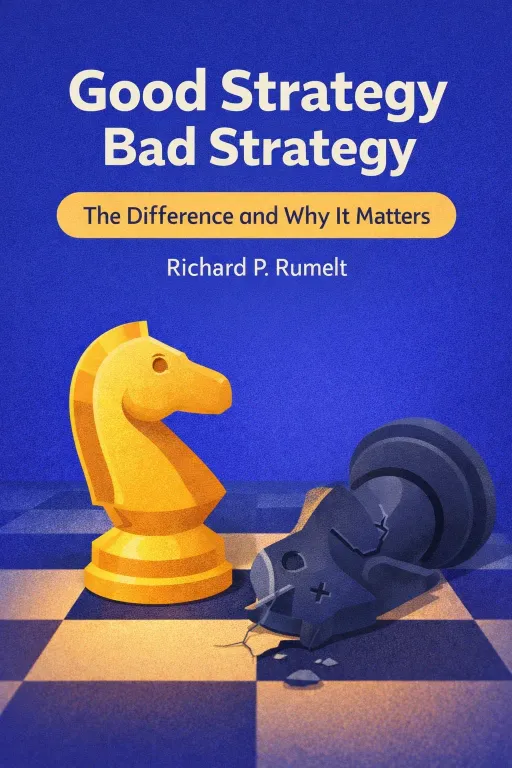
** *The Strategy Cure: Diagnosing Good and Bad Plans in Healthcare and Beyond*
Golden Hook & Introduction
SECTION
Nova: Imagine walking into a hospital with a severe, mysterious pain, and the doctor looks at you, smiles, and says, "Our strategy is to be completely pain-free by next week!" No tests, no exams, just a highly motivated, enthusiastic goal. You'd run out of there, right? Because a goal is not a cure. Yet, in the business world, we see this exact same thing happen every single day. Leaders mistake high-sounding aspirations for actual, workable strategies. Today, we are going to tackle Richard Rumelt's masterpiece,, from three distinct angles. First, we'll dissect the "Kernel" of a good strategy and why it starts with a brutal, honest diagnosis. Second, we'll explore the hidden traps of "Chain-Link Systems" where one weak link can quietly derail an entire organization. And finally, we'll look at how to train our minds to spot "fluff" and make independent, high-stakes decisions when everyone else is just following the crowd. I'm Nova, and joining me today is Danish, a healthcare professional with a brilliantly analytical mind. Welcome, Danish!
Danish: Thanks, Nova! It's great to be here. You know, that medical analogy you started with? It hits incredibly close to home. In healthcare, we are trained to be obsessively diagnostic. If you don't find the root cause of a patient's symptoms, any treatment you prescribe is just guesswork, or worse, dangerous. Reading Rumelt's book made me realize that corporate "strategy" is often missing that exact diagnostic discipline. We get so caught up in the "where we want to go" that we completely skip the "what is actually blocking us from getting there."
Nova: Exactly! It's like trying to build a house by starting with the paint color. Rumelt argues that a good strategy is actually unexpected because most organizations don't have one. They have a laundry list of wishes. So, let's dive into what he calls the "Kernel" of good strategy. It's a beautifully simple three-part framework: a diagnosis, a guiding policy, and coherent action. Danish, as a thinker, how did that structure resonate with you when you first looked at it?
Danish: It felt incredibly logical, almost like the scientific method applied to business. Rumelt defines the diagnosis as identifying the critical challenge. It simplifies an overwhelming, messy reality into a single, solvable problem. Once you have that, the guiding policy is your overall approach to dealing with that obstacle—it's like the treatment plan. And finally, the coherent actions are the specific, coordinated steps to carry out that policy. If you're missing any of these three, the kernel is misshapen, and the strategy falls apart.
Deep Dive into Core Topic 1
SECTION
Nova: It really is a chain of logic. And to illustrate this, Rumelt uses one of the most famous business turnarounds in history: Steve Jobs saving Apple in 1997. Now, we all think of Apple today as this massive, unstoppable giant, but back in '97, they were literally two months from bankruptcy. They were bleeding cash, and their product lineup was a total disaster. They had fifteen different desktop models, dozens of portables, printers, servers... it was absolute chaos. So, Jobs comes back as interim CEO. What does he do? Does he launch a massive marketing campaign? Does he announce a futuristic, sci-fi product? No. He does something completely unexpected. He slashes the product line by eighty percent.
Danish: That's the part that fascinates me. He diagnosed the problem not as a lack of marketing, but as excessive complexity and cash bleed. His diagnosis was simple: "Apple is trying to do too much, and we are running out of money." The guiding policy he chose was radical simplification—focusing only on a tiny, sustainable core. And the coherent actions? He cut fifteen desktop models down to just one, the Power Mac G3. He cut all portable models down to one laptop. He fired the engineers working on printers and peripherals, shut down distributors, and moved manufacturing offshore to Taiwan. He literally cleared the deck so they could breathe.
Nova: It was incredibly brave. He had to say "no" to so many people, including his own engineers and loyal customers. But by concentrating all of Apple's limited resources on just four basic products—consumer desktop, consumer portable, pro desktop, and pro portable—he stabilized the ship. And when Rumelt asked him about his long-term strategy, Jobs gave an answer that blew him away. He didn't give a five-year financial projection. He just said, "I am going to wait for the next big thing."
Danish: That is pure strategic patience. As an INTP, I absolutely love that. It shows he understood that you can't force a window of opportunity to open. You have to survive, build a strong position, and be ready to strike when the landscape shifts. And of course, that "next big thing" eventually became the iPod, the iPhone, and the iPad. But none of that would have been possible if he hadn't ruthlessly diagnosed the cash bleed in 1997 and taken coherent, painful actions to stop it.
Nova: It's a perfect example of how a good strategy is about focus and choice. But let's bring this back to your world, Danish. In healthcare, you're dealing with incredibly complex systems. How does this "Kernel" concept—especially the diagnosis part—apply to the challenges you see on the ground?
Danish: Oh, it's highly applicable. Think about a hospital trying to reduce patient wait times in the Emergency Department. A "bad strategy" approach would be to set a goal: "We will reduce wait times by thirty percent this year!" and then put up motivational posters telling everyone to work faster. That's not a strategy; it's just pressure. A "good strategy" starts with a diagnosis. Is the bottleneck a lack of beds upstairs to admit patients? Is it a delay in getting lab results back? Or is it a staffing issue during peak hours? If the diagnosis is that lab turnaround times are slow, the guiding policy might be to prioritize ED lab samples. The coherent actions would involve redesigning the lab's workflow, dedicating a specific technician to ED samples, and integrating the software systems. You are focusing your energy on the specific pivot point that will multiply the effectiveness of your effort.
Nova: I love that. You're diagnosing the system, not just demanding more effort from the people inside it. And that actually leads us beautifully into our second core topic: "Chain-Link Systems." Rumelt explains that some systems are like a chain, where the overall strength is strictly limited by the weakest link. If you have a weak link, strengthening the other links doesn't make the chain any stronger. In fact, it's a waste of resources.
Deep Dive into Core Topic 2
SECTION
Danish: This concept is so powerful, Nova. In economics and systems engineering, it's often called "quality matching." If you have a complex process, and one step is highly prone to error, investing millions to make the other steps ninety-nine percent perfect actually yields zero return on investment. The system still fails at the weak point.
Nova: Exactly! And the most tragic, vivid example of this is the Space Shuttle Challenger disaster in 1986. The Challenger was this marvel of modern engineering—millions of parts, incredibly advanced guidance systems, state-of-the-art booster engines, and a highly trained crew. But on that cold January morning, just seventy-three seconds after liftoff, it exploded. And the cause? A single, small rubber O-ring in the right solid rocket booster failed because of the cold weather. The hot gas breached the seal, and the entire system was lost.
Danish: It's a chilling reminder of chain-link logic. You could have the most advanced guidance computer in the world, the most aerodynamic hull, the most brilliant astronauts—none of it mattered because the O-ring was the weakest link. And Rumelt points out that in a chain-link system, if you are a manager of one of the strong links, you actually have a disincentive to make your link even better if the weak link isn't being fixed. Why spend your budget improving your department's efficiency if the overall organization is still going to get stuck at the bottleneck?
Nova: That is such a profound organizational insight. It explains why so many large companies get "stuck" in a state of low effectiveness. Everyone is doing their own job, maybe even doing it well, but because there's no central coordination to identify and fix the bottlenecks sequentially, the whole system stagnates. Rumelt talks about how General Motors struggled with this for decades. They would improve the fit and finish of their cars, but the designs were still boring. Or they'd improve the engines, but the dashboard knobs would still fall off. It was a constant game of whack-a-mole because they weren't treating the company as an integrated, chain-linked design.
Danish: Yes! And to get a chain-link system unstuck, you can't rely on decentralized, incremental improvements. You need strong, centralized leadership to step in, take personal responsibility, and run sequential, focused campaigns. Rumelt shares the story of Marco Tinelli, who turned around a struggling Italian machinery company. Tinelli didn't try to fix everything at once. He ran three distinct, year-long campaigns. Year one was purely about quality—making the machines the most reliable in the industry. There were no immediate profits, but it fixed the first link. Year two was about training the sales force to leverage that new quality. And year three was about cost reduction, bringing tool manufacturing in-house to make the business highly competitive. He focused the entire company's energy on one bottleneck at a time.
Nova: It's like a master class in focus. And it really highlights why "bad strategy" is so common. It's because fixing a chain-link system is incredibly hard work. It requires making difficult choices, saying "no" to competing interests, and absorbing short-term losses or criticisms while you wait for the sequential campaigns to pay off. Most leaders would rather just fill a template with vague, comforting words.
Danish: Oh, the "template-style" strategy! Rumelt is absolutely ruthless about this, and I was cheering while reading it. You know the drill: Vision, Mission, Values, and Strategies. You fill in the blanks with words like "innovative," "customer-centric," and "global leader." It's what Rumelt calls "fluff"—a form of gibberish masquerading as high-level thinking. It uses inflated, abstruse language to create the illusion of substance, but when you look closely, there's no actual diagnosis of a challenge, and certainly no coherent action.
Nova: It's "Sunday words," as he calls them! Like a bank describing its strategy as "customer-centric intermediation." Which literally just means "we take money from depositors and lend it to borrowers, and we try to be nice about it." That's not a strategy; that's just a description of being a bank!
Danish: Exactly. It's like a hospital saying its strategy is "to provide world-class, compassionate care to every patient." That's beautiful, and it's a wonderful mission, but it's not a strategy. A strategy would be: "Our community has a high rate of diabetic complications, and our local clinics are overwhelmed. We will focus our resources on establishing a specialized, mobile diabetic care network to treat patients in their neighborhoods, reducing hospital admissions by twenty percent." That is a strategy. It diagnoses a specific challenge, sets a guiding policy, and outlines coherent, measurable actions.
Synthesis & Takeaways
SECTION
Nova: That is a perfect, clinical-grade strategy right there! It's clear, it's focused, and it's actionable. And this brings us to our final segment: how do we, as individuals, train our minds to think like strategists? How do we avoid the "inside view" and the "social herding" that leads to so much bad decision-making? Rumelt suggests that we need to treat our strategies as scientific hypotheses. Danish, this feels like it was written specifically for your analytical, INTP brain.
Danish: It really does. Treating a strategy as a hypothesis means you accept that it's an educated guess, not a certainty. And the only way to validate a hypothesis is through empirical testing and real-world data. He uses the story of Howard Schultz and the genesis of Starbucks. When Schultz went to Italy, he noticed this vibrant, social espresso bar culture. It was an "anomaly" compared to the cheap, bland, instant coffee culture in America at the time. Schultz hypothesized that Americans would pay a premium for that Italian espresso experience. But he didn't just launch a massive, nationwide chain overnight. He started with one shop, called Il Giornale, and treated it as a living experiment.
Nova: Yes! He gathered data constantly. And he realized that the pure Italian model didn't quite work for Americans. In Italy, people stand at the bar, drink their espresso in thirty seconds, and leave. There was opera music playing, and the waiters wore formal bow ties. Americans wanted to sit down, they wanted to customize their drinks with nonfat milk, and they wanted paper cups to take their coffee to go. So, Schultz adapted. He removed the opera music, added chairs, introduced paper cups, and localized the concept. He refined his hypothesis based on empirical feedback until he had a model that could scale into the Starbucks we know today.
Danish: It's a perfect example of scientific empiricism in business. He didn't let his initial "vision" blind him to the actual data his customers were giving him. And that's the key to avoiding what Rumelt calls the "inside view"—the belief that your project, your company, or your situation is so special that general rules and historical data don't apply to you. We see this in healthcare all the time, and certainly in the wider business world. People launch massive initiatives convinced they will succeed, ignoring the fact that eighty percent of similar initiatives have failed in the past. They think, "Well, those statistics don't apply to us because we are different."
Nova: It's the classic "this time is different" trap. And it's often fueled by "social herding," where everyone in an industry is just copying each other, assuming that the "other guy" must have done the research. It's how we get massive financial bubbles, like the fiber-optic telecom bubble in the late nineties, or the housing crisis in 2008. Everyone was just following the crowd, abandoning their independent judgment to the excitement of the herd.
Danish: Yes, and to combat that, Rumelt suggests some incredibly practical mental techniques. One of my favorites is the "virtual panel of experts." When you are facing a complex problem, imagine how a group of people you deeply respect would diagnose it. You could invoke Steve Jobs, or a brilliant mentor, or an expert in your field. By holding a mental dialogue with these diverse personalities, you force yourself to look at the problem from multiple "corner solutions" rather than just latching onto the first comfortable idea that pops into your head. It helps you overcome "quick closure" and cognitive myopia.
Nova: It's like having a board of directors in your own head! And another great tool he mentions is "pre-commitment." Before you enter a meeting or seek out more information, write down your explicit judgment or prediction about the situation. That way, when the reality unfolds, you can't look back and say, "Oh, I knew that would happen." It forces you to confront the gaps in your own judgment and actively learn from your mistakes.
Danish: That is such a powerful way to calibrate your thinking over time. It turns every decision into a learning opportunity.
Nova: It really does. Well, Danish, we have covered some incredible ground today. From the three-part "Kernel" of strategy, to the hidden bottlenecks of "Chain-Link Systems," to the discipline of treating our plans as testable hypotheses. If you had to leave our listeners with just one actionable takeaway from Richard Rumelt's work, what would it be?
Danish: I would say, the next time you are handed a "strategic plan" or are asked to create one, look past the goals, look past the inspiring vision statements, and ask yourself one simple, diagnostic question: "What is the critical challenge we are actually trying to solve here, and what are the coordinated, concrete actions we are taking to overcome it?" If you can't answer that, you don't have a strategy—you just have a wish list.
Nova: A wish list indeed! Danish, thank you so much for sharing your analytical insights and clinical perspective with us today. This has been an absolutely fascinating conversation.
Danish: Thank you, Nova. I really enjoyed it!
Nova: And to our listeners, thank you for tuning in. Remember, a good strategy isn't about having the loudest cheer or the grandest ambition; it's about having the sharpest diagnosis and the courage to focus your energy where it truly matters. Until next time, keep analyzing, keep questioning, and keep curing those bad strategies!