

Unmasking Market Dynamics: Beyond the Obvious Trends.
Golden Hook & Introduction
SECTION
Nova: Atlas, what's your gut reaction when you hear the word 'strategy'? Be honest.
Atlas: Honestly, Nova? It often feels like a fancy word for 'a longer to-do list that we'll abandon next quarter.' Or worse, 'chasing whatever shiny new trend the competition just announced.' It's exhausting.
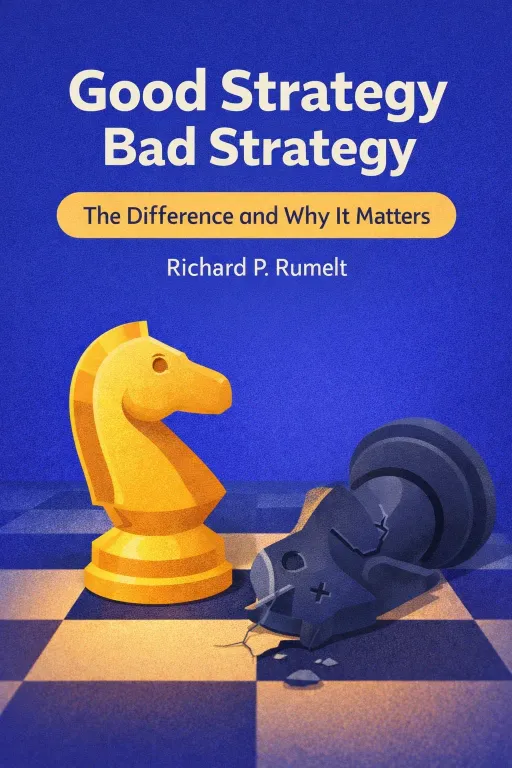
Nova: Ah, the ghost of operational effectiveness haunting the halls of true strategic thinking! What if I told you that very feeling, that exhaustion and trend-chasing, is precisely the 'blind spot' Richard Rumelt warns against in his groundbreaking book, "Good Strategy Bad Strategy"?
Atlas: Oh, I like that. The 'blind spot.' Tell me more.
Nova: Rumelt, a former military strategist turned business professor, saw through the corporate jargon to reveal that most so-called 'strategies' are just goals or generic best practices. He argued that true strategy is a coherent action plan, not just a set of aspirations. It's about confronting a critical challenge head-on, not just managing tasks.
Atlas: So, it's not about having a vision board, it's about having a battle plan? For someone trying to balance a million demands and build a lasting foundation, that distinction feels pretty critical.
Nova: Absolutely. And that leads us directly into our first core idea: the critical difference between strategic clarity and the illusion of operational effectiveness.
Strategic Clarity vs. Operational Illusion
SECTION
Nova: Rumelt often uses the analogy of a ship. Operational effectiveness is making sure your ship is sailing efficiently – clean decks, well-maintained engines, everyone rowing in sync. But strategy? That's knowing you're going and, and more importantly, how to navigate the storms to get there. He calls 'bad strategy' a 'fluff' that avoids the hard work of diagnosis.
Atlas: Fluff. I like that. That's a great way to put it. So, for a builder, it’s the difference between efficiently laying bricks versus knowing if you're building a shed or a skyscraper. But how do you the real challenge? It feels like we're constantly putting out fires.
Nova: Precisely. Rumelt gives a fantastic, if somber, example: the US military's approach to the Vietnam War. Their stated strategy was essentially 'more resources, more pressure.' But the real challenge wasn't a lack of resources; it was the nature of guerrilla warfare and the political will of the North Vietnamese. They kept optimizing their operational effectiveness—more bombs, more troops—but without a guiding policy that addressed the challenge, it was doomed to fail.
Atlas: Wow, that's a powerful and frankly, a bit chilling, example. So, a 'guiding policy' isn't just a goal like 'win the war.' It's the you're going to win, specifically tailored to the diagnosed problem. It implies a deep understanding of the situation.
Nova: Exactly. It's the intellectual work of identifying the specific obstacle, and then designing a coordinated set of actions to overcome it. For our listeners who are constantly balancing competing demands, this means pausing to ask: 'What is the problem we're trying to solve here? Not just the symptom, but the root cause?' It's about the discernment Atlas, which your instincts are already honed for.
Atlas: That sounds like it requires protecting a lot of 'white space' for thinking, which is a big recommendation for our strategist listeners. It’s not just things efficiently, it’s effectively. It's about challenging the assumption that more effort automatically means better results. But once you have that guiding policy, how do you know if it's actually any good, or if it will hold up in the real world?
Shaping Your Market: The Power of Porter's Five Forces
SECTION
Nova: That's a brilliant segue, Atlas, because once you have that internal clarity, you need to look outwards. And no one taught us to analyze the external landscape better than Michael Porter with his "Competitive Strategy" and the Five Forces. This isn't just about reacting to the market; it's about understanding its fundamental structure to find a sustainable competitive advantage.
Atlas: Ah, Porter's Five Forces. Bargaining power of buyers, bargaining power of suppliers, threat of new entrants, threat of substitute products or services, and rivalry among existing competitors. This feels like the ultimate toolkit for a builder looking to anchor their product's future, as our listener profile suggests. It’s about building a strong foundation.
Nova: It is! Think of it like this: if Rumelt helps you understand your internal 'ship' and its true destination, Porter helps you understand the 'ocean' you're sailing on—its currents, its predators, and its hidden treasures. For example, consider the airline industry. High threat of new entrants due to massive capital requirements? Not really. But intense rivalry among airlines, high bargaining power of buyers who can easily compare prices, and strong threat of substitutes like cars or trains? Absolutely. Understanding this structural pressure explains why airline profitability is historically so challenging, even for operationally excellent carriers.
Atlas: So, it's not just about offering cheaper tickets or better service, but about understanding the forces that shape the industry's profitability. That's a profound shift from just 'doing better' to 'playing a different, smarter game' by understanding the rules of the game itself.
Nova: Precisely. Porter's work fundamentally shifts your focus from merely reacting to market changes to proactively shaping your position within it. It's about identifying where the economic power lies and how you can either leverage it or defend against it. It's a strategic framework for identifying sustainable advantages, not just temporary wins gained from being slightly better than the competition. It's about building a defensible moat around your business.
Atlas: I can see how this would be invaluable for someone driving sustainable growth. It's not just about finding a niche, it's about understanding if that niche is actually defensible against those five forces. So, how do these two ideas, Rumelt's guiding policy and Porter's Five Forces, really work together for someone looking to make a lasting impact?
Synthesis & Takeaways
SECTION
Nova: They're two sides of the same strategic coin, Atlas. Rumelt gives you the internal compass and the discipline to define your core challenge and a coherent action plan. Porter gives you the map of the external world, showing you where the strategic opportunities and threats truly lie. A powerful strategy uses Rumelt's clarity to craft a guiding policy that the forces Porter identifies.
Atlas: So, if your biggest challenge is, say, intense rivalry in a saturated market, your guiding policy might be to differentiate through a unique value proposition that lessens that rivalry, perhaps by creating a new segment or leveraging a unique supplier relationship. It's about building a foundation that considers the entire ecosystem, not just your direct competitors.
Nova: Exactly! It turns chaos into clarity. It anchors your product's future, just as our listener profile highlights. The single biggest challenge your product faces isn't just a problem; it's the critical challenge that demands a Rumelt-ian guiding policy, informed by a deep Porter-esque understanding of your market's structural forces. This is how you build an unstoppable team and navigate the competitive landscape.
Atlas: That gives me chills, honestly. It's about moving from feeling like a leaf in the wind to actually steering the ship, knowing the currents. It's proactive, foundational, and impactful, which I know resonates deeply with our listeners who are builders and strategists. It's about trusting your discernment and protecting your energy for what truly matters.
Nova: So, our challenge for you today, our amazing listeners, is to take a moment and honestly ask: What is the single biggest challenge your product or initiative faces in the market today? And more importantly, what specific, coherent action could be your guiding policy to address it, leveraging a deep understanding of your market dynamics? Share your insights with us. We'd love to hear how these ideas spark your strategic thinking and help you build those foundations for sustainable growth!
Atlas: And remember, true growth isn't just about doing more; it's about thinking smarter and building with intention.
Nova: This is Aibrary. Congratulations on your growth!