

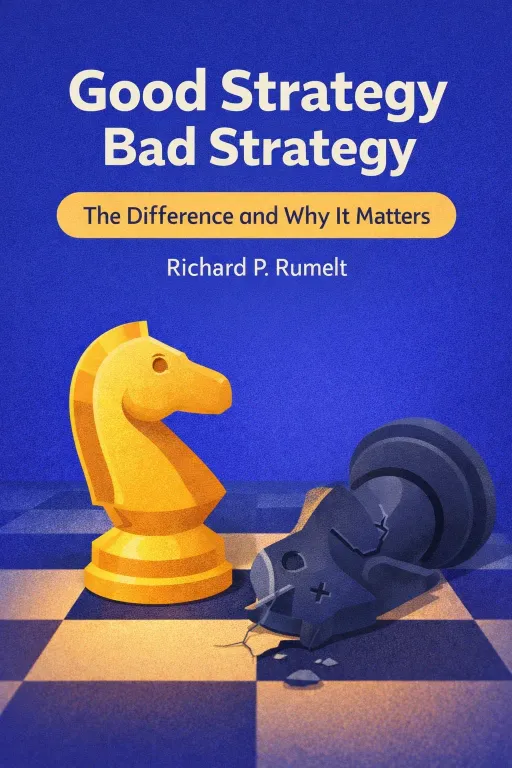
The 'Visionary' Trap: Why You Need Strategic Constraints to Build Lasting Impact
Golden Hook & Introduction
SECTION
Nova: We're often told to "dream bigger," to "think without limits," to chase every single opportunity that comes our way. But what if the secret to building something truly impactful, something that lasts, isn't boundless vision, but rather, radical focus?
Atlas: Hold on, Nova. Are you really suggesting that less is more when it comes to vision? Because most of the leaders I admire, the true visionaries, are all about pushing boundaries, not setting them. That sounds almost counterintuitive for someone trying to make a big impact.
Nova: It absolutely sounds counterintuitive, Atlas, and that's precisely the trap we're talking about today. It's the 'Visionary' Trap. We're diving into why having clear strategic constraints isn't just helpful, it's essential for building lasting impact. This idea is heavily informed by incredible minds like Richard Rumelt, who, as a professor and a consultant to some of the world's largest companies, brought a rare blend of academic rigor and real-world practicality to strategy. And also by A. G. Lafley and Roger L. Martin, who famously turned Procter & Gamble into a powerhouse by applying these very principles.
Atlas: So, we're talking about moving beyond just having a great idea, and really figuring out how to make that idea stick, how to make it. Because a lot of people have big visions, but then they get lost in the execution.
Nova: Exactly. It's about transforming ambition into actionable excellence. Vision without clear, focused strategy often feels like navigating a ship without a rudder. You have a destination, but you’re just drifting. And that brings us right into our first deep dive: why strategic constraints are the ultimate antidote to visionary overwhelm.
Strategic Constraints – The Antidote to Visionary Overwhelm
SECTION
Nova: Think about it this way, Atlas. A floodlight illuminates a vast area, but a laser pointer, precisely focused, can cut through steel. Many visionaries operate like floodlights, spreading their energy and resources across too many initiatives, hoping something will stick. But true impact comes from acting like a laser.
Atlas: I can definitely relate to that. It’s easy to get excited by every new possibility, especially when you're trying to build something significant. The fear of missing out on a potential breakthrough can be paralyzing. So, are you saying we should actively our options?
Nova: Precisely. Lafley and Martin, in their groundbreaking work, argue that strategy is fundamentally about making specific choices: where to play and how to win. It's not about trying to be everything to everyone; it's about intentionally narrowing your focus to dominate in chosen areas. For instance, Lafley, when he returned to Procter & Gamble, didn't try to rejuvenate every single brand. He made incredibly tough choices, shedding underperforming brands and doubling down on categories where P&G could truly be a leader.
Atlas: That’s a bold move. Because for our listeners who are trying to grow a new product or build a new venture, saying "no" to opportunities, even seemingly good ones, feels like you're limiting your potential growth. It feels risky.
Nova: It feels risky, but it's the kind of risk that minimizes wasted effort and maximizes impact. Imagine P&G trying to compete effectively in every single consumer goods category globally. It would be impossible. By choosing to play in specific segments—like fabric care, baby care, beauty care—and then defining they would win in those segments—through superior product performance, brand building, or distribution—they channeled their massive resources with incredible precision. This focus allowed them to pour R&D, marketing, and talent into those specific areas, leading to innovations that truly stood out, rather than being diluted across a sprawling empire.
Atlas: So, it's less about limitation and more about concentration of force. It’s about being deliberate. If you're building a new product, for example, it's not just about having a great concept, but clearly defining which specific customer segment you're serving, and what unique value proposition will make you unbeatable.
Nova: Exactly. It’s the difference between hoping to be good at many things, and committing to being exceptional at a select few. This intentional narrowing isn't about stifling creativity; it's about providing a clear channel for it, ensuring every ounce of effort contributes meaningfully to a defined objective.
The 'Good Strategy' Framework: Diagnosis, Guiding Policy, Coherent Action
SECTION
Atlas: Okay, so if we're going to be incredibly intentional about to play and to win, that brings up another critical question. How do we make sure we're focusing on the things? Because "focus" can also mean stubbornly pursuing the wrong path, right?
Nova: Absolutely, Atlas. And this is where Richard Rumelt's framework for a 'good strategy' becomes indispensable. He argues that a bad strategy is often just a list of goals, or vague aspirations like "we want to be the best" or "we need to increase market share." A good strategy, however, has three essential components: diagnosis, a guiding policy, and coherent actions.
Atlas: That sounds like a scientific method for business, almost clinical. Can you break that down? What's the diagnosis part? Is it like a doctor figuring out what's actually wrong?
Nova: Precisely! Diagnosis is the critical first step. It's about identifying the true nature of the challenge, not just its symptoms. Rumelt emphasizes that this requires honest, rigorous analysis to uncover the or that are holding you back. For example, a company might say their problem is "low sales." A good diagnosis, however, might reveal the problem is "lack of product differentiation in a commoditized market," or "a dysfunctional sales team."
Atlas: So, it's about digging beneath the surface. For someone trying to build a high-performance culture, this would mean not just saying "we need better culture," but actually diagnosing the culture isn't performing. Is it a lack of trust? Poor communication? Misaligned incentives?
Nova: You've got it. Once you have that clear diagnosis, the next step is the guiding policy. This is your overall approach to overcoming the diagnosed challenge. It's not a detailed plan, but a high-level strategy that directs and constrains subsequent action. If the diagnosis was "lack of product differentiation," a guiding policy might be "innovate in niche, high-value segments." It’s the strategic choice you make to address that specific problem.
Atlas: And then the coherent actions? That's where the rubber meets the road, I assume?
Nova: Exactly. Coherent actions are the coordinated steps that implement the guiding policy. They are consistent with each other and amplify each other's effects. If your guiding policy is "innovate in niche, high-value segments," your coherent actions would involve things like increasing R&D investment in specific areas, restructuring marketing to target those niches, and perhaps even acquiring smaller, innovative companies. The key is that these actions aren't random; they flow logically from the diagnosis and the guiding policy. This systematic approach, moving from a deep understanding of the problem to a focused plan, is what transforms broad vision into concrete, winning moves. It’s what allows you to build something truly lasting and significant.
Synthesis & Takeaways
SECTION
Nova: So, what we’re really talking about today is that true power, the ability to build lasting impact, comes from focused effort, not just big dreams. Strategic constraints, like defining where to play and how to win, provide those essential boundaries. And within those boundaries, Rumelt's framework of diagnosis, guiding policy, and coherent action gives us the rigorous methodology to execute brilliantly.
Atlas: It’s about being incredibly intentional with our energy, recognizing that our vision only becomes powerful when it's channeled with precision. For anyone striving for strategic excellence and clarity, this is foundational. It’s the difference between merely wishing for impact and systematically building it.
Nova: Absolutely. And if you're feeling that visionary overwhelm, that sense of spreading yourself too thin, our tiny step for you this week is to define one 'where to play' and one 'how to win' statement for your current biggest goal. It’s an exercise in intentional focus.
Atlas: And remember, that dedicated time for strategic thinking isn't a luxury; it's the absolute foundation for everything you're trying to build, whether it's a new product, a high-performance team, or a lasting legacy.
Nova: This is Aibrary. Congratulations on your growth!