

The Strategic Trap: Why Generalists Miss the Execution Edge
Golden Hook & Introduction
SECTION
Nova: Alright, Atlas, quick challenge for you. Five words. Describe 'strategy' as it's often experienced in the corporate world.
Atlas: Oh, five words... Big words, no map, lost team.
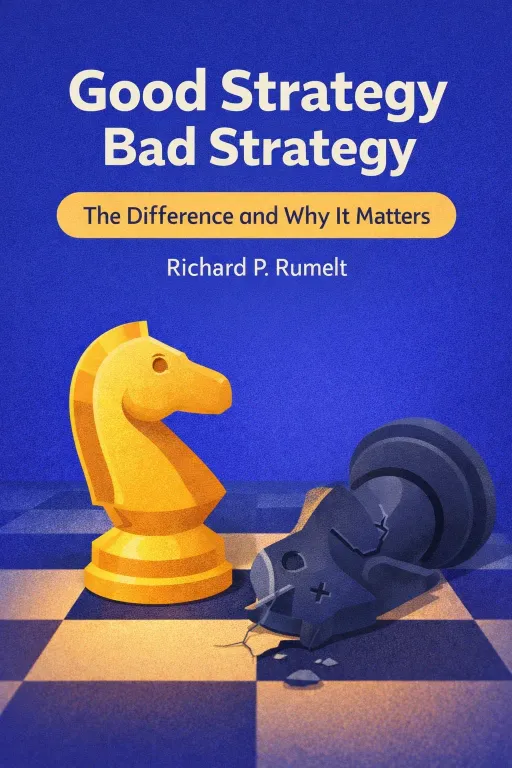
Nova: Oh, that's cutting! And perfectly sets the stage for today. We're diving deep into 'The Strategic Trap: Why Generalists Miss the Execution Edge,' exploring two foundational texts: Richard Rumelt's 'Good Strategy/Bad Strategy,' and Andrew S. Grove's 'High Output Management.' Rumelt, a celebrated professor and consultant, spent decades watching brilliant ideas falter due to poor strategic design. And Grove, a co-founder of Intel, literally built an empire on operational rigor. They both saw the same problem from different angles, and their insights are profoundly practical.
Atlas: Exactly! Because 'big words, no map' is the story of so many initiatives. You have this grand vision, everyone nods, but then… crickets. Or worse, chaos. It's like having a perfect recipe but no kitchen, or ingredients, or even a chef. You have the of a delicious meal, but no actual food.
Nova: Which brings us to our first core idea: the illusion of strategy without action.
The Illusion of Strategy Without Action
SECTION
Nova: Many brilliant ideas die on the vine, not because they're bad ideas, but because they lack a coherent action plan. It's what we call strategic drift. Companies spend millions on consultants, build beautiful slide decks, and then... nothing changes. Why do you think that happens?
Atlas: Oh man, that's a familiar feeling! I imagine a lot of our listeners have been there. It's like, you get all excited about a new direction, there's a big launch, and then it just sort of… dissipates into the ether. Why do we keep falling into that trap?
Nova: Well, part of it is the allure of the 'big picture.' Strategic thinking feels important, powerful. But without execution, it's just a good story. Rumelt points out that bad strategy often uses fluff, ignores real problems, and avoids making tough choices. It's easier to say 'we will be the market leader' than to define the specific, hard steps to get there. It’s a common pitfall in organizations that prioritize appearance over substance, or perhaps just don't know how to translate ambition into tangible steps.
Atlas: So, it's almost a self-preservation mechanism? Like, if we don't define the actions, we can't be held accountable for not doing them? That sounds a bit cynical, but also… real. I mean, for anyone trying to make tangible progress, that's incredibly frustrating.
Nova: It can be. Or it can simply be a lack of clarity, a fear of narrowing options too soon. But the result is the same: paralysis. Imagine a company trying to 'innovate aggressively.' Sounds great, right? But if that means 20 different teams are all vaguely trying to innovate in their own directions, without clear priorities, resources, or metrics, it's just a scattergun approach. It feels like action, but it's not coherent action.
Atlas: That’s going to resonate with anyone who's ever been on a 'strategic initiative' task force that just… fizzled out. You feel busy, but you’re not actually moving the needle. So, if that's bad strategy, if that's the illusion, what does 'good' actually look like?
Rumelt's Kernel: The Anatomy of Good Strategy
SECTION
Nova: That's where Richard Rumelt comes in with his concept of the 'kernel' of a good strategy. He says it has three essential parts: a diagnosis, a guiding policy, and coherent actions. Think of it like a doctor. First, you diagnose the problem. What is going on? Then, you have a guiding policy – a general approach to tackle that problem. And finally, you have coherent actions – specific, coordinated steps that align with that policy to solve the diagnosis.
Atlas: Okay, so it's not just 'grow revenue by 20%.' That's a goal, not a strategy. The diagnosis part really clicks for me. It's like, you can't just say 'I'm sick,' you need to know of sick. What's a good example of a clear diagnosis leading to a strong guiding policy and then those coherent actions?
Nova: Absolutely. Take Apple in the late 90s, before Steve Jobs’ return. Their diagnosis was: too many products, too complex, no clear focus. They were bleeding money, losing market share, and their brand was diluted. Their guiding policy under Jobs was radical simplification and focus on a few brilliant products. And the coherent actions were things like cutting 70% of their product line, focusing on design, and building a direct-to-consumer model. Every single action flowed from that clear diagnosis and guiding policy. It wasn't just a vague hope; it was a targeted, decisive attack on a very specific problem.
Atlas: Wow, that's a powerful example. It wasn't just 'make more money.' It was 'we are unfocused and inefficient, so we will simplify and get excellent at a few things.' That makes so much more sense. It's about knowing your real challenge, not just your desired outcome. It’s a methodical mind’s dream, because it gives you a clear path.
Nova: Exactly. And this clarity, this operational rigor, is precisely what bridges the gap between insight and results. It ensures your plans move from paper to practice, fundamentally solving the problem of strategic drift that we just discussed. It forces you to be honest about your situation and intentional about your response.
Grove's Operational Rigor: Bridging Strategy to Execution
SECTION
Nova: And speaking of bridging that gap, Andrew Grove, the legendary CEO of Intel, literally wrote the book on turning strategy into daily action with 'High Output Management.' Grove wasn't just about big ideas; he was about the of getting things done. He emphasized the importance of process and metrics to transform strategic objectives into daily, measurable tasks, focusing on leverage points for maximum impact.
Atlas: Okay, so Rumelt gives us the 'what' of good strategy, and Grove gives us the 'how' to actually implement it. But how do you take something like 'be the market leader' and turn that into a 'daily measurable task'? That seems like a huge leap for a lot of people who are trying to apply these big concepts.
Nova: It's all about breaking it down. Grove would say, for any strategic goal, you need to identify the 'output' you desire. Then, you track key indicators that tell you if you're getting there. For example, if your strategy is 'dominate the high-performance chip market,' your diagnosis might be 'our competitors are catching up in manufacturing efficiency.' Your guiding policy: 'optimize our fabrication process for speed and yield.' Your coherent actions would involve specific engineering projects, new equipment, and training.
Atlas: I see. So, the metric isn't just 'market share' at the end of the year, it's 'this week, what's our chip yield on line 7?' That's incredibly granular, but it makes sense. It's about finding those 'leverage points' where a small input can have a huge output. It's not just about the big picture, it’s about the micro-actions that contribute to it.
Nova: Precisely. Grove was famous for his focus on 'output-oriented management.' He believed that a manager's output is the output of their organization. He championed Objectives and Key Results, or OKRs, which many companies use today. It's about setting ambitious objectives and then having measurable key results that show progress. This forces clarity and operational rigor, ensuring plans move from paper to practice, not just in quarterly reviews, but every single day. It’s how Intel became a powerhouse; it wasn’t just good ideas, it was relentlessly good execution.
Atlas: That sounds like something that would really help someone who's a practical learner, someone who wants tangible results. It’s about taking that big, abstract strategic goal, and making it concrete enough to act on, even for 15 minutes a day, like our growth seeker listeners often aim for. It cuts through the fluff.
Synthesis & Takeaways
SECTION
Nova: So, what we’ve learned today is that strategic thinking isn't just about visionary insights; it's about connecting those insights to a clear diagnosis, a guiding policy, and coherent, measurable actions. It's about closing that critical gap between the big idea and the daily grind of execution.
Atlas: Absolutely. And for anyone listening who feels like their great ideas get stuck in limbo, or their strategic plans gather dust, the tiny step we can all take today is simple: Pick one current strategic goal. Just one. Then, define its single most critical next action, and assign a clear owner to it. Not a committee, not a vague 'someone,' but one person. That's how you start turning 'big words, no map' into 'progress made, impact felt.' It builds confidence, one small step at a time.
Nova: That’s a powerful, tangible step. Because ultimately, the most brilliant strategy in the world is just a good story until it's executed, until it moves from the whiteboard to the workflow. It's about trusting the process of breaking it down, finding those leverage points, and making it real, day in and day out. It’s the difference between aspiration and achievement.
Atlas: And that, for me, is the ultimate growth. It's not just about thinking smarter, but about acting smarter. It's about bridging that gap and seeing real outcomes.
Nova: Exactly. Thank you for joining us today on Aibrary, where we bridge the gap between brilliant books and real-world impact. This is Aibrary. Congratulations on your growth!