

The Strategic Mindset: Stop Reacting, Start Shaping Your Business Future
Golden Hook & Introduction
SECTION
Nova: Alright, Atlas, five words. Give me your five-word review of what 'strategy' usually looks like in most companies.
Atlas: Oh, that's easy. "PowerPoints, buzzwords, hopeful, vague, busy."
Nova: You nailed it! It's like everyone’s scrambling to hit targets, but nobody really knows or they’re supposed to get there. It’s all motion, no real movement.
Atlas: That’s it! And for curious learners, for people who are passionate about exploring new knowledge and really want to dive deep, that kind of busywork can be incredibly frustrating. It feels like you’re trying to build a castle with no blueprint.
Nova: Exactly! And that’s precisely why we’re diving into "The Strategic Mindset: Stop Reacting, Start Shaping Your Business Future" today. It's truly eye-opening because it cuts through all that corporate fluff and asks: What is strategy,?
Atlas: But why is this confusion so prevalent, Nova? Why do so many businesses—and honestly, so many individuals—mistake a wish list for a roadmap?
Nova: That’s the million-dollar question, isn't it? And it’s where we absolutely have to start with the foundational work of someone like Richard Rumelt.
Strategy vs. Goals: The Core Misconception
SECTION
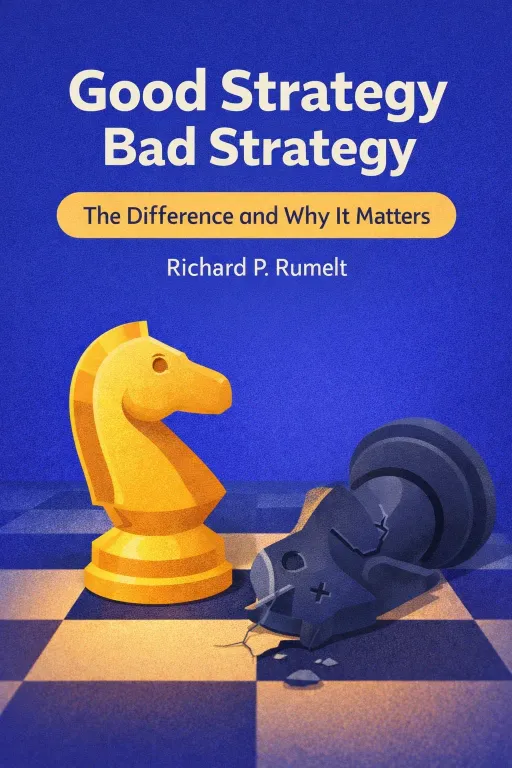
Nova: Rumelt, in his seminal work "Good Strategy Bad Strategy," really pulls back the curtain. He makes it clear: a true strategy isn't just a list of ambitious goals. It's a coherent action plan designed to overcome a.
Atlas: Okay, so it’s not just "we want to grow by 20%." That’s a goal. What makes it a strategy then?
Nova: Great question. Rumelt breaks it down into three core elements. First, you need a. This means truly understanding the nature of the critical challenge. It's not just saying "our sales are down," it's asking they're down. Is it product quality? Market shift? Competitor innovation?
Atlas: That makes sense. You can’t fix what you don’t understand. So, diagnosis first. What’s next?
Nova: Second, you need a. This is the overall approach you’ve chosen to deal with that diagnosed challenge. It’s a high-level decision about you're going to respond. For example, if your diagnosis is "customer churn due to poor post-purchase support," your guiding policy might be "become the industry leader in customer satisfaction."
Atlas: Oh, I see. That’s a decision, a direction, not just a vague hope.
Nova: Precisely. And the third element is. These are the coordinated steps that implement your guiding policy. So, if your policy is to lead in customer satisfaction, your coherent actions might include a complete overhaul of your service channels, investing in advanced customer support software, extensive staff training, and implementing a dedicated, real-time feedback loop.
Atlas: Right, like how a company might say, "We want to be the most innovative tech company." But that's just a goal. A strategy would be: "Our critical challenge is losing top talent to competitors who offer more R&D freedom. Our guiding policy is to foster an internal culture of radical experimentation, and our coherent actions include dedicating 20% of engineering time to passion projects, creating an internal venture fund, and publicizing our failures as learning opportunities."
Nova: Absolutely spot on, Atlas! That’s a fantastic example. It’s about making real choices. And a huge part of that is choosing. Bad strategy, what Rumelt calls 'fluff,' often avoids making these tough choices. It feels good to say "we will be everything to everyone!" or "we will achieve synergistic excellence!" but that's just avoiding the hard work of actual strategy.
Atlas: Oh, I know that feeling. It’s like trying to please everyone at a dinner party and ending up serving bland, unmemorable food. But wait, isn’t it painful for businesses to choose what to do? Doesn’t it feel like you’re limiting yourself?
Nova: It can feel that way initially, but that's where the insight lies. True strategic leadership requires the courage to say no. Choosing what not to do is not a limitation; it's a focusing mechanism. It concentrates your limited resources, energy, and talent on the areas where you can actually make a decisive impact. It's a strength, not a weakness, because it prevents dilution and ensures your actions are truly coherent.
Atlas: That’s actually really inspiring. It means you’re not just reacting to every shiny new object or every competitor’s move. You’re being proactive, deliberate.
The 'Where to Play, How to Win' Framework
SECTION
Nova: And that naturally leads us to the second key idea we need to talk about, which often acts as a counterpoint to just diagnosing bad strategy: how do you good strategy from the ground up? This is where A. G. Lafley and Roger L. Martin's "Playing to Win" offers a brilliant, practical framework.
Atlas: Okay, so Rumelt helps us spot the bad stuff. Lafley and Martin then give us the tools to build the good stuff?
Nova: Precisely. Their model is elegantly simple but profoundly powerful: it centers on two fundamental questions: "Where to Play?" and "How to Win?" These aren't just rhetorical; they demand concrete answers.
Atlas: So, "Where to Play?" I imagine that’s about identifying your market, your customers, your niche?
Nova: Exactly. It’s about defining the specific arenas where your business will compete. This isn't just about geography; it's about customer segments, product categories, technologies, channels, and even specific points in the value chain. For a new coffee shop, "where to play" isn't just "the city center." It could be "serving high-end, ethically sourced espresso to remote workers in the downtown arts district, specifically between 7 AM and 2 PM."
Atlas: That makes me wonder, how does a company avoid getting distracted by all the other opportunities out there? The temptation to expand everywhere must be huge.
Nova: That’s the strategic discipline. It loops back to Rumelt's "choosing what not to do." Lafley and Martin emphasize that "where to play" requires rigorous analysis of market attractiveness, competitive intensity, and your own capabilities. You deliberately exclude arenas where you can't realistically win or where the cost of entry is too high. It's about finding the sweet spot where your strengths align with unmet market needs.
Atlas: So, once you’ve figured out you’re playing, then it’s about "How to Win?" Is that just about being better than the competition?
Nova: It’s more nuanced than just "being better." "How to Win" is about defining the unique value proposition and the capabilities that will allow you to achieve sustainable advantage in your chosen "where to play" arenas. Are you going to win on cost? On differentiation? Through superior customer experience? Through innovation? It’s about creating a distinct and defensible competitive advantage.
Atlas: Can you give an example? Like how would that play out for our hypothetical coffee shop? They’ve chosen their "where to play" – high-end espresso for remote workers in the arts district.
Nova: For sure. To "win" in that specific arena, they might decide their "how to win" is: "By offering a curated, rotating selection of rare single-origin beans, served by highly trained baristas who provide personalized recommendations and create a serene, minimalist workspace environment." They're not trying to be the cheapest or the fastest; they're winning on connoisseurship and atmosphere.
Atlas: That sounds a bit out there. Doesn’t this kind of narrow focus limit ambition? What if they want to be a huge chain someday?
Nova: That’s a common misconception. A focused strategy doesn't limit ambition; it it for maximum impact. By winning decisively in a small, well-defined arena, you build the capabilities, reputation, and financial strength to expand strategically into adjacent "where to play" arenas, always with a clear "how to win" for each new step. It's about mastering one battlefield before conquering the next, rather than trying to fight on all fronts at once and losing everywhere.
Synthesis & Takeaways
SECTION
Nova: In essence, what both Rumelt and Lafley & Martin teach us is that strategy is not a mystical art or a bureaucratic exercise. It's a deliberate, disciplined process of making tough choices. Rumelt helps us diagnose the fluff and understand what true strategy, and Lafley & Martin give us a practical framework for.
Atlas: So, it’s really about clarity and focus. It's about understanding your current reality, making tough decisions, and then aligning everything you do to those decisions. It gives you a compass, not just a destination.
Nova: Exactly. It's about shaping your future instead of just reacting to it. It transforms your business from a ship tossed by every wave into one with a clear course and a powerful engine. It’s not a complex document, but a clear, focused set of choices that drive your organization toward a defined victory.
Atlas: That’s actually really powerful. And for anyone listening who feels like they're just constantly busy but not making real progress, the tiny step here is incredibly actionable.
Nova: It truly is. So, here’s a challenge from us: Identify one critical challenge in your business today. Just one. Can you articulate a single, coherent action plan to address it? Not next month, not next quarter. This week.
Atlas: I love that. It’s about taking that big, abstract idea of strategy and bringing it right down to the ground. Because if you can’t act on it this week, is it really a strategy, or just another hopeful thought?
Nova: Indeed. The future is shaped by the choices we make today. What choices are you making?
Nova: This is Aibrary. Congratulations on your growth!