

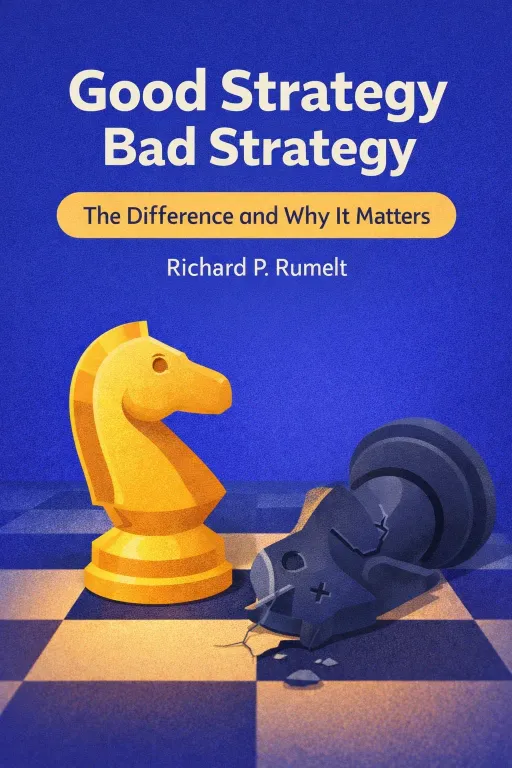
The Strategic Compass: Navigating Your Vision Through Uncharted Waters
Golden Hook & Introduction
SECTION
Nova: Most people think they have a strategy. They don't. They have a wish list.
Atlas: Oh, I love that. So, you're telling me all those PowerPoint decks outlining grand ambitions aren't actually strategy? My world is crumbling.
Nova: Not necessarily crumbling, Atlas, but definitely getting a reality check. We've all seen those plans that look fantastic on paper, right? All the right buzzwords, the lofty goals, the inspiring vision board. But then, when push comes to shove, they just… evaporate.
Atlas: Absolutely. It's like building a magnificent castle in the air and then wondering why it doesn't stand up to the first gust of wind.
Nova: Exactly! And that's precisely what we're dissecting today. We’re diving into the brilliant minds behind modern strategic thought. We'll be pulling insights from Richard Rumelt's seminal work, "Good Strategy Bad Strategy," a book widely acclaimed for its unflinching look at what true strategy entails. Rumelt, a professor at UCLA, has been shaping strategic thinking for decades, and his work is famous for its directness and deep clarity.
Atlas: So, we're talking about the heavy hitters who didn't just theorize, but actually did the work. Rumelt's known for being pretty blunt, isn't he? He doesn't pull punches when it comes to calling out bad strategy.
Nova: He certainly doesn't! And then, we’ll turn to A. G. Lafley and Roger L. Martin's "Playing to Win," which offers a powerful framework for making strategic choices. Lafley, of course, is celebrated for his incredible turnaround of Procter & Gamble, transforming a struggling giant into a powerhouse. Martin, his collaborator, is an equally respected thought leader in business strategy.
Atlas: So, we're getting theory grounded in incredible real-world success. I'm ready for the truth. What separates the dreamers from the doers in the strategic world?
The Anatomy of a Good Strategy: Diagnosis, Guiding Policy, and Coherent Actions
SECTION
Nova: Well, Rumelt argues that a good strategy isn't just a goal; it's a "kernel" with three parts: a diagnosis, a guiding policy, and coherent actions. And here’s the surprising part: most people skip the first, most crucial step.
Atlas: Hold on, I thought strategy was all about setting big, audacious goals. Are you saying that’s not strategy at all?
Nova: Not by itself, no. That's ambition. Rumelt highlights that bad strategy often avoids making choices, focuses on fluffy objectives, and mistakes ambition for the actual work of strategy. Think of it like a doctor. A bad doctor would just tell you, "You need to be healthier!" A good doctor first diagnoses the specific illness.
Atlas: So, the diagnosis is about identifying the core challenge, not just the symptoms. I can definitely see how many organizations jump straight to "we need more revenue" without understanding revenue is low.
Nova: Precisely. A good diagnosis identifies the nature of the challenge. It’s often the hardest part because it requires deep insight, confronting uncomfortable truths, and a willingness to acknowledge what’s going on. Imagine a tech company that says, "Our strategy is to innovate more!" That’s not a diagnosis. That’s a generic aspiration.
Atlas: Okay, so what would a real diagnosis look like for that tech company?
Nova: It might be: "Our core challenge is that our product development cycle is too long, leading to competitors consistently beating us to market with similar features, eroding our first-mover advantage." That's specific, actionable, and points to a root cause.
Atlas: That makes sense. It’s like saying, "We're losing the race because our car is too slow," instead of "We need to win more."
Nova: Exactly! Once you have that clear diagnosis, the guiding policy comes next. This is your overall approach to overcoming that core challenge. It's not a detailed plan, but a high-level framework. For our tech company, the guiding policy might be: "Streamline the product development process by empowering smaller, cross-functional teams with greater autonomy."
Atlas: So, it’s not just a vague directive, it’s a specific to tackle the diagnosed problem. And then the coherent actions are the actual steps you take?
Nova: Yes, the coherent actions are the coordinated efforts designed to implement that guiding policy. For our tech company, this would include things like breaking large teams into smaller units, implementing agile methodologies, investing in new collaboration tools, and retraining managers to facilitate rather than micromanage. All these actions are because they align with the guiding policy, which in turn addresses the diagnosis.
Atlas: I can see how that builds a resilient system. It's not just a collection of random initiatives; it's an interconnected web of decisions. It’s fascinating how many 'strategies' are actually just a jumble of things people to do, rather than a focused attack on a core problem.
Playing to Win: The Cascade of Choices for Competitive Advantage
SECTION
Nova: And this leads us perfectly into our second core idea, which builds on Rumelt's foundation. Because once you've diagnosed your challenge and established a guiding policy, you need a framework to make those disciplined choices. That's where A. G. Lafley and Roger L. Martin's "Playing to Win" becomes indispensable.
Atlas: I’ve been thinking about this – making choices is tough. Especially when you're trying to build something new or scale an existing vision. How do Lafley and Martin help us navigate that?
Nova: They introduce what they call the "cascade of choices," a powerful framework that forces you to define your path to competitive advantage. It starts with "what are our winning aspirations?"—which is more than just "we want to grow." It's about you define winning.
Atlas: So, not just "we want to be the best," but "we want to be the undisputed leader in sustainable packaging for the beverage industry in North America." Something that specific?
Nova: Precisely! That specificity matters. From there, you move to "where will we play?" This is about defining the specific markets, segments, product categories, and geographies where you choose to compete. It's about saying "no" to a lot of attractive opportunities to focus your efforts.
Atlas: That sounds like one of the hardest parts. The temptation to try and be everything to everyone must be enormous, especially for leaders trying to empower their teams and grow. But choosing where not to play is just as important as choosing where to play.
Nova: It is. Lafley often talks about how tough these choices are. But by making them explicitly, you free up resources and focus your energy. Then comes "how will we win?" This is your unique value proposition, how you'll differentiate yourself to achieve that winning aspiration in your chosen playing field. Is it through superior product design, cost leadership, unparalleled customer service, or something else entirely?
Atlas: That’s where the innovation really comes in, I imagine. It's not just about having a great product, but about having a way to the competition consistently within your chosen arena.
Nova: Exactly. And to do that, you need "core capabilities" – the specific skills, assets, and activities that enable you to execute your "how to win" strategy. If your "how to win" is through superior product design, then a core capability might be world-class industrial design talent and rapid prototyping facilities.
Atlas: And finally, “management systems” to support all of this?
Nova: Yes, the final piece is "management systems." These are the processes, structures, and metrics that ensure your capabilities are developed and deployed effectively, allowing you to track progress and make adjustments. It's how the entire organization aligns to execute the strategy.
Atlas: Okay, so this sounds great on paper, but how do you make these tough "where to play" and "how to win" choices without getting paralyzed by analysis, especially if you're building a new system from scratch? It feels like a lot of interconnected decisions.
Nova: That’s where the "cascade" part is critical. Each choice informs the next. You don't make them in isolation. You cycle through them, testing the logic. For instance, if your "how to win" requires a capability you realistically can't build or acquire, you might need to rethink your "how to win" or even your "where to play." It's an iterative process of disciplined choice, not a one-time declaration.
Atlas: So, it's not about having all the answers upfront, but about a rigorous process of asking the right questions and making tough trade-offs. I can see how this framework would be incredibly empowering for leaders looking to scale their impact and build resilient ventures. It gives them a clear map.
Synthesis & Takeaways
SECTION
Nova: Absolutely. What Rumelt gives us is the diagnostic lens—the ability to brutally assess reality and pinpoint the true challenge. And what Lafley and Martin provide is the prescriptive path—a framework for making the interconnected choices that turn that diagnosis into a winning reality.
Atlas: It’s a powerful combination. It shifts strategy from being this vague, aspirational concept to a disciplined process of choice and action. It's about understanding your current long-term vision, identifying the single biggest challenge you face, and then deliberately crafting a coherent set of actions to address it, not just hoping for the best.
Nova: Precisely. True strategy is about understanding the landscape, making tough choices about where to focus your limited resources, and then aligning every action to those choices. It's not about being busy; it's about being effective. It's not about being ambitious; it's about being strategic. And this kind of disciplined thinking is what ultimately builds resilient ventures and empowers teams to achieve truly meaningful scale and impact.
Atlas: That’s actually really inspiring. So, as we wrap up, I'm left wondering: what's the single biggest strategic choice need to make right now to move your vision forward?
Nova: A fantastic question to leave our listeners with!
Atlas: And a tiny step to take: articulate that choice, and then identify one coherent action you're taking to address it.
Nova: This is Aibrary. Congratulations on your growth!