

The 'Perfect' Plan is a Myth: Why You Need Adaptive Strategy.
Golden Hook & Introduction
SECTION
Nova: Most of what you think you know about 'planning' is actually holding you back. That perfectly detailed, airtight strategy you spent weeks crafting? It's probably obsolete before you even launch. And here's the kicker: that's a good thing.
Atlas: Whoa, whoa, whoa. Hold on a second, Nova. I'm imagining a lot of our listeners, especially those of us who thrive on precision and meticulous design, are probably blinking right now. Isn't the whole point of engineering, of leading a project, to a perfect plan? To eliminate variables and know exactly where you're going?
Nova: I get it, Atlas. That desire for certainty, for a flawless blueprint, it’s deeply ingrained, especially in fields that demand technical excellence. But the real world, as you know, is gloriously, frustratingly messy. Static strategies often fail precisely because they don't account for emergent challenges. They become relics before they're even executed.
Atlas: So basically you’re saying our quest for the 'perfect' plan is a fool's errand? That’s going to resonate with anyone who's ever seen a beautifully laid-out Gantt chart crumble on day two.
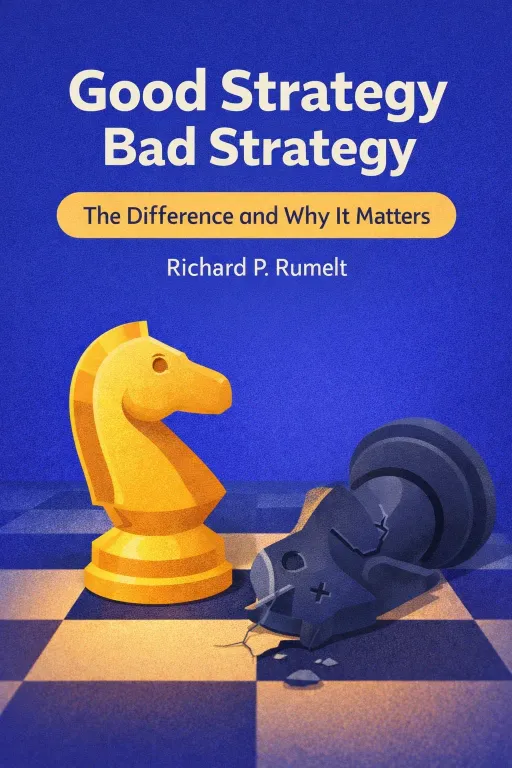
Nova: Exactly! And that's what we're diving into today, inspired by some brilliant thinkers who challenge this very notion. We're talking about how to build plans that are robust yet flexible, guiding action without rigid constraints. Our insights today are heavily influenced by two seminal works: Richard Rumelt's "Good Strategy/Bad Strategy" and "Strategy Safari" by Henry Mintzberg, Bruce Ahlstrand, and Joseph Lampel.
Atlas: Ah, Rumelt. I've heard that name.
Nova: Rumelt is fascinating because he's not just an academic; he's advised corporations and governments, bringing a very practical, grounded perspective to strategy. He cuts through the fluff. And Mintzberg and his co-authors, they're like the anthropologists of strategy, taking us on a "safari" through all the different ways organizations actually formulate strategy. It’s less about a single prescriptive method and more about understanding the rich, diverse landscape.
Beyond Goals – The Kernel of Good Strategy
SECTION
Nova: So, let's start with Rumelt. He argues that good strategy isn't just about setting ambitious goals. Everyone has goals. "Be number one," "Increase profits by 20%." Those are aspirations, not strategies.
Atlas: I see. So what actually a good strategy, then? If it's not just a fancy goal?
Nova: He defines good strategy as a coherent set of actions that respond to a critical challenge. It has what he calls a "kernel," which consists of three parts: a diagnosis, a guiding policy, and coherent actions.
Atlas: Diagnosis, guiding policy, coherent actions. Okay, that sounds like a framework, which I appreciate. But wait, isn't the diagnosis part often obvious? Like, "our sales are down," or "our product isn't competitive." You just identify the problem and then set a goal to fix it.
Nova: That's where many strategies go wrong, Atlas. A good diagnosis goes much deeper than surface-level symptoms. It identifies the of the challenge. It’s about uncovering the critical factors, the bottlenecks, the leverage points. If your diagnosis is superficial, your strategy will be, too.
Atlas: Can you give an example? Because for someone who wants to jump straight to solutions, this "diagnosis" part can feel like analysis paralysis.
Nova: Absolutely. Imagine a small tech startup, "InnovateCo," that's struggling to retain users for its new project management app. Their initial "goal" might be "increase user retention by 30%." A bad strategy would just throw features at the problem or spend more on marketing.
Atlas: Right, that’s the typical response. More features, more ads.
Nova: Precisely. But a strategic diagnosis for InnovateCo might reveal that while the app is powerful, its onboarding process is incredibly complex. New users get overwhelmed and abandon it within the first day. The diagnosis isn't "low retention," it's "complex onboarding creates a high barrier to initial user value."
Atlas: Ah, I like that. That’s a specific, actionable insight. It’s not just stating the obvious.
Nova: Exactly. From that diagnosis, a guiding policy emerges. For InnovateCo, it could be: "Streamline the user onboarding experience to deliver core value within the first 10 minutes, without requiring extensive training."
Atlas: Okay, so the guiding policy is the strategic approach to the specific diagnosis. And then the coherent actions follow from that.
Nova: Yes! The coherent actions would be things like: redesigning the UI for simplicity, creating interactive in-app tutorials, introducing a "quick start" guide, and user-testing the onboarding flow repeatedly. Every action is aligned with that guiding policy, which itself is a direct response to the specific diagnosis. It’s a powerful chain of thought, not just a wish list.
Atlas: That’s a great way to put it. It sounds much more robust than just, "Let's make our app better." I can see how that would give a team clear direction, even if the end goal is still "higher retention."
Strategy as Evolution – Embracing Emergence and Learning
SECTION
Nova: And that naturally leads us to the second key idea we need to talk about, which often acts as a counterpoint to what we just discussed: the reality that even the best "kernel" strategy needs to adapt. This is where Mintzberg and his collaborators come in, showing us that strategy isn't always a deliberate, top-down master plan.
Atlas: Okay, so we've got our diagnosis, our guiding policy, our coherent actions. That sounds pretty solid. What could possibly go wrong?
Nova: Well, the world keeps spinning, doesn't it? New competitors emerge, technology shifts, user needs evolve. Mintzberg argues that strategy often isn't just —meaning, planned out consciously in advance—but also. It's an unfolding pattern of decisions that arise from what an organization actually, rather than just what it intends to do.
Atlas: Emergent strategy. That sounds a bit… chaotic for a precision engineer. How can you lead a team, how can you build anything with confidence, if the plan is just constantly "emerging"? Doesn't that just mean a lack of clear direction or, honestly, a lack of planning?
Nova: That’s a common misconception. Emergence isn't chaos; it's disciplined adaptation. Think of a resourceful innovator launching a new product. They might have a clear initial vision—a deliberate strategy. But as they get early user feedback, see how people use the product, or discover unforeseen market opportunities, their strategy starts to shift. The successful ones aren't the ones who stick rigidly to their initial plan, but those who learn and adapt.
Atlas: So, like, they their app was for individual productivity, but then they noticed teams were using it for collaborative brainstorming, and they pivoted to focus on that?
Nova: Exactly! That pivot wasn't necessarily part of the initial "deliberate" plan. It from observing actual usage, from learning. The guiding policy might still be "solve a critical problem for our users," but the specific and evolved. This requires a different kind of leadership, one that values observation, flexibility, and quick learning cycles.
Atlas: That makes me wonder… for our listeners who are leading engineering teams or complex projects, how do you balance the need for a coherent, guiding policy with this idea of emergent strategy? It seems like a tension between structure and fluidity.
Nova: It is a tension, but a productive one. The "kernel" from Rumelt gives you your North Star, your core intent. It defines the challenge and your general approach. But Mintzberg reminds us that the to that North Star might not be a straight line on a map. It might involve navigating through unexpected terrain, making small course corrections based on new information. It's about having a strong compass but being willing to adjust your sails.
Atlas: So, you still have a strong sense of purpose, but you're not afraid to change tactics when the evidence tells you to. That sounds a bit like how a truly great engineer refines a design—they start with a solid concept, but they iterate and improve based on testing and new data.
Nova: Precisely. It’s about building a learning organization, where every action isn't just execution, but also an experiment. It's how resourceful innovators truly innovate. They're not just executing a static blueprint; they're constantly interacting with reality, learning, and letting their strategy evolve. It's how you build plans that are robust flexible, guiding action without rigid constraints.
Synthesis & Takeaways
SECTION
Nova: So, what we've really been exploring today is how to move beyond the illusion of a perfect, static plan. It's about combining that deep diagnostic thinking from Rumelt with the adaptive, emergent mindset championed by Mintzberg.
Atlas: That’s actually really inspiring. As someone who appreciates clarity and structure, the idea that a "perfect" plan is a myth could feel unsettling at first. But what you've laid out makes it feel more empowering, more realistic. It’s not about abandoning planning; it’s about making our plans more resilient.
Nova: Absolutely. It means trusting your instincts, building on your strong technical foundation, but also embracing the messiness of the real world. It's a continuous cycle of diagnosis, policy, action, observation, and adaptation.
Atlas: For our listeners, especially those who are driven by improvement and constantly seeking mastery, what's one tiny step they can take to start applying this adaptive strategy?
Nova: A great tiny step for your next project: clearly articulate the central challenge before defining solutions. Then, outline a guiding policy to address it. Don't jump to "how" until you've truly defined the "what" and the "why."
Atlas: That sounds like a powerful shift in perspective. Start with the problem, not just the solution. And be ready to learn and adapt along the way. I can definitely see how that would streamline workflows and lead to more effective outcomes for any project manager or leader.
Nova: Indeed. It's about stepping away from the fantasy of perfect foresight and embracing the power of insightful adaptation.
Atlas: That’s a fantastic way to put it.
Nova: This is Aibrary. Congratulations on your growth!