

The 'Future-Proof' Fallacy: Why True Strategic Thinking Isn't About Predicting, But Adapting.
Golden Hook & Introduction
SECTION
Nova: Atlas, what’s the first thing that comes to mind when I say 'strategic planning'?
Atlas: Oh, easy. Crystal balls, five-year forecasts, trying to predict exactly what’s around the corner. You know, 'future-proofing' the business.
Nova: What if I told you that very idea of 'future-proofing' is actually one of the biggest strategic blind spots a leader can have?
Atlas: Hold on. That sounds… counter-intuitive. Isn’t the whole point of strategy to predict and prepare for the future? To make sure we don't get blindsided?
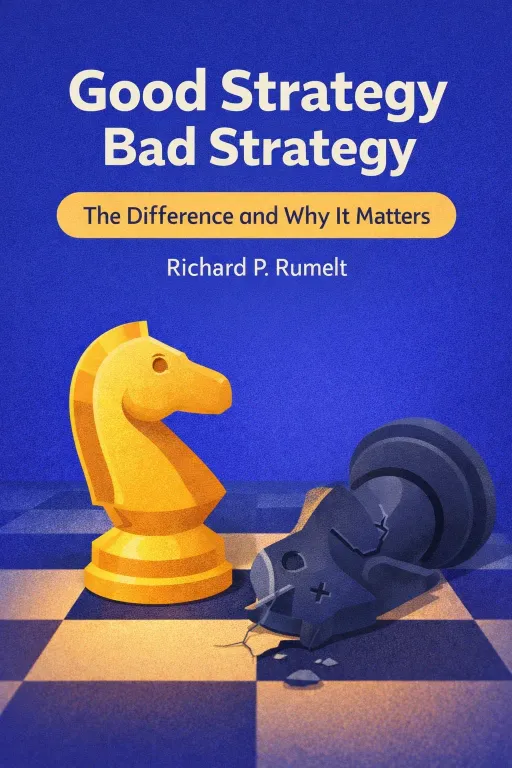
Nova: That’s the seductive myth, isn't it? The one that promises certainty in an uncertain world. But today, we're diving into that provocative idea, drawing heavily from the wisdom of master strategists like Richard Rumelt, whose book 'Good Strategy/Bad Strategy' is widely acclaimed for cutting through the corporate jargon and getting to the heart of what real strategy looks like.
Atlas: So, less about gazing into the future, more about building something that can whatever future comes our way?
Nova: Precisely. It’s about shifting our focus from prediction to robust adaptation. And it’s a shift that can fundamentally change how you lead and how your organization thrives.
The Strategic Blind Spot – Why Predicting the Future Fails
SECTION
Atlas: Okay, I’m intrigued. But I imagine a lot of our listeners, especially those in fast-moving industries, feel immense pressure to have a clear roadmap for the next three to five years. Why is relying on that prediction a blind spot?
Nova: Imagine you're driving a car through a dense fog. You can squint as hard as you want, try to guess what's beyond the next bend, but you’re still driving blind, right? You're far better off having excellent brakes, responsive steering, and a clear understanding of your road conditions.
Atlas: That’s a great analogy. So, the fog is the uncertainty of the future.
Nova: Exactly. The world is inherently complex, interconnected, and dynamic. Black swan events, rapid technological shifts, sudden market disruptions – these aren’t anomalies anymore; they’re the norm. When we create a rigid, five-year plan based on what we will happen, we’re essentially building a static sandcastle on a rapidly changing shoreline.
Atlas: I can see that. That means the moment the tide comes in a little differently, or a new wave hits, your beautiful sandcastle just gets washed away.
Nova: And that’s the danger. Many organizations pour immense resources into these elaborate forecasts, convinced they can 'future-proof' themselves. They construct these intricate plans, often driven by aspiration rather than reality, and when the market inevitably deviates, they're left scrambling, trying to force reality to fit their outdated blueprint.
Atlas: So, it's not just that the predictions are wrong, which they often are, but that the of relying on them makes you less adaptable?
Nova: That's the crucial part. It instills a false sense of security and often discourages looking for emergent opportunities or threats that don't fit the predetermined narrative. Think of a company that invested heavily in a specific technology, convinced it was the future, only to be outmaneuvered by a completely different innovation they dismissed because it wasn't in their "forecast." They ignored early signals, stuck to their rigid plan, and ultimately, their market share eroded dramatically.
Atlas: Wow, that’s kind of heartbreaking. It’s like they were so focused on the destination they they were going to, they missed the turns that would have actually gotten them somewhere better. But don’t leaders need a vision? How do you distinguish between a powerful guiding vision and a static, dangerous forecast?
Nova: That’s an excellent distinction, Atlas, and it brings us right to the heart of the solution.
Beyond Forecasting – Crafting Adaptable Strategies with Rumelt & Mintzberg
SECTION
Nova: A vision inspires; a static forecast handcuffs. The difference lies in how you build your strategy. This is where Richard Rumelt's work becomes incredibly illuminating. He argues that good strategy has a coherent 'kernel' with three parts: a diagnosis, a guiding policy, and coherent actions.
Atlas: A kernel? Like a seed?
Nova: Exactly! A seed contains the DNA, the fundamental instructions for growth, but it doesn't predict the exact shape of every leaf or branch. The diagnosis is about clearly defining the you're facing. What are the critical obstacles? What's the problem you're trying to solve? It’s not about predicting the answer, it’s about understanding the question with brutal honesty.
Atlas: So, less about saying, "In five years, we'll be the market leader in X," and more about, "Our biggest challenge is that our customers find our product too complex."
Nova: Precisely! Then comes the guiding policy – a high-level approach to overcome the diagnosis. It’s a strategic principle, not a specific action. For example, if the diagnosis is "product complexity," the guiding policy might be "simplify the user experience across all touchpoints."
Atlas: Okay, so you diagnose the problem, you set a general direction. What about the "coherent actions"?
Nova: Those are the coordinated steps that implement the guiding policy. This is where the rubber meets the road. If your guiding policy is "simplify user experience," your coherent actions might include forming cross-functional teams dedicated to UX, investing in new design tools, and conducting extensive user testing. These actions must be aligned and mutually reinforcing. Bad strategy, on the other hand, often skips the diagnosis, offers generic goals, and presents a laundry list of unrelated initiatives.
Atlas: That makes so much sense. I’ve seen that in practice – companies with mission statements full of buzzwords, but no clear problem they’re solving, and their teams are just doing a bunch of disconnected things. So, Rumelt gives us a backbone. But you also mentioned Henry Mintzberg. How does he fit into this adaptable strategy picture?
Nova: Mintzberg’s brilliance lies in showing us that strategy isn't a single, rigid process. He identifies different "schools of thought" – essentially, different ways strategy can emerge. For example, he talks about "deliberate strategy," which is the planned, top-down approach we often think of. But he also emphasizes "emergent strategy" – where patterns of action arise or intention.
Atlas: Emergent strategy? So, things just… happen, and then you call it strategy?
Nova: Not quite “just happen.” It's about recognizing successful patterns of behavior or innovation that bubble up from within the organization, often from the front lines, and then formalizing them. It’s about being open to learning and adapting as you go, rather than sticking rigidly to the initial grand plan.
Atlas: That’s a great way to put it. So, a company might to enter market A, but then their sales team, through unexpected customer interactions, discovers a huge opportunity in market B. An emergent strategy would be to pivot and capitalize on market B, even if it wasn't in the original "deliberate" plan.
Nova: Exactly! An organization that embraces both Rumelt's coherent kernel Mintzberg's diverse strategic lenses is incredibly powerful. They have a clear understanding of their current challenge and a guiding policy, but they also remain open and agile enough to adapt their coherent actions as new information or opportunities emerge.
Atlas: That’s actually really inspiring. It’s like instead of trying to predict the exact path of the river, you learn how to build a boat that can handle rapids, navigate around obstacles, and even change direction if a more promising tributary appears.
Synthesis & Takeaways
SECTION
Nova: That’s a perfect analogy, Atlas. The 'future-proof' fallacy creates brittle organizations. True strategic thinking, informed by Rumelt and Mintzberg, builds resilience. It’s about cultivating that mindset of constant diagnosis, clear guiding principles, and the flexibility to adjust your actions based on an ever-evolving reality.
Atlas: So, for our listeners who are constantly striving to stay ahead and build for tomorrow, this isn’t about abandoning foresight. It’s about evolving foresight into something more robust: the ability to adapt with clarity and purpose. It’s about asking, "Where in my current strategic approach might I be mistaking aspirations or generic goals for true, actionable strategy, and how can I refine it?"
Nova: Exactly. It's an ongoing, dynamic process, not a static destination. It’s about trusting your strategic instincts, but grounding them in rigorous diagnosis and adaptable action.
Atlas: And protecting that focus for deep work, to really engage with those emergent patterns.
Nova: Absolutely.
Atlas: This is Aibrary. Congratulations on your growth!