

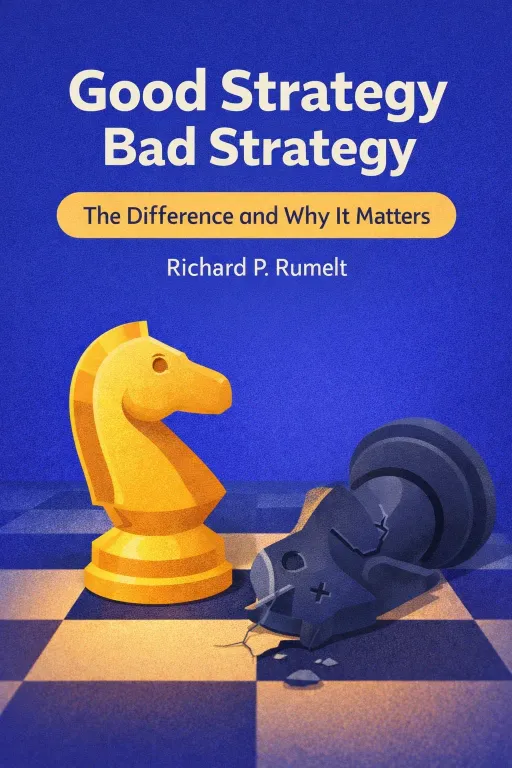
The Fog of War is a Trap: Why Clear Strategy Delivers Real Agent Value.
Golden Hook & Introduction
SECTION
Nova: Atlas, quick fire: what comes to mind when I say "strategy meeting"?
Atlas: Oh, I know this one! It's that magical place where buzzwords go to multiply, and then… absolutely nothing happens.
Nova: Exactly! That's the feeling, isn't it? That frustrating disconnect between grand plans and actual, tangible results. It's almost like a "fog of war" descends, even on the most brilliant technical efforts.
Atlas: Oh, I can absolutely relate to that. Especially when you're knee-deep in an Agent project, pushing through complex integrations, and suddenly you wonder, "Wait, what's the actual of all this again?" The aimless wandering you mentioned earlier? That hits home.
Nova: It does, and that's precisely why we're diving into some foundational thinking today. We're exploring why clear strategy isn't just a nice-to-have, but a crucial component for delivering real Agent value. Our guides for this journey are two incredible books: "Good Strategy/Bad Strategy" by Richard Rumelt, and "Playing to Win" by A. G. Lafley and Roger R. Martin.
Atlas: Rumelt's book specifically has such a reputation for cutting through the noise. It feels like it single-handedly redefined how many leaders and practitioners even think about strategy. It strips away all the fluff, doesn't it?
Nova: Absolutely. Rumelt's work is a masterclass in demystifying business strategy, focusing on actionable coherence over corporate jargon. And that's where we need to start. Because many brilliant technical efforts, particularly in the cutting-edge world of Agent engineering, don't fail from a lack of effort or technical skill. They fail from a lack of clear, coherent strategy. Without it, even the most sophisticated Agent systems can just… wander. Aimlessly. Failing to deliver true value.
The Anatomy of Good vs. Bad Strategy (Rumelt's Kernel)
SECTION
Atlas: Honestly, that's a scary thought. You put in all that work, all that incredible technical expertise, and it just… drifts. So, what does Rumelt say is the antidote to that aimless wandering? How do we even begin to define a strategy?
Nova: Rumelt argues that a good strategy has a distinct "kernel." Think of it like the core of an operating system for your project. This kernel has three essential parts: a diagnosis, a guiding policy, and coherent actions. It’s a powerful, simple framework that exposes the common pitfalls of what he calls "bad strategy."
Atlas: Okay, a kernel. That sounds very… systematic. For us architects and full-stack engineers, how do we spot these "bad strategies" when we're deep in the code? What's the real trap here beyond just 'fuzzy goals'? Can you give us an example of how this plays out in an Agent project gone wrong?
Nova: Let's paint a picture. Imagine an ambitious tech company decides they need an "autonomous sentiment analysis agent" for customer support. The goal is grand: "Be the best in AI customer service." Sounds good, right?
Atlas: On the surface, sure. Everyone wants to be the best.
Nova: Exactly. But here's where the bad strategy creeps in. The is weak. Instead of deeply understanding their current sentiment analysis is failing, or what specific customer pain points exist, they just assume, "Our AI isn't smart enough." They don't look at the messy data, the nuanced human emotions, or the actual workflows.
Atlas: So, no real root cause analysis? Just a general feeling of "we need more AI"?
Nova: Precisely. That leads to a misguided. Instead of, say, "Focus on identifying high-severity customer churn signals in real-time, specifically from written complaints," their guiding policy becomes, "Just make the AI smarter." It's a goal, not a policy for to achieve it.
Atlas: Ah, I see. A "guiding policy" isn't just what you want to do, it's you intend to overcome the diagnosed challenge. It’s the strategy for the strategy.
Nova: You've got it. And because the diagnosis and guiding policy are so vague, the never materialize. The team throws more data scientists at the problem, tries every new NLP model, invests heavily in GPU clusters—all brilliant technical efforts in isolation. But there's no clear, unified direction because the core problem was never truly understood.
Atlas: Wow, that's incredibly frustrating. I can feel the team's burnout just listening to that. High cost, cutting-edge tech, and ultimately, a low-impact system that misses the mark because it was never aimed properly.
Nova: It’s a classic example of "fluff" masquerading as strategy. Rumelt calls out strategy that's just a collection of buzzwords, or mistaking a goal for a strategy. The real trap is that it feels like you're something strategic, but you're just spinning your wheels.
Atlas: So, a good diagnosis would be like, "Our current sentiment agent misinterprets 30% of sarcastic customer feedback, leading to a 15% increase in customer support escalations for that specific category." That's specific.
Nova: Much better! And then a guiding policy would be, "We will implement a context-aware sarcasm detection module, specifically trained on our historical customer interaction data, to reduce misinterpretations by half within six months." That gives your engineers something concrete to build towards. It’s a coherent plan to overcome a defined challenge.
Atlas: Okay, I'm starting to see how this shifts your thinking from just reacting to problems to proactively designing a winning approach. It's about understanding the before you even think about the from a technical standpoint.
Making Strategy Actionable: The "Playing to Win" Framework
SECTION
Nova: Exactly! And that naturally leads us to the second key idea we need to talk about, which often acts as a powerful complement: "Playing to Win" by A. G. Lafley and Roger R. Martin. If Rumelt gives us the anatomy of good strategy, Lafley and Martin give us a practical framework for one.
Atlas: This is what we're always striving for as value creators – turning abstract tech into real business value. So, how do they approach making strategy actionable?
Nova: They present strategy as a set of integrated choices, a cascade of decisions that answer five fundamental questions: What is our winning aspiration? Where will we play? How will we win? What capabilities must be in place? And what management systems are required? It’s a holistic, interconnected approach.
Atlas: "Where to play" and "how to win" immediately jump out at me. For an Agent architect, how does "where to play" help us identify those high-impact integration points for Agent tech, beyond just "build an Agent"? And for "how to win," how do we ensure our Agent systems are not just stable, but truly and?
Nova: Let's consider another hypothetical. Imagine an Agent engineering team tasked with building a "proactive supply chain optimization agent." This team, learning from past mistakes, applies "Playing to Win."
Atlas: Okay, I'm listening. How do they win?
Nova: First, "Where to play." Instead of trying to optimize the entire global supply chain, which is a massive undertaking, they make a focused choice. They decide to play specifically in "perishable goods logistics within a particular regional market," like fresh produce distribution in the Pacific Northwest. This is a high-value, high-complexity niche where an Agent could have disproportionate impact.
Atlas: That already sounds more focused than "optimize all the things!" It's identifying a specific battleground where their Agent can actually make a difference.
Nova: Exactly. Then, "How to win." They decide to win by leveraging real-time sensor data and predictive analytics for, outperforming competitors who rely on static, historical models. Their Agent will predict delays due to traffic, weather, or demand fluctuations, and automatically suggest optimal alternative routes, minimizing spoilage and delivery times. That's their competitive advantage.
Atlas: That's a clear differentiator! It’s not just an Agent; it’s about that Agent creates a unique advantage that others don't have. So, what about the capabilities and management systems?
Nova: Their "Capabilities" would include building a robust, low-latency data ingestion pipeline for all that real-time sensor data, and assembling a team highly skilled in explainable AI, so logistics managers can trust and understand the Agent's recommendations.
Atlas: Trust is huge for adoption, especially with complex AI. And the data pipeline is the backbone.
Nova: Right. Finally, "Management Systems." They establish clear feedback loops with logistics managers, ensuring the Agent's recommendations are constantly refined. They set performance metrics that directly align with business KPIs, like "reduction in spoilage rate" and "on-time delivery percentage." This isn't just about building the tech; it's about integrating it into the entire operational flow.
Atlas: Wow. That's a night-and-day difference from the first example. You can see how each choice builds on the other, creating a truly integrated, value-generating Agent system. It’s not just about the code; it's about the deliberate choices that shape the code's impact.
Nova: Precisely. It fundamentally shifts your thinking from merely reacting to problems to proactively designing a winning approach for your Agent engineering projects. It’s about making those integrated choices to ensure your Agent isn't just technically brilliant, but strategically impactful.
Synthesis & Takeaways
SECTION
Atlas: This has been incredibly insightful, Nova. It really drives home that strategy isn't some abstract concept for the C-suite. It's a practical, vital tool for anyone building complex systems like Agents, especially when you're trying to create real business value.
Nova: Absolutely. The "fog of war" in Agent engineering is real. It's the overwhelm of new technologies, the pressure to deliver, the sheer complexity. But these frameworks offer a way to cut through that fog, to move from vague intentions to clear, actionable plans that truly deliver.
Atlas: It’s empowering, actually. It means we, as engineers and architects, have a framework to be more than just coders; we can be strategic partners in creating groundbreaking solutions.
Nova: That's the goal. It's about taking that powerful technical intuition and pairing it with a robust strategic mindset. It's about proactively designing winning approaches, not just reacting to the next technical challenge.
Atlas: So, for everyone building or architecting Agent systems out there, let's turn this into a challenge. What's one core challenge in your current Agent project that could truly benefit from a clearer diagnosis and a more focused guiding policy?
Nova: Think about it. Take these insights and apply them. Shift your perspective from simply solving problems to proactively designing for success. That's where the real breakthroughs happen.
Atlas: It’s about being deliberate.
Nova: Always.
Nova: This is Aibrary. Congratulations on your growth!