

Strategic Clarity in a Noisy World
Golden Hook & Introduction
SECTION
Nova: Atlas, five words: what’s the biggest mistake businesses make when planning for growth?
Atlas: Chasing shiny objects, ignoring root problems.
Nova: Oh, that’s sharp! And incredibly accurate. Because today, we’re diving into strategic clarity in what often feels like a very noisy, chaotic world. A world where everyone's shouting about the next big thing, but few are whispering about the challenge.
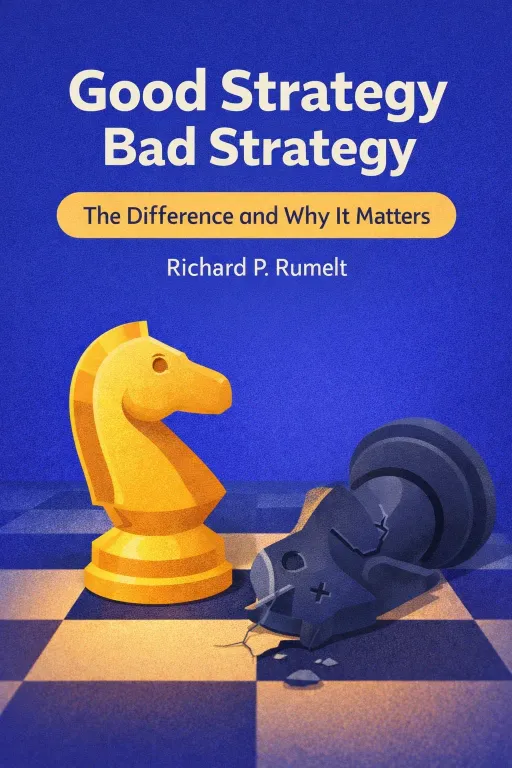
Atlas: Absolutely. We’re pulling back the curtain on two powerful thinkers who cut through that noise. First, Richard Rumelt, the acclaimed strategy guru whose book, "Good Strategy Bad Strategy," has become a cornerstone for demystifying what true strategy actually is, stripping away the jargon to reveal its core.
Nova: And then, we’ll turn to Safi Bahcall, a physicist turned entrepreneur, whose brilliant book "Loonshots" brings a truly unique, almost scientific perspective to how organizations can foster radical innovation without sacrificing their bread-and-butter operations. His background really allows him to see organizational dynamics in a fresh, often counter-intuitive way.
Atlas: It’s a powerful combination. We’re going to explore how Rumelt gives us the lens to understand a good strategy looks like, and Bahcall shows us to build the environment to execute it, especially when you’re aiming for sustainable, scalable success.
The Kernel of Strategy: Unveiling the True Diagnosis
SECTION
Nova: So, let's start with Rumelt and his "kernel" of strategy. He argues that true strategy isn't just about setting ambitious goals or having a vision board. It's built on three essential parts: a diagnosis of the challenge, a guiding policy, and a set of coherent actions.
Atlas: I guess that makes sense. Diagnosis sounds simple, though. Isn't it just identifying a problem? What's the "deep analysis" part Rumelt implies that makes it so crucial, especially for listeners who are constantly building efficient systems and driving growth?
Nova: That’s the critical distinction, Atlas. A diagnosis is often just a restatement of the problem or a fluffy goal. Like saying, "Our problem is we need more innovation!" or "We need to grow revenue by 20%!" Rumelt calls this "fluff." A diagnosis, a diagnosis, identifies the that stands in the way of achieving your goals. It’s often counter-intuitive, uncomfortable, and requires deep, analytical thinking.
Atlas: So you're saying it's not about you want to achieve, but you can't achieve it right now? For strategists focused on building and optimizing, this sounds like a necessary pause, a deep dive into the 'why' before the 'how.'
Nova: Exactly. Think of it like this: a company might complain, "Our problem is that our competitors are more agile." A bad diagnosis would be, "We need to be more agile!" A good Rumeltian diagnosis would go deeper: "Why aren't we agile? Is it our hierarchical decision-making process? Is it a fear of failure embedded in our culture? Is it an outdated IT infrastructure that slows everything down?" The real challenge isn't the symptom, it's the underlying disease.
Atlas: That makes sense. It’s like a doctor diagnosing an illness instead of just wishing for health. You have to pinpoint the exact pathogen, not just treat the fever. So, for a builder, this means understanding the structural weakness, not just trying to paint over the cracks.
Nova: Precisely. Rumelt emphasizes that a good diagnosis often reveals a surprising insight about the nature of the challenge, which then naturally points towards a guiding policy and coherent actions. It’s the difference between saying "We need to improve sales" and "Our sales team is spending 80% of its time on low-value leads because our targeting algorithm is outdated, leading to burnout and high churn." The second one gives you something concrete to act on.
Atlas: Wow, that’s actually really inspiring. It means the biggest hurdle to growth might not be what you think it is, and finding that single, clear diagnosis is the ultimate strategic clarity.
Loonshots and Franchises: Structuring for Dual Growth
SECTION
Nova: And once you have that clear diagnosis – whether it points to a need for radical innovation or more efficient execution – the next strategic hurdle is you actually structure your organization to achieve it. This is where Safi Bahcall’s "Loonshots" comes in.
Atlas: I’m curious, what does a physicist bring to organizational design? I imagine a lot of our listeners, who are building efficient systems and driving scalable success, are always looking for new frameworks that can truly transform team dynamics.
Nova: Bahcall’s central idea, drawing from physics, is that organizations undergo "phase transitions." Just like water can be ice, liquid, or steam, an organization can be optimized for either radical innovation – what he calls "loonshots" – or for efficient, predictable execution – which he calls "franchises." The problem arises when you try to force both into the same environment without understanding their fundamental differences.
Atlas: Wait, so you're saying innovation and execution are fundamentally at odds? For someone obsessed with building efficient, scalable systems, that sounds like a conflict that needs careful management, not separation. How does that work?
Nova: Bahcall argues that the 'artists' who create loonshots – those crazy, radical ideas that could change everything – thrive in a culture of maximum freedom and tolerance for failure. They need to experiment, to be quirky, to follow their gut. The 'soldiers' who run franchises – the established, profitable products – need discipline, clear metrics, and efficient processes. If you put the artists and soldiers together without proper separation, the 'soldiers' will often crush the loonshots because they seem inefficient, risky, and disruptive to the existing system.
Atlas: That sounds like a corporate immune system rejecting a new organ. So it's about creating different "habitats" within the same organization. Not just tolerating, but actively the nascent, risky ideas. That feels counter-intuitive to a growth-driven mindset that often prioritizes immediate returns.
Nova: It’s absolutely counter-intuitive, and that’s why it’s so powerful. Bahcall details how companies like Bell Labs, during its golden age, created these separate environments. They had scientists pursuing fundamental research almost entirely separate from the teams turning those discoveries into marketable products. The key is the mechanism – how successful loonshots are carefully handed off to the franchise side to be scaled, without the franchise culture stifling them prematurely.
Atlas: So the goal isn't to make everyone an artist or everyone a soldier, but to understand that both are vital for long-term, sustainable growth. And then, to design the organizational structure – the "phase separation" – that allows both to flourish in their own way. That’s a profound shift in thinking about team dynamics and business model innovation.
Synthesis & Takeaways
SECTION
Nova: What's even more interesting is how these two ideas connect. Rumelt gives us the strategic clarity to diagnose whether our biggest hurdle is a fundamental lack of direction, or perhaps a structural issue preventing innovation. Bahcall then offers a blueprint for to build an organization that can tackle those different types of challenges effectively.
Atlas: Exactly. The deep question from our notes today – "Can you identify a single 'diagnosis' that explains the biggest hurdle to your growth?" – isn't just a question; it's the strategic starting gun. And once you have that diagnosis, you need to decide if you’re building a stronger franchise, or nurturing a radical loonshot.
Nova: And remember, for our listeners who are driven by growth and building resilient organizations, embracing iterative learning is key. Every step forward counts, especially when it’s informed by a clear diagnosis and a well-structured approach.
Atlas: This isn't just theory; it’s about understanding the fundamental principles that fuel sustainable growth and allow for true business model innovation. It’s about designing the future of commerce by truly understanding the present.
Nova: It's about being strategic not just in you do, but in you think about your challenges and you build your teams to overcome them.
Atlas: What a powerful combination of insights to fuel our strategic thinking.
Nova: Absolutely. This is Aibrary. Congratulations on your growth!