

Stop Overthinking, Start Leading: The Guide to Decisive Action in Complex Times.
Golden Hook & Introduction
SECTION
Nova: You know that feeling when you're staring at a mountain of data, convinced that one more spreadsheet will reveal the perfect answer? What if I told you that very pursuit is often the enemy of actual leadership?
Atlas: Hold on, Nova. Are you saying we should just… wing it? Because for people like our listeners, who are strategic innovators and visionary leaders, gathering information feels like a sacred duty. It's how you see the big picture and navigate complex challenges.
Nova: Not at all, Atlas! I’m saying there’s a crucial difference between informed leadership and analysis paralysis. Today, we're dissecting that very idea with insights from 'Stop Overthinking, Start Leading: The Guide to Decisive Action in Complex Times.' This book, while concise, cuts right to the chase, offering a counter-intuitive approach to decision-making that prioritizes clarity over exhaustive analysis. It's a pragmatic guide born from the intense pressure of modern leadership, designed to get you moving when the world demands it. It’s about getting off the sidelines and into the game.
Atlas: Oh, I like that. Getting into the game. Because I imagine a lot of our listeners, especially those trying to bridge the remote gap with hybrid culture design or future-proof their firm with disruptive business models, are feeling that pressure to act decisively. But it often feels like you need all the pieces before you can move.
The Trap of Analysis Paralysis & The Call for Strategic Simplification
SECTION
Nova: Exactly. The book highlights a cold, hard fact: complex problems too often lead to analysis paralysis. We convince ourselves that waiting for perfect information is prudent, when in reality, it just means missed opportunities. Think of it like a seasoned ship captain. A bad captain might wait for a perfectly clear sky, no wind, and an ideal current before setting sail, meticulously charting every possible variable. Meanwhile, the cargo spoils, and the opportunity to reach their destination vanishes.
Atlas: That makes sense. It’s like, you’re so focused on optimizing the map, you forget to actually start the journey. So, what’s the book's 'Nova's Take' on this? How do we break free from that cycle of endless data gathering?
Nova: The book’s take is that effective leadership demands a coherent strategy that simplifies complexity. It’s not about ignoring data, but about identifying the and focusing your resources to overcome it, rather than trying to solve everything at once. It’s about having a clear path, not just more data. The captain who understands the critical challenge knows that sometimes, you need to navigate a strong headwind with a specific tack to reach safety, even if it's not the ideal-weather scenario.
Atlas: So you're saying for our listeners, who are constantly facing complex, interconnected problems, the real skill isn't about collecting more information, but about discerning which problem is the critical? That sounds like a powerful shift in mindset. But how do you even identify that single critical challenge when everything feels urgent?
Good Strategy vs. Bad Strategy & The Rumelt Framework
SECTION
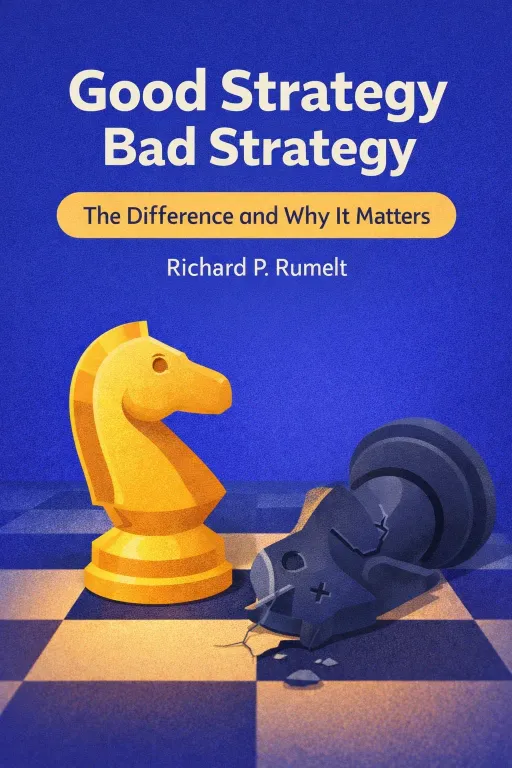
Nova: That’s where we turn to the brilliant insights of Richard Rumelt, whose work on good strategy is foundational to this book’s perspective. Rumelt defines good strategy as having three interconnected parts: a coherent diagnosis, a guiding policy, and a set of coherent actions. It’s a powerful framework for strategic simplification.
Atlas: Okay, so "diagnosis, guiding policy, coherent actions." Let's unpack that. What does a "diagnosis" look like in this context, especially for someone trying to cultivate a thriving ecosystem in a hybrid work environment?
Nova: A good diagnosis isn't just stating the obvious. It’s about identifying the true nature of the critical challenge. For instance, a bad diagnosis for a hybrid culture might be, "Our team isn't connected enough." That's a symptom. A good diagnosis might be, "The lack of spontaneous, informal knowledge sharing between our remote and in-office teams is hindering innovation and creating a two-tiered employee experience." See the difference? It pinpoints the.
Atlas: I see. That’s a much deeper understanding. It’s like a doctor not just saying, "You have a cough," but diagnosing "You have bacterial pneumonia caused by this specific strain." So, once you have that sharp diagnosis, what’s the "guiding policy"?
Nova: The guiding policy is your overall approach to overcome that diagnosis. It’s a coherent strategy, not just a vague goal. For our hybrid culture example, if the diagnosis is lack of informal knowledge sharing, a guiding policy might be, "Design intentional, asynchronous communication channels and virtual 'water cooler' moments that foster cross-functional collaboration and serendipitous connection, regardless of location." It’s a specific, strategic choice.
Atlas: That makes me wonder, how do you prevent that guiding policy from becoming just another aspirational statement? For leaders exploring disruptive business models, it's easy to say, "We will disrupt the market," but that’s not a policy, is it?
Nova: Exactly. That's a goal, not a strategy. A bad strategy often confuses goals with strategy. Rumelt warns against vague plans. The guiding policy must be actionable. And that leads us to the third part: coherent actions. These are specific steps, aligned with your policy, that directly address the diagnosis. For our hybrid culture, coherent actions might include: implementing a dedicated project-based collaboration platform with specific guidelines for asynchronous updates, scheduling mandatory "virtual coffee breaks" with rotating cross-team pairings, and creating a peer-to-peer knowledge sharing library.
Atlas: Ah, so it’s not just about setting a course, but actively rowing in that direction. It’s about ensuring every stroke is moving you towards overcoming that critical challenge. That’s incredibly powerful for someone who sees the big picture and wants to ensure their team moves forward with purpose and direction. It avoids the trap of having a great vision but no real way to get there.
Synthesis & Takeaways
SECTION
Nova: Precisely. The book's core message is that rather than drowning in data, we need to cultivate the discipline to simplify. Identify that single critical challenge, craft a clear guiding policy, and execute coherent actions. This isn’t about being reckless; it’s about being truly strategic and decisive, especially in complex times.
Atlas: Honestly, that sounds like a game-changer for anyone who’s ever felt overwhelmed by the sheer volume of choices and information. It’s about embracing the discomfort of transformation, as our growth recommendations suggest, and knowing when to pause analysis and start leading. So, for our listeners who are ready to stop overthinking and start leading, what’s the single most important thing they can do today?
Nova: The book offers a tiny, yet mighty, step. For your next big decision, articulate the single biggest challenge you face. Don't list five; find the one. Then, propose one specific action to address it. Just one. That clarity is your compass.
Atlas: One challenge, one action. That’s beautifully simple and incredibly powerful. It’s about intentional pauses for reflection, but then decisive action.
Nova: Absolutely. It’s about channeling that strategic foresight and nurturing leadership into tangible progress.
Nova: This is Aibrary. Congratulations on your growth!