

Stop Guessing, Start Leading: The Guide to Strategic Influence.
Golden Hook & Introduction
SECTION
Nova: You know that feeling when you're working really hard, doing all the right things, but it feels like you're just… treading water? Like you're guessing your way through your biggest goals and not really making the impact you envision?
Atlas: Oh man, I totally know that feeling. It's like you're busy, but not necessarily productive. You're moving, but not really going anywhere. It’s incredibly frustrating for anyone trying to lead or make a difference.
Nova: Exactly! And that's precisely the challenge our conversation today aims to tackle. We're diving into a powerful book, "Stop Guessing, Start Leading: The Guide to Strategic Influence."
Atlas: I like that title. It immediately cuts to the chase. No ambiguity there.
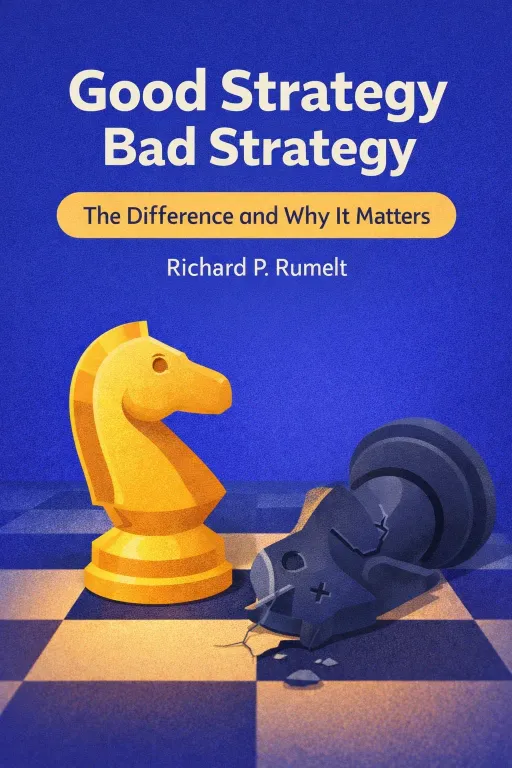
Nova: Absolutely. And it's built on the shoulders of giants like Richard Rumelt, whose groundbreaking work, "Good Strategy/Bad Strategy," really redefined what strategy even means. Rumelt, a veteran of academia and a seasoned consultant to some of the world's largest companies, didn't just write another business book. He profoundly challenged the entire industry's understanding of strategy itself. He brought a level of intellectual rigor to a field often mired in buzzwords, making it clear that true strategy is about making tough, coherent choices, not just aspirational statements. He's been called 'the strategist's strategist' for a reason.
Atlas: That's fascinating. So, he's not just giving us a new flavor of the month, he's actually trying to fundamentally shift how we think about something as critical as strategy. It sounds like he’s cutting through the noise.
Nova: He really is. And the core problem he identifies is this pervasive issue of 'bad strategy'. It's not just about poor execution, it is a fundamental misunderstanding of what strategy truly entails. It’s that feeling of treading water we just talked about.
The Anatomy of Bad Strategy & The Pitfalls
SECTION
Nova: So, let's unpack this 'bad strategy' idea. Rumelt argues that many leaders, even aspiring ones with the best intentions, fall into this trap. It's often characterized by vague, fuzzy goals and a collection of confusing, often disconnected actions.
Atlas: But wait, isn't having big, aspirational goals a good thing? It sounds almost counter-intuitive to say 'fuzzy goals' are bad. For our listeners who are driven by making a difference, setting a big, bold vision seems like the first step. What's the real danger there?
Nova: That's a great question, Atlas. Aspiration isn't the problem. The problem arises when that aspiration isn't anchored in reality, or when it lacks a clear, actionable path. Imagine a company that announces a grand new 'innovate or die' initiative. Sounds inspiring, right?
Atlas: Totally. Very motivational.
Nova: But then, when you dig a little deeper, you find the goals are things like 'be more innovative' and 'foster a culture of creativity.' The actions are equally vague: 'have more brainstorming sessions' or 'encourage out-of-the-box thinking.' There's no clear diagnosis of they aren't innovative now, what specific barriers exist, or these actions will directly lead to measurable innovation. It's a lot of fluff and fog masquerading as strategy.
Atlas: I see. So it's like saying you want to get fit, but your 'strategy' is just 'exercise more' and 'eat better,' without a specific workout plan or a diet you can actually stick to. You're hoping enthusiasm alone will get you there.
Nova: Precisely! Rumelt calls this kind of bad strategy a failure to choose. True strategy involves making tough choices about what to do, what resources to commit, and what specific challenge you're addressing. Bad strategy often avoids these hard decisions, leading to what he terms a 'kernel' that's essentially empty.
Atlas: That sounds rough, but I can definitely relate. It's easy to fall into that trap because it feels good to have those big, optimistic statements. But for someone who wants to genuinely lead and make a difference, how do they spot this 'bad strategy' in themselves or their teams before they waste a lot of time and energy?
Nova: A key indicator is when strategy documents are filled with jargon, buzzwords, and financial targets that aren't tied to any specific operational plan. Another sign is when there's no clear 'diagnosis' of the core challenge. If you can't articulate the fundamental problem you're trying to solve, you're likely operating on bad strategy. It’s a common pitfall that even highly experienced leaders can stumble into, especially when the pressure for quick, positive-sounding answers is high.
Building a 'Good Strategy' Kernel & Practical Application
SECTION
Nova: So, if that's 'bad strategy,' what does 'good' look like? Rumelt gives us a powerful framework, a 'kernel' with three distinct, interconnected parts: diagnosis, guiding policy, and coherent actions.
Atlas: Okay, so this is the blueprint for actually stopping the guessing and starting to lead effectively. Let’s break it down. What’s the first part, 'diagnosis'?
Nova: Diagnosis is about clearly defining the core challenge. It's like a doctor not just treating a fever, but figuring out you have the fever. For example, a struggling retail store might say, 'Our sales are down.' That's a symptom. A good diagnosis would be: 'Foot traffic is down because our prime demographic, busy young professionals, now shops online for convenience, and our current in-store experience doesn't offer unique value that justifies a trip.'
Atlas: Wow, that’s a huge difference. It’s moving from a vague problem to a very specific, actionable insight. It sounds like you really have to dig deep and ask 'why' multiple times to get to that true diagnosis.
Nova: Absolutely. And once you have that clear diagnosis, the second part of the kernel is the 'guiding policy.' This is your overall approach to overcome that specific challenge. For our retail store, if the diagnosis is about convenience and lack of unique in-store value, the guiding policy might be: 'Transform the store into an experiential hub that offers unique, in-person workshops and curated local products not available online.'
Atlas: That’s a great way to put it. So, the guiding policy is the strategic choice, the 'how we're going to win' against that specific diagnosis. It's not just a mission statement, it's a direction. And this is where Covey's 'begin with the end in mind' really shines, right? You're defining your desired outcome before you even think about the steps.
Nova: Precisely! Covey's principle is foundational here. You're defining your desired outcome, your strategic direction, you jump into action. And that brings us to the third part: 'coherent actions.' These are specific, coordinated steps designed to carry out your guiding policy. For our retail store, these actions would be: 'redesigning the store layout to incorporate dedicated workshop spaces,' 'actively partnering with local artisans and experts to host unique workshops,' and 'launching targeted social media campaigns specifically for workshop sign-ups, not just product sales.'
Atlas: Okay, so it’s not just a list of things to do; they all have to connect back to that guiding policy, which itself addresses the diagnosis. It’s a complete chain. I’m curious, for someone listening right now, an aspiring leader who wants to make a difference, how does this framework apply to their personal goals or even their career trajectory? It sounds like a lot of corporate jargon, but really it's about clarity.
Nova: It is. Think about it this way: your biggest goal, whether it's getting a promotion or launching a new project, has a core challenge. That's your diagnosis. Your guiding policy is your unique approach to overcome that challenge, and your coherent actions are the specific steps you'll take. It’s a powerful tool for clarity, direction, and ultimately, impact. It cuts through the noise of simply 'working harder' and directs your energy to 'working strategically.'
Synthesis & Takeaways
SECTION
Nova: What we've been talking about today, this distinction between good and bad strategy, it's not just for CEOs of multinational corporations. It’s a fundamental lens through which you can view any challenge, big or small, personal or professional. It’s about cultivating a mindset that refuses to guess.
Atlas: That’s actually really inspiring. It frames leadership not as about having all the answers, but about asking the right questions to get to the core diagnosis. It empowers you to be an intentional leader, rather than just reacting to circumstances. The value here is in the clarity and intentionality it brings, reducing wasted effort and dramatically increasing your influence.
Nova: Exactly. And the beauty of this framework is its simplicity, once you grasp it. It makes the complex process of strategic thinking accessible and actionable. It helps you articulate your vision, influence others more effectively, and build a strong foundation for ethical decisions because you understand the 'why' behind your choices. It really is about understanding complex interactions to create lasting impact.
Atlas: So, for our listeners, here’s a tiny step you can take right now: think about your current biggest goal. Then, write down its core challenge—that’s your diagnosis. Next, articulate your main approach to overcome it—that's your guiding policy. And finally, list three specific actions you'll take that are aligned with that policy.
Nova: Do that, and you'll immediately feel the shift from guessing to leading. It truly is a game-changer.
Atlas: A powerful way to start.
Nova: This is Aibrary. Congratulations on your growth!