

Stop Guessing, Start Leading: The Guide to Data-Driven Decisions.
Golden Hook & Introduction
SECTION
Nova: Most leaders think they're strategists, but they're often just dreamers with a fancy PowerPoint. We're about to expose the brutal truth of why so many 'strategies' fail, and it's not what you think.
Atlas: Whoa, that's a bold claim, Nova! Are you telling me all those grand corporate visions are just… elaborate wish lists? Because I imagine a lot of our listeners, the ones pushing for impact and building their careers, start with a big vision.
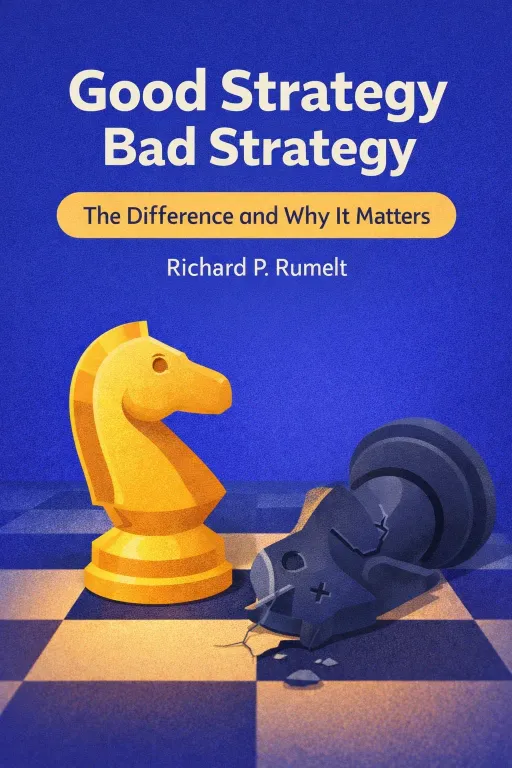
Nova: Absolutely, Atlas. Vision is crucial, but it’s only the beginning. Today, we’re diving into how to transform those fuzzy plans into crystal-clear, defensible strategic decisions, drawing essential frameworks from Richard Rumelt's 'Good Strategy/Bad Strategy' and Daniel Kahneman's groundbreaking 'Thinking, Fast and Slow.'
Atlas: Two absolute titans! Each tackling decision-making from such different angles. What’s the common thread that brings them together for us today? What overarching problem do they solve?
Nova: It’s about making clear, defensible decisions. Rumelt gives us the diagnostic tools for what a good strategy looks like, and Kahneman reveals the how – the psychological traps that can derail even the smartest plans. It's the ultimate guide to stop guessing and start leading.
The Diagnostic Power of Good Strategy
SECTION
Nova: So, let’s start with Rumelt. He argues that a good strategy isn't just about having a grand goal or a lofty vision. It’s about identifying a clear challenge and then applying a coherent set of actions to overcome it.
Atlas: Okay, but isn't ambition essential for leadership? For those of us trying to build a career and make an impact, isn't a big vision the starting point? You need something big to aim for, right?
Nova: You do, but vision without a diagnostic approach is just aspiration. Think of a company that’s losing market share. A bad strategy might say, "Our goal is to be the market leader again!" That’s a goal, not a strategy. A good strategy would first diagnose they're losing market share. Is it a new competitor? Changing customer preferences? Internal inefficiencies?
Atlas: So, it's almost like a doctor diagnosing an illness, rather than just treating symptoms? Because I imagine many strategies are just symptom-treatments. They’re patching things up without getting to the root cause.
Nova: Exactly! Rumelt calls it the "kernel" of strategy: first, a diagnosis of the true challenge; second, a guiding policy for how to approach it; and third, a set of coherent actions designed to execute that policy. A bad strategy often skips the diagnosis, or it pretends the problem doesn't exist. It uses fluff, or it sets goals and calls them strategy.
Atlas: This really resonates with anyone trying to translate strategy into numbers, like in advanced financial modeling. If the strategy itself is fuzzy, if you haven't truly diagnosed the challenge, how can you model it effectively? How do you even begin to measure success?
Nova: You can't, not genuinely. You end up modeling assumptions, not reality. Take a real-world example: A major airline was consistently losing money. Their initial "strategy" was to cut costs across the board. But a deeper diagnosis revealed the real problem wasn't just costs, but costs. They were spending on things customers didn't value, while neglecting areas that truly mattered for customer experience. A good strategy would reallocate, not just cut.
Battling Cognitive Biases in Decision-Making
SECTION
Nova: And speaking of fuzzy, sometimes the fuzziest part of our strategy isn't external, but internal – it's how our own minds work. This is where Daniel Kahneman’s 'Thinking, Fast and Slow' becomes absolutely indispensable.
Atlas: Oh, I know that feeling! That 'gut instinct' that feels so right, but sometimes leads you completely astray. Is Kahneman saying we shouldn't trust our intuition at all? Because I imagine for a lot of network weavers, that intuition is key to connecting with people.
Nova: Kahneman isn't saying intuition is always wrong, but he's showing us its limitations. He reveals how our minds operate on two systems. System 1 is fast, intuitive, and emotional. It’s what helps you recognize a face or slam on the brakes. System 2 is slow, deliberate, and logical. It’s what you use to solve a complex math problem or plan a detailed project.
Atlas: So, System 1 is like the autopilot, and System 2 is when you actively take the wheel. The problem is, our brains prefer autopilot, especially when we're busy or stressed.
Nova: Precisely. And in leadership, especially under pressure, we often default to System 1, which is prone to biases. Think about availability heuristic – we tend to overestimate the likelihood of events that are easier to recall. Or confirmation bias, where we seek out information that confirms our existing beliefs. These biases can lead even the smartest leaders to formulate what Rumelt would call a "bad strategy."
Atlas: So, for leaders trying to inspire teams and drive decisions, how do you communicate a strategy that's built on slow, deliberate System 2 thinking, when everyone's wired for fast, intuitive System 1 responses? It sounds like you're fighting human nature.
Nova: It’s not about fighting human nature, it’s about understanding it and building safeguards. Imagine a tech startup founder, brilliant but prone to overconfidence. They believe their product is revolutionary because they’ve surrounded themselves with people who echo that belief – a classic confirmation bias. They ignore market research suggesting otherwise. The strategy is built on passion, not data.
Atlas: That makes me wonder, how do you even those frameworks? It sounds like you have to constantly fight your own brain, constantly second-guess yourself, which can paralyze decision-making.
Nova: It's not about paralysis; it's about conscious design. A good framework forces System 2 engagement. It might involve a "pre-mortem" where you imagine the strategy has failed and work backward to understand why. Or requiring diverse, dissenting opinions before a major decision. These are deliberate mechanisms to counteract our innate biases.
Synthesis & Takeaways
SECTION
Nova: So, when we bring Rumelt and Kahneman together, the picture becomes incredibly clear. Rumelt's diagnostic approach, identifying the real challenge and formulating coherent actions, absolutely requires Kahneman's awareness of our cognitive biases. It’s not just about what to do, but how to ensure our minds let us do it right, without self-sabotage.
Atlas: That’s such a powerful synthesis. It's not just about having a good strategy on paper; it's about having the mental discipline to execute it without being derailed by our own internal wiring. For those of us who care about ethical finance practices and broader social good, this is huge. Bad strategy, fueled by unchecked bias, can have real-world negative consequences, impacting countless lives.
Nova: Absolutely. The tiny step for today, for every listener, is to identify one recent strategic decision you made. Use Rumelt's criteria: did it identify a clear challenge? Did it have coherent actions? And then, reflect: were any Kahneman-esque biases at play? Did you rush to System 1 when System 2 was truly needed?
Atlas: That’s a powerful challenge. It forces you to actually the work, not just think about it. It makes you a conscious leader.
Nova: Indeed. It’s about moving from guessing to leading, with a clear understanding of your challenge, and the self-awareness to overcome your internal biases. That, my friend, is your unfair advantage.
Atlas: Love that. This is Aibrary. Congratulations on your growth!