

Stop Data Overload, Start Strategic Insight: The Guide to Meaningful Metrics
Golden Hook & Introduction
SECTION
Nova: Atlas, before we dive into today's topic, I have a challenge for you. Give me a five-word review of "data overload."
Atlas: Oh, man. Five words? Okay… "Drowning. In. Numbers. No. Insight."
Nova: Perfect! "Drowning. In. Numbers. No. Insight." That perfectly captures the modern dilemma, doesn't it? We’re awash in information, spreadsheets, dashboards, metrics coming at us from every angle, and yet, sometimes it feels like we’re seeing less clearly than ever before.
Atlas: Absolutely. It’s like having a million pieces of a puzzle, but no picture on the box, and half of them are from another puzzle entirely. You’re busy, but you’re not building anything coherent.
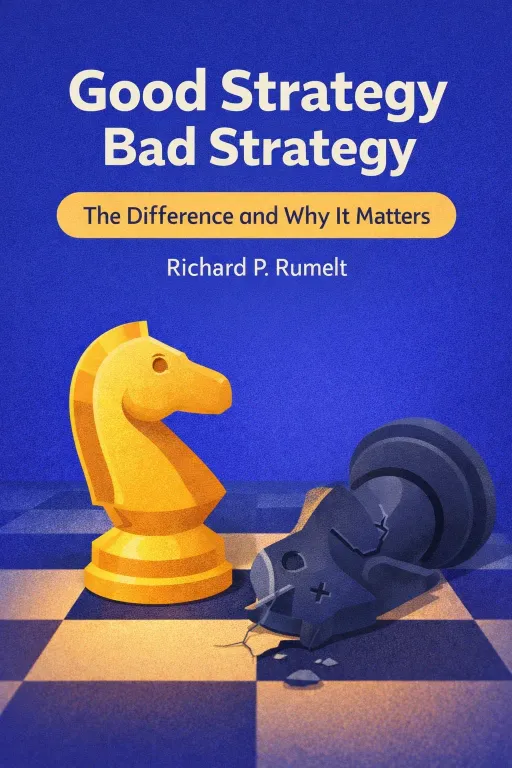
Nova: Exactly. And that’s what we’re tackling today: how to cut through that noise and find the signals that truly matter. We’re drawing insights from some seriously sharp minds today, particularly Richard Rumelt, author of "Good Strategy/Bad Strategy," and John Doerr, who brought us "Measure What Matters."
Atlas: These aren't just academic musings either. Rumelt, as a long-time professor at UCLA's Anderson School of Management, has spent decades dissecting why some strategies soar and others crash, often due to how they define success. And Doerr, he's the venture capitalist who championed Objectives and Key Results, or OKRs, at places like Google, turning them into a global standard for measurable ambition. Their work is grounded in high-stakes, real-world application.
Nova: Which makes their insights incredibly valuable. Because raw data, as we know, can be overwhelming. But true strategic advantage? That comes from discerning meaningful metrics. It’s about cutting through the noise to find the signals that drive real progress and clarify your path.
The Signal Amidst the Noise: Distinguishing Meaningful Metrics
SECTION
Atlas: So, where do we even begin when everything feels like a priority, and every data point screams for attention? How do we stop drowning in those numbers and actually gain some insight?
Nova: That's where Rumelt's work becomes our compass. He argues that good strategy isn't just a list of aspirations or goals. It identifies a clear, specific challenge, and then applies a set of coherent, coordinated actions to overcome challenge. Think of it like a doctor. A bad doctor might just order every test under the sun, hoping to stumble upon something. A good doctor, however, listens to your symptoms, forms a hypothesis, and then orders specific tests to confirm or deny that hypothesis, targeting their inquiry.
Atlas: So, the "bad strategy" equivalent in the data world would be just tracking everything because you can, without first defining the "illness" or the "challenge" you're trying to solve?
Nova: Precisely. Many organizations fall into the trap of what he calls "bad strategy." They'll list financial goals, market share aspirations, or innovation targets, but they fail to diagnose the root cause of why they aren't achieving those things. They're tracking hundreds of metrics – website clicks, social media engagement, email open rates, sales calls – all valuable in isolation, but without a clear strategic challenge, they become a fog. You're busy, you're tracking, but you're not making coherent progress.
Atlas: That sounds rough, but isn't it tempting to just track everything, hoping something sticks? Especially for someone who processes vast information and wants to ensure they're not missing anything critical?
Nova: Absolutely, it’s a very human tendency. We think more information equals more control. But Rumelt highlights that "bad strategy" often avoids making tough choices. It uses vague language, avoids identifying specific problems, and sets goals that are merely aspirational. When your strategy is vague, your metrics become equally vague or proliferate wildly to cover every possible angle. The outcome is often confusion, wasted resources, and a feeling of running in place despite all the data collection.
Atlas: So, it's like we're collecting puzzle pieces, but we don't even know what the final picture is supposed to be, so we end up with a pile of colorful but disconnected fragments. We need to identify the first, then figure out what specific information will help us solve it.
Nova: Exactly! It's about finding those key leverage points. What are the 2-3 things that, if we truly understood and measured them, would tell us if we’re actually making progress on our core challenge? It’s a radical shift from "measure everything" to "measure what moves the needle."
Strategic Focus & Measurable Outcomes: The Power of Intentional Measurement
SECTION
Nova: And that naturally leads us to the second key idea we need to talk about, which often acts as the practical framework for implementing Rumelt's strategic clarity: John Doerr's Objectives and Key Results, or OKRs.
Atlas: Ah, OKRs. They've become almost legendary in the tech world, but for those who might only know the acronym, what exactly are they, and how do they help us cut through the data noise?
Nova: OKRs are a powerful goal-setting framework. An Objective is you want to achieve – it should be significant, concrete, action-oriented, and inspirational. It’s the direction. The Key Results are you'll know if you've achieved that Objective – they must be specific, measurable, achievable, relevant, and time-bound. They are the benchmarks. The magic happens when these two are tightly linked.
Atlas: So, the Objective sets the strategic challenge, and the Key Results are the meaningful metrics we were just talking about? The ones that actually tell us if we're overcoming that challenge?
Nova: Precisely. Think about Google in its early days. Their objective might have been something like "Organize the world's information and make it universally accessible and useful." That's ambitious, inspiring. But how do you that? Their Key Results weren't vague, like "be better at search." They were things like "reduce search latency by X milliseconds," or "increase user satisfaction by Y%," or "index Z billion new web pages." These were concrete, measurable outcomes.
Atlas: Wow. That's a perfect example. It's not just about setting a big goal; it's about breaking it down into a few, very specific, very things that, if achieved, undeniably mean you're closer to that big objective.
Nova: And it’s that measurability that cuts through the data overload. Instead of tracking every single metric related to "organizing information," they focused on the 2-3 Key Results that truly indicated progress toward. It ensured alignment, focus, and accountability across the entire organization. It converts complexity into clear, actionable strategic direction.
Atlas: I can see how that would bring immense clarity for a team or even an individual. But Nova’s Take in our content mentioned defining one clear objective and no more than three measurable key results. For someone in a complex field, isn't that incredibly restrictive? How do you you've picked the three?
Nova: That’s the art of it, Atlas, and it's why Rumelt's "good strategy" is so critical first. You don't just pick three random metrics. You define your singular, most important objective, which comes from your clear strategic challenge. Then, you ask: "What are the absolute minimum number of outcomes that, if achieved, would unequivocally tell me I succeeded at this objective?" It forces you to identify those key leverage points we discussed. It's about ruthless prioritization and understanding cause and effect. If you can achieve those three results, then your objective is met.
Atlas: So it's not about what be measured, but what be measured to prove success against a clearly defined challenge. That's a subtle but powerful distinction. It's about intentionality, not just activity.
Synthesis & Takeaways
SECTION
Nova: Exactly. What we've explored today is this powerful synergy: Rumelt's insistence on a clear, coherent strategy that diagnoses a specific challenge, combined with Doerr's framework for translating that strategy into ambitious, measurable outcomes. It’s not about having all the data; it’s about intelligently choosing what to measure, based on a profound understanding of your path and desired progress.
Atlas: I mean, that’s actually really inspiring. It takes the feeling of being overwhelmed by data and replaces it with a sense of control and purpose. It's about mastery, not just management, of information. It's about turning that mountain of data into a clear, illuminated path.
Nova: And the beauty is, it starts with a tiny step. For your next project, define just one clear objective. What is the single most important thing you need to achieve? And then, identify no more than three measurable key results that will tell you, without a doubt, if you’ve hit that objective.
Atlas: And share them with your team. That clarity, that focus, it’s infectious. It moves everyone from just "doing stuff" to "driving strategic impact." It’s an incredibly empowering way to approach any challenge.
Nova: It truly is. It's how you convert complexity into clear, actionable strategic direction.
Atlas: Nova, this has been a fantastic exploration of moving from data overload to genuine strategic insight.
Nova: Always a pleasure, Atlas.
Nova: This is Aibrary. Congratulations on your growth!