

Mastering the Art of Strategic Vision & Execution
Golden Hook & Introduction
SECTION
Nova: You know, Atlas, I've been thinking a lot lately about how many organizations, and even individuals, talk a really good game when it comes to "strategy." They've got the vision boards, the mission statements, the inspiring jargon...
Atlas: Oh, tell me about it. The word 'strategy' itself has become this kind of corporate incantation, hasn't it? Like if you say it enough times, success will magically appear. I’ve seen more 'strategic initiatives' that feel like glorified to-do lists than actual blueprints for transformation.
Nova: Exactly! It’s like everyone wants to be a 'visionary leader' but very few actually know how to build the road that gets them there. This isn’t just about big ideas, it’s about making tough choices and aligning every single action to a clear, compelling direction.
Atlas: That’s a really sharp point. It makes me wonder, what's the actual difference between just having a good idea and having a? Because my gut tells me a lot of what passes for strategy today is just... aspiration.
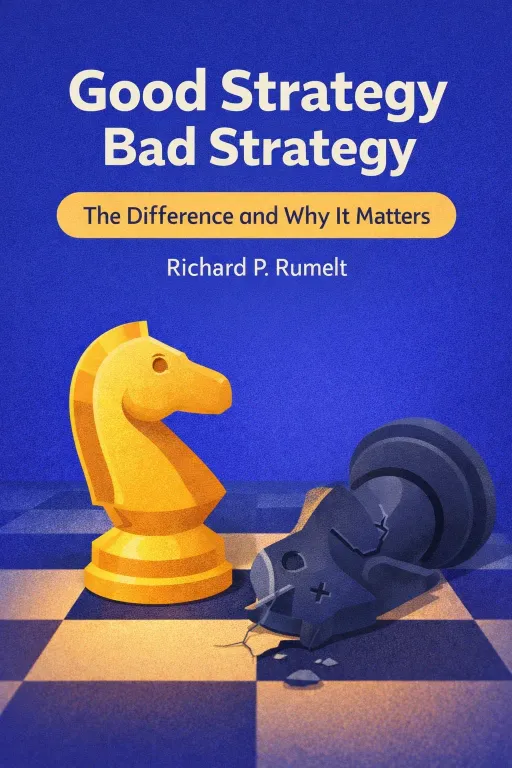
Nova: Well, that's precisely what we're dissecting today, pulling insights from two absolute titans in the field: Richard Rumelt’s seminal work,, and then we're going to layer that with the incredibly practical framework from A. G. Lafley and Roger L. Martin’s.
Atlas: Rumelt, Rumelt. He's often called the 'strategist's strategist,' isn't he? I remember hearing his background is fascinating; he started in electrical engineering and then shifted to business, which probably gives him this really rigorous, almost scientific approach to strategy that cuts through the fluff.
Nova: Absolutely. That engineering background is key. He brings this incredible clarity to a field often muddled by buzzwords. And Lafley and Martin——that book is like the ultimate playbook for anyone who wants to not just understand strategy, but actually it. It’s been heralded for taking Procter & Gamble from struggling to soaring through their strategic choices.
Atlas: That’s a powerful combination then. So, to really unpack this, where do we even begin to differentiate between the strategic gold and the strategic… glitter?
The Anatomy of a Good Strategy
SECTION
Nova: Let's start with Rumelt, because he lays the absolute groundwork for what distinguishes a good strategy from a bad one. He argues that bad strategy often stems from four major hallmarks: fluff, failure to face the problem, mistaking goals for strategy, and bad strategic objectives.
Atlas: Okay, 'fluff' I get. That’s the jargon-filled, buzzword-heavy mission statements that sound inspiring but mean absolutely nothing in practice. Like 'synergistic paradigm shifts for optimized stakeholder engagement.'
Nova: Precisely! It's the kind of language that sounds intelligent but obscures a lack of actual substance. Rumelt calls it 'gaseous prose.' But the second hallmark, 'failure to face the problem,' that's where things get really interesting. He says a good strategy and then to overcome it. Bad strategy, on the other hand, often skirts around the real issues, offering vague generalities instead of pinpointing the core problem.
Atlas: So, for our listeners who are often trying to drive impact and optimize processes, this isn't just about saying 'we need to grow revenue.' It’s about asking, 'why isn't revenue growing? Is it a product problem, a market problem, a sales execution problem?' And then picking of those to tackle.
Nova: Exactly! Imagine a company whose revenue is flatlining. A bad strategy would say, 'Our strategy is to achieve 15% growth next year.' That's a goal, not a strategy. A good strategy, following Rumelt, would say: 'Our critical challenge is that our core product, while once innovative, has fallen behind competitors in feature set, leading to declining market share. Our strategy is to reallocate R&D resources to rapidly develop and launch a next-generation product within 18 months, while simultaneously initiating a targeted marketing campaign to retain existing customers during this transition.'
Atlas: Oh, I like that. That’s actually a. It’s got a diagnosis, a guiding policy, and a set of coherent actions. It’s not just wishful thinking. That’s going to resonate with anyone who’s ever sat through a meeting where the 'strategy' was just a list of things they to happen.
Nova: And this leads to his third hallmark: mistaking goals for strategy. A goal is an aspiration. A strategy is a plan of action designed to achieve that goal, specifically by overcoming a challenge. And the fourth is what he calls 'bad strategic objectives' – those that are fuzzy, don't align with the diagnosis, or are simply impossible.
Atlas: So, if your goal is to 'dominate the market' but your actions are just 'do more marketing,' that’s a bad strategic objective because it lacks focus and isn't truly addressing the underlying challenge.
Nova: Right. Rumelt’s genius is in showing that real strategy is about focus and coherence. It's about as much as what to do. It's about identifying the most crucial knot in a complex problem and then pulling on that one thread. He emphasizes that a good strategy has a 'kernel' consisting of three parts: a diagnosis of the situation, a guiding policy for how to deal with it, and a set of coherent actions to implement that policy.
Atlas: That’s such a practical way to break it down. I imagine a lot of our listeners, who are always looking to optimize and drive impact, see this clarity as incredibly valuable. It strips away the pretense.
Nova: It absolutely does. It forces you to be honest about your challenges and disciplined in your approach. It’s not about being clever; it’s about being clear. And that clarity is what unlocks breakthroughs.
The Integrated Framework for Strategic Execution
SECTION
Nova: Now, once you have that Rumelt-esque 'good strategy' – clear diagnosis, guiding policy, coherent actions – the next question is, how do you it? How do you ensure it’s not just a brilliant document gathering dust, but a living, breathing blueprint that drives your organization? That’s where Lafley and Martin’s truly shines.
Atlas: Ah, so this is where the rubber meets the road. Because a great strategy on paper means nothing if it doesn't translate into real-world results. I imagine a lot of our listeners have experienced that disconnect between the 'strategic offsite' and the daily grind.
Nova: Precisely. They offer a five-step integrated framework that connects aspirations to execution. It’s like a strategic chain, and each link is critical. The five choices are: What is our winning aspiration? Where will we play? How will we win? What capabilities must be in place? And what management systems are required?
Atlas: Okay, 'winning aspiration' sounds like a fancy way to say 'goal,' but I’m guessing it’s more nuanced than that. How is it different from Rumelt’s 'goal vs. strategy' point?
Nova: Excellent question, and it actually complements Rumelt perfectly. A winning aspiration isn't just a financial target. It's about and. Lafley and Martin argue it must be about winning in a specific place, for a specific customer. So, it's not just 'grow revenue,' but 'be the undisputed leader in sustainable home cleaning products in North America.' It’s about a clear ambition that defines success.
Atlas: So, it’s a more holistic, market-centric definition of success. And then 'where will we play'? Is that about market segmentation?
Nova: Exactly. This is about defining the playing field. Which geographies, product categories, customer segments, and channels will you focus on? It’s another act of choice, of trying to be everything to everyone. For instance, P&G under Lafley decided to focus on specific segments of consumer packaged goods where they could genuinely win, rather than spreading themselves thin across every possible market.
Atlas: That makes so much sense. For someone who's always looking at the bigger picture and optimizing, this is about drawing clear boundaries. You can’t win everywhere, so pick your battles.
Nova: And then comes 'how will we win?' This is the core of your competitive advantage. Will you win on cost, differentiation, speed, customer intimacy, or innovation? It’s your unique value proposition. For example, Southwest Airlines wins on low cost and efficient operations, while Porsche wins on performance and brand prestige. They can't both 'win' in the same way.
Atlas: So, if you’ve decided you’re playing, this is the strategy for that playing field. And then, 'what capabilities must be in place'? This feels like the practical backbone.
Nova: It is. These are the specific organizational strengths, skills, and assets you need to deliver on your 'how to win' choice. If your strategy is to win on innovation, you need world-class R&D, a culture of experimentation, and rapid prototyping capabilities. If it's on cost, you need lean manufacturing, efficient supply chains, and aggressive cost management. These aren't just things you you had; they are things you build or acquire.
Atlas: And finally, 'what management systems are required'? This sounds like the engine that keeps it all running.
Nova: It’s the glue. These are the systems, structures, and measures that reinforce and support your capabilities and choices. Your budgeting process, performance reviews, incentive structures, communication channels—they all need to align with your strategy. If your strategy is innovation but your compensation system rewards only short-term cost-cutting, you have a misalignment. Lafley and Martin argue that these five choices are interdependent. You can’t make one in isolation. They form a robust, coherent system.
Atlas: That’s a powerful integrated view. It’s not just about a brilliant idea, it’s about a brilliant idea because every part of your organization is pulling in the same direction. What I really like about this is how it connects the high-level vision with the nitty-gritty of daily operations, which is often where strategies fall apart. It ensures the strategic vision isn't just inspiring, but deeply embedded.
Synthesis & Takeaways
SECTION
Nova: Exactly. When you combine Rumelt’s clarity on what constitutes a strategy—diagnosing the real problem, having a guiding policy, and coherent actions—with Lafley and Martin’s integrated framework for by aligning aspirations, playing fields, winning tactics, capabilities, and management systems, you get this incredibly powerful blueprint.
Atlas: It really shifts the perspective from strategy as a theoretical exercise to strategy as a series of disciplined, interconnected choices. It’s about saying 'no' to a lot of things so you can say a powerful 'yes' to the few things that truly matter.
Nova: And for our listeners, the aspiring architects and strategic operators, this is the toolkit they need to not just see the bigger picture, but to actually it. It’s about transforming ambition into tangible impact, moving beyond just optimizing to truly driving breakthrough results.
Atlas: So, if there’s one tiny step our listeners could take after hearing this, what would it be? For me, it feels like it starts with that Rumelt diagnosis: What’s the single most critical challenge you or your team are facing right now?
Nova: I love that. And then, once you’ve articulated that challenge, think about three distinct, actionable choices you could make to address it. And then, crucially, evaluate the potential outcomes of each. Don't just pick the easiest; pick the one that truly addresses the core, even if it's harder.
Atlas: That’s a fantastic challenge. It ties directly into the 'making tough choices' aspect they both emphasize. It's not about being busy; it's about being strategically impactful. This isn’t just about growth; it’s about growth.
Nova: Absolutely. It’s about creating a future, not just reacting to it. And that, I think, is the ultimate power of mastering strategic vision and execution.
Atlas: What a powerful way to frame it. This conversation gives me such a clear perspective on moving beyond vague intentions to actual, concrete action that drives real change.
Nova: It’s about realizing that strategy isn't a mystical art, but a rigorous science of choice and alignment.
Atlas: This is Aibrary. Congratulations on your growth!