

How to Lead AI Teams Without Losing Your Strategic Edge.
Golden Hook & Introduction
SECTION
Nova: Atlas, if I say the word "strategy," what's the first thing that comes to your mind? And be honest.
Atlas: Oh, man. Honestly? It's usually a beautifully designed PowerPoint deck that's already gathering dust in someone's digital archives. Or, you know, a very important meeting where everyone agrees on "synergy" and "leveraging core competencies" without ever quite defining what any of that means.
Nova: Exactly! It's so easy for "strategy" to become this nebulous, high-level concept that sounds impressive but ultimately leads to, well, more dusty PowerPoints. But when it comes to leading AI teams, a vague strategy isn't just inefficient; it's a fast track to chaos, wasted resources, and missed opportunities.
Atlas: That sounds rough, but I can definitely relate. A lot of our listeners leading AI efforts probably feel that fragmentation you mentioned. It’s like they’re building incredible pieces of a puzzle, but no one’s really showing them the picture on the box.
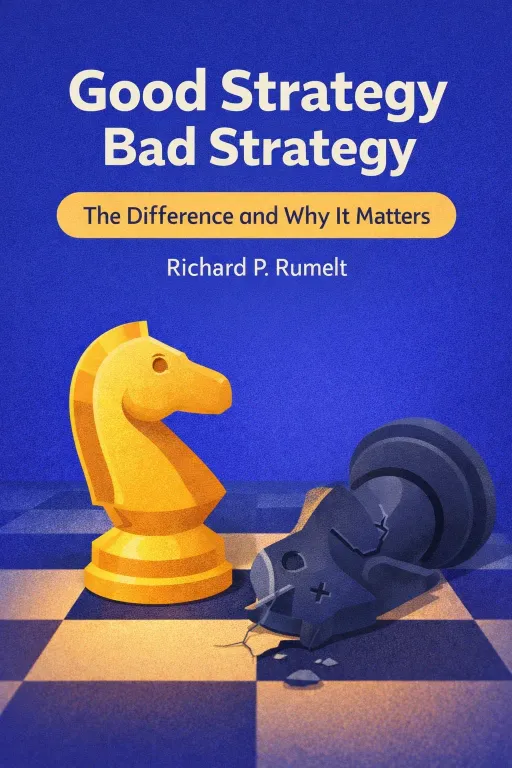
Nova: That's a perfect analogy. And that's precisely why today, we're diving deep into two foundational texts that, when combined, offer an incredibly powerful framework for leading AI product organizations. We're talking about the strategic brilliance of Richard Rumelt's "Good Strategy/Bad Strategy" and the iterative genius of Eric Ries's "The Lean Startup." Rumelt, often called "the strategist's strategist," cuts through corporate jargon with academic rigor, while Ries transformed how we think about innovation, moving his principles far beyond just startups.
Atlas: So, we're essentially looking at the 'why' and the 'how' of navigating the AI landscape. I’m curious to see how these two seemingly different approaches actually complement each other.
The 'Why' Before the 'How' with Richard Rumelt
SECTION
Nova: Absolutely. Let's start with Rumelt. His central argument is that good strategy isn't just about setting ambitious goals or having a vision board. It's a coherent action plan. And it has three crucial elements: a diagnosis of the challenge, a guiding policy, and a set of coherent actions.
Atlas: Diagnosis, guiding policy, coherent actions. That sounds almost deceptively simple. My gut tells me a lot of AI initiatives probably skip that first step, the diagnosis part.
Nova: You are spot on. Imagine a doctor who just starts prescribing medicine without running tests or understanding the patient's symptoms. That's what many AI teams do. They get excited about a new model or a cool technology and jump straight to building, without truly diagnosing the core problem they're trying to solve.
Atlas: That makes me wonder how many AI projects start with "Let's build a chatbot!" without ever asking, "What's the actual communication breakdown we're trying to fix, or what specific user pain point is this meant to alleviate?"
Nova: Exactly! Rumelt would call that "bad strategy." A good strategic diagnosis doesn't just state the obvious. It identifies the critical aspects of the situation, the true obstacles preventing progress. For an AI team, this might mean realizing that the real challenge isn't a lack of data, but a lack of a clear, measurable business objective for the AI's output.
Atlas: So, the diagnosis isn't just identifying a problem, it's about uncovering the of the problem in a way that points toward a solution.
Nova: Precisely. Once you have that clear diagnosis, you can formulate a "guiding policy." This isn't a detailed plan, but rather an overall approach, a compass bearing for how to overcome the diagnosed obstacles. For example, if your diagnosis is "our AI product roadmap is too fragmented and lacks impact," a guiding policy might be "focus all AI development on customer retention initiatives for the next year."
Atlas: That’s a great way to put it. It’s like, instead of saying "we want to grow," it's "we're going to grow by retaining our existing customer base with hyper-personalized AI-driven experiences." It gives you a clear direction, but still leaves room for you'll get there.
Nova: And that 'how' is the third element: coherent actions. These are the coordinated steps designed to implement the guiding policy. They should be mutually reinforcing and aligned with the diagnosis. In our example, coherent actions might involve specific data engineering projects, new model development for churn prediction, and integrating AI insights into customer service workflows.
Atlas: So, if your guiding policy is customer retention, building a brand-new, cutting-edge generative AI art tool for the marketing department probably isn't a coherent action. It might be cool, but it's not with your strategy.
Nova: You got it. Rumelt's framework forces you to define your 'why' before you even think about the 'how,' preventing that fragmentation and wasted effort that plagues so many AI initiatives. It's about giving your team a clear target and a unified purpose.
Agile Execution in AI with Eric Ries
SECTION
Atlas: That makes perfect sense for setting the direction. But even with the clearest strategy, AI development is a journey through uncertainty. How do you make progress without getting bogged down, especially when the tech is evolving so fast? This sounds like where the rubber meets the road, or perhaps, where the data meets the model.
Nova: Absolutely, and that's where Eric Ries and "The Lean Startup" come in. Ries introduces validated learning and rapid experimentation as the tactical approach that perfectly complements strategic thinking. It's all about building, measuring, and learning.
Atlas: Build, measure, learn. I've heard that phrase a lot, but I’ve also seen it misapplied. How does that translate into the often complex, data-heavy world of AI? Isn't experimentation expensive and data collection complex? How do you do 'rapid' experimentation when you need massive datasets or specialized hardware?
Nova: That's a critical question. The core idea is to de-risk large investments through small, fast experiments. For an AI team, this means identifying the riskiest assumptions about your product or model and designing the smallest possible experiment to test them.
Atlas: Can you give an example? Like, how would this work for an AI-powered recommendation engine?
Nova: Sure. Let's say your Rumelt-inspired guiding policy is to "increase user engagement through superior content recommendations." Your team might initially assume that a highly complex deep learning model is the only way to achieve this. But a "Lean Startup" approach would suggest you first build a Minimum Viable Product, or MVP, for your recommendation engine.
Atlas: So, not the perfect, fully-fleshed-out AI, but something basic that still delivers some value?
Nova: Exactly. Your MVP might be a simple rule-based system or a basic collaborative filtering algorithm. The "build" phase is creating that. The "measure" phase is seeing if users actually engage more with these basic recommendations, or if they even notice a difference. You might track click-through rates, time spent on recommended content, or even run A/B tests.
Atlas: And then the "learn" phase is analyzing that data to validate or invalidate your initial assumption. Did the simple model work? Or do you really need more sophisticated AI? This sounds like it prevents you from pouring millions into a complex model that ultimately doesn't move the needle for engagement.
Nova: Precisely. It's about learning what users truly value you optimize for scale or complexity. This is crucial for AI, where the 'challenge' is constantly evolving. And to your point about ethics, validated learning also means you can test the ethical implications of your AI in smaller, controlled environments. You can measure for bias, fairness, and transparency at an early stage, iterating on those aspects before a full-scale rollout.
Atlas: Wow, that’s actually really inspiring. So, it's not just about speed and efficiency, but also about building in responsible innovation from the ground up. You're not just iterating on features, you're iterating on impact and ethics.
Synthesis & Takeaways
SECTION
Nova: That's "Nova's Take" in a nutshell, Atlas. The real power comes from combining Rumelt's strategic clarity with Ries's iterative execution. Rumelt's diagnosis and guiding policy tell you problems are worth solving with AI and to head in. Ries's validated learning then provides the framework for to test your assumptions and build that AI solution effectively and responsibly, learning and adapting as you go.
Atlas: It's like Rumelt gives you the master blueprint, and Ries gives you the agile construction crew that can adapt to unexpected ground conditions. This integrated approach helps leaders avoid that fragmentation we talked about earlier. It means you're not just building AI; you're shaping its impact with purpose and precision.
Nova: Exactly. It's about defining the 'why' before the 'how,' and then continuously refining the 'how' through rapid, validated learning. So, for our listeners, here's a tiny step you can take today.
Atlas: I'm ready.
Nova: Take your current AI product roadmap, and identify one key challenge you're facing. Then, write a one-sentence 'guiding policy' to tackle it, just as Rumelt would suggest.
Atlas: And then, think about one small experiment you could run to validate an assumption around that policy. What's the smallest step you could take to learn something critical, before committing to a huge investment?
Nova: Strategic clarity combined with agile learning allows AI leaders to not just react to the future, but to actively and ethically shape it, ensuring their innovations have genuine impact. We’d love to hear about the guiding policies and experiments you come up with. Share your insights with us on social media!
Atlas: Absolutely. Your insights help us all grow.
Nova: This is Aibrary. Congratulations on your growth!