

From Chaos to Clarity: The Art of Strategic Planning in a Complex World
Golden Hook & Introduction
SECTION
Nova: Most of what people call 'strategy' isn't strategy at all. It's wishful thinking, a list of goals, or just a pile of tasks. And that's precisely why so many ambitious plans crumble, not from lack of effort, but from a fundamental misconception of what strategy truly is.
Atlas: Wow. That's a bold claim right out of the gate, Nova. But honestly, it resonates. I imagine a lot of our listeners, especially those leading teams or trying to chart a new personal course, have felt that frustration. You put in the work, but the pieces just don't quite connect.
Nova: Exactly, Atlas. We often mistake activity for progress, and a list of ambitions for a strategic blueprint. Today, we're cutting through that chaos to find clarity. We're diving into the art of strategic planning in our complex world, drawing from some truly foundational thinkers.
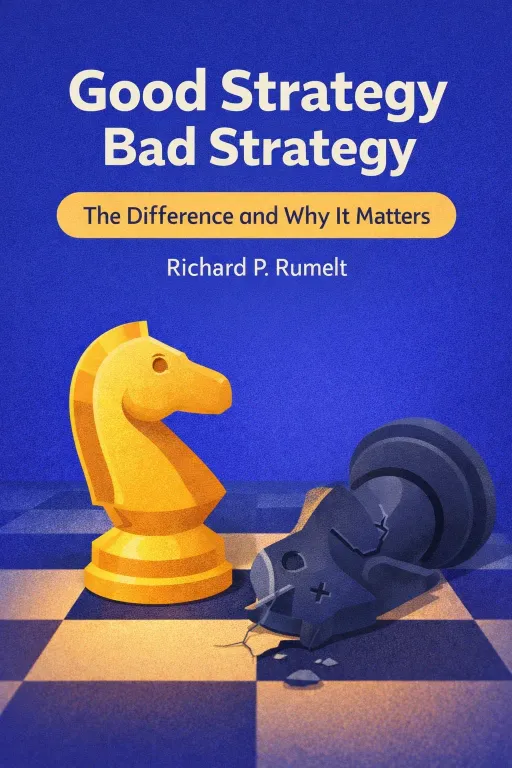
Atlas: And we're not just talking theory here. The core ideas we're exploring today come from two absolute titans in the field. First, Richard Rumelt, a professor and seasoned consultant whose book,, really redefined what effective strategy looks like. He's been advising companies and governments for decades, so his insights are grounded in deep, practical experience.
Nova: Absolutely. And then we'll pivot to the dynamic duo, A. G. Lafley and Roger L. Martin, whose book outlines a strategic choice cascade that transformed Procter & Gamble under Lafley's leadership. Their framework isn't just academic; it's a battle-tested approach to making winning choices in the marketplace.
Atlas: Right. So, we're talking about frameworks from people who've actually done it, seen it, and taught it. That makes me wonder, Nova, where do we even begin to unpack this idea of moving from chaos to clarity?
The Kernel of Good Strategy: Diagnosis, Guiding Policy, Coherent Actions
SECTION
Nova: We start with Rumelt, because he gives us the foundational truth: a good strategy has what he calls a 'kernel.' Think of it like the core of an atom, holding everything together. This kernel has three essential components: a diagnosis, a guiding policy, and coherent actions.
Atlas: A kernel. I like that imagery. So, are you saying most companies just skip the kernel and go straight to, like, planting the seed and hoping for the best?
Nova: Precisely! Many organizations jump straight to a list of goals: "We want to increase market share by 20%!" Or "We'll be the industry leader!" But that's not strategy; that's aspiration. A bad strategy often just recites goals, or talks about grand visions without explaining to get there. Rumelt's work, which has been widely acclaimed as a seminal text in strategic thinking, really highlights this critical distinction. He argues that vague, fluffy strategies are a disservice to everyone involved.
Atlas: So, what does a proper 'diagnosis' actually look like then? Because I imagine a lot of our listeners are thinking, "I know what my problems are!"
Nova: That's the tricky part. A true diagnosis isn't just listing symptoms. It's identifying the of the challenge. It's like a doctor moving beyond "my head hurts" to figure out your head hurts. For instance, imagine a tech startup struggling to retain users. A bad diagnosis might be "our users are leaving." A good diagnosis, after deep analysis, might reveal: "Our users are leaving after the first week because our onboarding process is confusing and they don't see the immediate value proposition compared to competitors who offer a smoother initial experience."
Atlas: Oh, I see. That's a very different problem statement. It’s specific, it’s actionable. It tells you where to focus your energy.
Nova: Exactly. Once you have that sharp diagnosis, the next step is the 'guiding policy.' This is your overall approach to overcoming the diagnosed challenge. It's not a detailed plan, but a principle. For our tech startup, a guiding policy might be: "We will ruthlessly simplify the user onboarding experience and highlight core value within the first three interactions."
Atlas: That’s a great way to put it. It’s a principle, not a to-do list. It sets the direction.
Nova: And finally, the 'coherent actions.' These are the specific, coordinated steps designed to implement that guiding policy. For our startup, this would be: "Redesign the onboarding flow to reduce steps by 50%," "Implement A/B testing on new user tutorials," and "Assign a dedicated product manager to user retention for the next quarter." These actions are because they all directly spring from the guiding policy, which in turn addresses the diagnosis.
Atlas: So basically, you're saying a good strategy is like a story. It has a clear problem, a directional plot, and then a series of specific events that move the plot forward. It's not just "we want a happy ending."
Nova: That’s a perfect analogy, Atlas! It’s about building a logical bridge from challenge to solution. Rumelt's insights are so powerful because they expose the illusion of strategy that plagues so many organizations, replacing it with a concrete, actionable framework. He emphasizes that the ability to formulate a coherent strategy is a rare and valuable skill.
Playing to Win: The Strategic Choice Cascade
SECTION
Atlas: Okay, so we know what a good strategy —it has that clear kernel. But how do you actually one? How do you make those crucial choices that lead to that diagnosis, guiding policy, and coherent actions? Because for a leader trying to grow their team or a company navigating a tough market, simply knowing what a good strategy looks like isn't enough. You need the 'how.'
Nova: And that naturally leads us to Lafley and Martin's brilliant framework from. Their core idea is the 'strategic choice cascade.' It’s a series of interconnected choices that, when made explicitly and thoughtfully, drive winning results. It starts with two fundamental questions: Where will we play? And how will we win?
Atlas: "Where to play" and "how to win." That sounds deceptively simple, but I imagine it's incredibly deep. For a leader trying to grow their team, what's the first 'where to play' question they should ask themselves?
Nova: It's about defining your arena, your playing field. For a team leader, it might not be a market, but rather: "Which specific projects or initiatives are we going to focus on?" "Which customer segments will we prioritize?" "Which capabilities within our organization will we leverage or build?" It’s about making explicit choices about what you do, and just as importantly, what you do. Lafley and Martin, through their work at P&G, demonstrated how making these clear choices allowed them to transform the company, moving away from trying to be everything to everyone, which often leads to being nothing to anyone.
Atlas: That makes me wonder, how do you avoid analysis paralysis when trying to define 'how to win'? Because that sounds like it could be an endless rabbit hole of competitive analysis.
Nova: It can be, if you let it. But 'how to win' isn't about perfectly predicting the future; it's about making a hypothesis. It's your unique value proposition, your sustainable competitive advantage. Are you going to win on cost? On innovation? On superior customer experience? On unparalleled brand loyalty? It's the integrated set of choices that allows you to deliver that value better than anyone else in your chosen 'where to play' arena. Think of Apple: they choose to play in premium electronics and services, and they win through seamless user experience, design, and a powerful ecosystem.
Atlas: So, it's not just about having a great product, but about having a clear, defensible reason why people will choose great product over another. That's a crucial distinction.
Nova: Exactly. And Lafley and Martin emphasize that these choices cascade. Once you know where to play and how to win, that informs the capabilities you need to build, the management systems you need to put in place, and the specific metrics you'll track. It creates a coherent, interconnected system that drives success. It ensures that every part of the organization is aligned and working towards the same strategic objectives, rather than pulling in different directions.
Atlas: I can totally see how that would be powerful. It’s like, Rumelt gives you the philosophical framework for what good strategy, and Lafley and Martin give you the practical steps to that strategy from the ground up, making those tough, explicit choices.
Nova: Absolutely. They complement each other beautifully. Both push us beyond vague aspirations to a place of ruthless clarity.
Synthesis & Takeaways
SECTION
Nova: So, bringing it all together, what Rumelt shows us is that a strategy isn't a goal; it's a specific, powerful response to a challenge. It's a diagnosis, a guiding policy, and coherent actions. And then, Lafley and Martin provide the blueprint for building that response, asking us to explicitly define where we will play and how we will win.
Atlas: It’s a powerful combination. It really reframes the whole idea of planning. It’s less about predicting the future, and more about making intelligent, integrated choices in the present to shape that future. It’s about clarity over complexity.
Nova: And that clarity is what unlocks progress in a deeply complex world. True strategy isn't about being busy; it's about being focused. It's about having the courage to say no to a thousand good ideas so you can say yes to the two or three critical actions that will actually move the needle. It empowers leaders to make decisions with conviction, because they understand the underlying logic of their choices.
Atlas: That’s actually really inspiring. It means that even in the most chaotic environments, with a clear strategic mindset, you can find a path forward. So, for our listeners today, I'd challenge you to take one of your current goals, whether it's for your team, your business, or even a personal project. Can you clearly articulate the core challenge, your guiding principle for overcoming it, and the first three coherent actions you'll take?
Nova: That's a fantastic reflection, Atlas. It's about transforming that vague aspiration into a tangible, strategic journey.
Atlas: This is Aibrary. Congratulations on your growth!