

Crafting Your Financial Empire: Foundations of Business Strategy
Golden Hook & Introduction
SECTION
Nova: Most people think "strategy" is just a fancy word for "goals." They'll say, "Our strategy is to grow by 20% this year!" And then they wonder why they're not hitting those numbers.
Atlas: Oh, I know that feeling. It's like saying your strategy for winning a marathon is "run faster." It's a goal, sure, but it's not a plan for you'll actually do it, right?
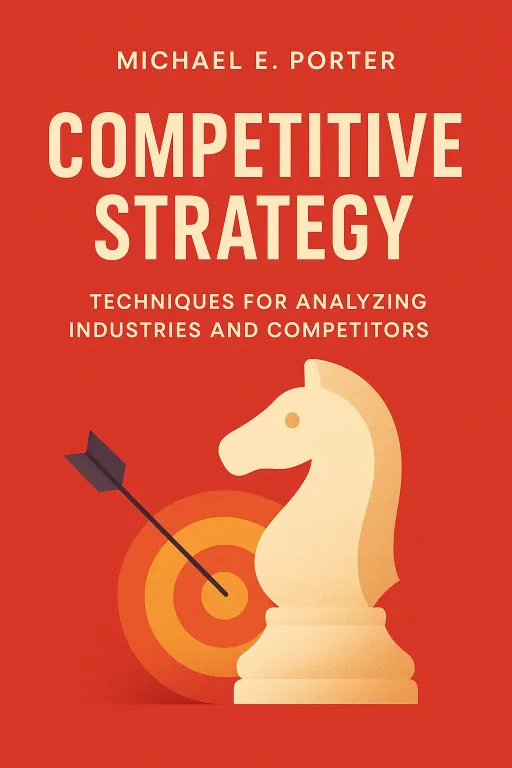
Nova: Exactly! It's a common trap, especially for driven entrepreneurs and strategists who are always looking at the bigger picture. They're so focused on the destination, they forget to map the terrain. Today, we're diving into two seminal works that fundamentally redefined what strategy truly is: Michael E. Porter's "Competitive Strategy" and Richard P. Rumelt's "Good Strategy/Bad Strategy."
Atlas: Two absolute titans of strategic thinking. Porter's work, which came out in 1980, completely shifted how businesses looked at their competitive landscape. He wasn't just talking about internal efficiency, he was talking about the that dictate whether you even have a fighting chance.
Nova: Absolutely. Porter, a Harvard Business School professor, basically handed the world a microscope to examine industries. His frameworks aren't just academic exercises; they're battle plans for ventures of all sizes. And then Rumelt, with his 2011 book, came in to clarify the murky waters of strategy, distinguishing the truly impactful from the mere wishful thinking. He spent decades consulting with major corporations and governments, seeing firsthand where strategies succeed and, more often, where they spectacularly fail.
Atlas: And for anyone out there building something, leading a team, or just trying to navigate a complex market, understanding these distinctions isn't just helpful, it's essential. It's about sharpening your competitive edge, not just hoping for one.
Nova: Precisely. Let's start with Porter, because before you can build a strategy, you need to understand the playing field.
Porter's Competitive Forces & Niche Identification
SECTION
Nova: Porter's core insight is that competition isn't just about your direct rivals. It's a much broader ecosystem, shaped by five fundamental forces. Think of them as the gravitational pulls and pushes within any industry.
Atlas: Okay, so what are these five forces? Because for someone trying to launch a small business, it can feel like the entire universe is pushing against them.
Nova: That’s a great way to put it. The first is the. How easy or hard is it for someone else to jump into your market? If it's easy, competition will be fierce, and profits will be low. Think about opening another coffee shop on a block already saturated with them.
Atlas: Right, like the barrier to entry is super low for a basic coffee shop. Anyone with a decent espresso machine and a lease can open one.
Nova: Exactly. Which leads to the second force:. If buyers have many options, they can demand lower prices or better quality, squeezing your margins. If you're that coffee shop, your customers can easily walk across the street.
Atlas: And then there's the flip side, I imagine. The?
Nova: You got it. The third force. How much control do your suppliers have over you? If there are only a few suppliers for a critical ingredient, they can charge you more, again, eroding your profitability. Imagine a coffee shop needing a specific, rare bean.
Atlas: That makes sense. So, new competitors, powerful customers, powerful suppliers. What are the other two?
Nova: The fourth is the. This isn't about direct competitors, but entirely different ways customers can solve the same problem. For our coffee shop, a substitute isn't another coffee shop, it's someone making coffee at home, or grabbing a smoothie, or even just skipping a morning beverage altogether.
Atlas: Ah, so it's about the customer's underlying need, not just the product. That’s a subtle but powerful distinction.
Nova: It absolutely is. And finally, the fifth force, which often feels the most obvious, is the. How many direct competitors are there? How aggressive are they? Are they constantly undercutting prices or launching new products?
Atlas: So, if I'm an entrepreneur, looking at these five forces, it sounds like a recipe for despair! How do I identify a with all these pressures? It feels like the deck is stacked against anyone trying to build something.
Nova: That's the strategic genius of Porter. He's not saying "don't compete." He's saying "understand the battlefield so you can choose where and how to fight." A unique niche often emerges by finding a spot where these forces are for, or where you can them to your advantage.
Atlas: Can you give me an example? Like, for that coffee shop we were talking about, how do they use this? Because "just make better coffee" isn't really a strategy, is it?
Nova: No, it's not. Let's take that local coffee shop. If they just open another generic cafe, they're dead. But what if they apply Porter?
Nova: First,: They decide to focus on a very specific, high-end, ethically sourced single-origin bean, roasted in-house, with a unique brewing method. This raises the bar; not just any new entrant can replicate that easily.
Nova: Second,: Their customers aren't just looking for caffeine; they're connoisseurs. They value the story, the quality, the experience. They're less price-sensitive, reducing buyer power.
Nova: Third,: By forming direct relationships with specific small farms and even investing in their practices, they reduce dependence on large commodity suppliers and potentially gain exclusive access to certain beans.
Nova: Fourth,: Their unique, almost artisanal coffee experience isn't easily substituted by home brewing or a quick smoothie. It's a destination, a ritual.
Nova: And finally,: They're not competing head-to-head with the Starbucks down the street on price. They've created a different category, reducing direct rivalry. They've carved out a niche where the forces are less punishing, allowing for better profitability and sustainability.
Atlas: Wow, that's a brilliant breakdown. So it's about intentional positioning, not just hoping for the best. It's about finding that sweet spot where you have a bit more breathing room. But even if you find that niche, how do you build the plan? Because a lot of strategic plans I've seen are just a bunch of buzzwords and optimistic forecasts.
Rumelt's Kernel of Strategy & Coherent Actions
SECTION
Nova: And that naturally leads us to Richard Rumelt, who argues that most of what passes for strategy is actually "bad strategy." He distinguishes good strategy by its coherent 'kernel.' It's not just about vision; it's about making tough choices and executing them.
Atlas: What's in this 'kernel'? Is it like a secret formula? Because a lot of entrepreneurs, myself included, are looking for a clear path forward when everything feels chaotic.
Nova: It’s not a secret formula, but it is a powerful framework. Rumelt says every good strategy has three essential parts: a, a, and. If any of these are missing, or if they don't align, you've got bad strategy.
Atlas: Okay, let's break that down. What's a good 'diagnosis'?
Nova: The is like the doctor's assessment before prescribing treatment. It identifies the critical challenge you face. It simplifies the complexity of the situation by picking out the most important aspects. It's not just a list of problems; it’s an explanation of those problems are problems and what the central obstacles are.
Atlas: So, for our high-end coffee shop, a bad diagnosis might just be "we need more customers." But a good diagnosis would be… what?
Nova: A good diagnosis might be: "The local market is saturated with commodity coffee, leading to price wars and a lack of customer loyalty. Our challenge is to differentiate by cultivating a premium experience that justifies a higher price point and builds a dedicated community, while simultaneously securing unique sourcing." It pinpoints the of the competitive challenge identified by Porter's forces.
Atlas: I see. It's deeply analytical. And then the 'guiding policy'?
Nova: The is your overall approach to overcoming that challenge. It's not a detailed plan, but a high-level framework that steers decision-making. It specifies how you'll move forward, setting boundaries and direction. For our coffee shop, the guiding policy might be: "Become the undisputed local leader in artisanal, ethically sourced coffee experiences, appealing to discerning customers who prioritize quality and sustainability over price."
Atlas: That sets a clear direction. It tells you what to say "yes" to and, more importantly, what to say "no" to. But the hardest part is always the "doing" for entrepreneurs. How does Rumelt bring that in?
Nova: That's where come in, and this is where most strategies fall apart. These are the specific, coordinated steps you take that are consistent with your guiding policy and directly address your diagnosis. They're not just random initiatives; they reinforce each other, creating a synergistic effect.
Nova: For our coffee shop, coherent actions might include: investing in advanced roasting equipment, training baristas extensively in brewing techniques and bean knowledge, designing a minimalist, high-end interior, hosting tasting events, developing direct trade relationships with specific farms, and launching a loyalty program focused on educational content about coffee origins.
Atlas: That’s a powerful distinction. It's not just a list of things to do, but a of actions that all pull in the same direction. It's about alignment, isn't it? Because I can imagine a lot of businesses have a diagnosis and maybe even a guiding policy, but their actions are all over the place.
Nova: Precisely. Rumelt argues that a good strategy is about leverage—applying concentrated effort to the most critical challenges. It’s about creating a chain of logic from understanding the problem to deciding what to do about it, and then actually doing it in a coordinated way. Without that coherence, you're just thrashing around, hoping for a lucky break.
Atlas: This is so critical for anyone who feels like they're balancing many roles and striving for excellence, but sometimes their efforts feel fragmented. It's about bringing that focus.
Synthesis & Takeaways
SECTION
Nova: So, bringing Porter and Rumelt together, you can see how they form a powerful one-two punch for any aspiring empire builder. Porter gives you the lens to analyze the external world, to find that unique niche where the competitive forces are manageable. He helps you answer: should I compete?
Atlas: And Rumelt then gives you the blueprint for to compete effectively in that chosen space. Once you have that diagnosis of your challenge, that guiding policy, and those coherent actions, you're not just setting goals; you're building a truly impactful entrepreneurial plan. It's about moving from "run faster" to "here's my training regimen, my nutrition plan, my specific race strategy."
Nova: Exactly. Think of it like this: Porter helps you pick the right mountain to climb, one that isn't swarming with other climbers all trying to reach the same peak with the same gear. And then Rumelt gives you the precise, coordinated steps—the ropes, the ice axes, the team coordination—to actually ascend that mountain safely and successfully.
Atlas: This isn't just theory for big corporations; it's fundamental for anyone building a small business, a personal brand, or even a career. It’s about seeing the bigger picture, analyzing, strategizing, and then acting with intention. It's truly about trusting your inner wisdom to carve out your unique path, but with a robust framework to guide you.
Nova: Absolutely. It's about moving beyond mere ambition to informed, strategic action. It’s the difference between wishing for financial independence and systematically building the foundation for it.
Atlas: What a powerful combination of insights. It really makes you rethink what "strategy" even means.
Nova: It should! This is Aibrary. Congratulations on your growth!