

Beyond the Code: How to Cultivate Your Strategic Vision as an Architect.
Golden Hook & Introduction
SECTION
Nova: You're an architect, a full-stack wizard, crafting incredible Agent systems that push the boundaries of what's possible. But what if I told you that your biggest strategic blind spot isn't in your code, or even in your architectural decisions, but in how you about strategy itself?
Atlas: Whoa, Nova, that's a bold claim right out of the gate! I mean, most architects I know are drowning in technical details, system designs, scaling issues. Are you saying we're missing the forest for the trees, or worse, that our trees are just... in the wrong forest?
Nova: Exactly, Atlas. It's about recognizing that true value creation as an architect extends far beyond technical prowess. It’s about translating that deep technical understanding into clear, actionable business strategy. And today, we're cracking open two foundational texts that redefine what strategy truly means.
Atlas: Lay it on me. I’m always game for a good paradigm shift.
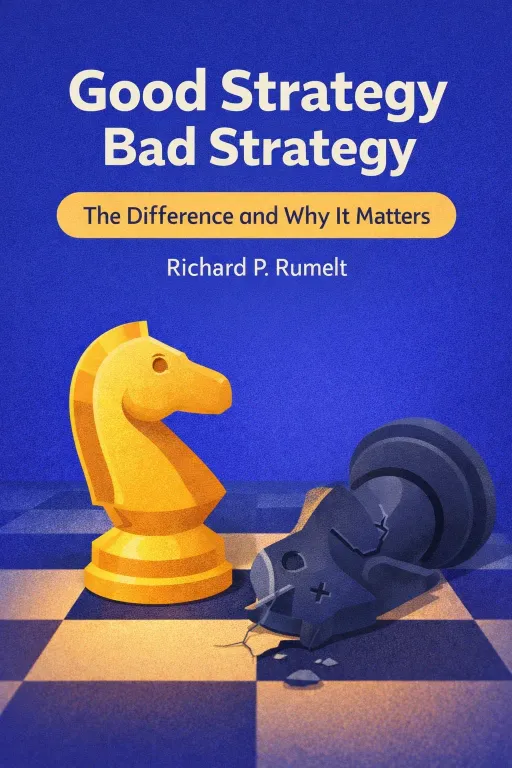
Nova: We're diving into Richard Rumelt's seminal work, "Good Strategy/Bad Strategy," and then we'll pivot to A. G. Lafley and Roger L. Martin's immensely practical framework, "Playing to Win." Rumelt, often hailed as the 'strategist's strategist,' is famous for his no-nonsense critique of vague, ambition-laden strategies that sound good on paper but deliver nothing. He's relentless in exposing what he calls "bad strategy."
Atlas: So he's calling out all those fluffy mission statements and wishful thinking disguised as strategy? I can definitely relate to seeing a few of those in the wild.
Nova: Precisely. And then, Lafley and Martin's work, which is credited with turning around a titan like Procter & Gamble, gives us the practical blueprint for making those strategic choices. It's about moving from diagnosing the problem to actually deciding where to compete and how to win. It's a powerful one-two punch for any architect looking to elevate their game.
The 'Good Strategy' Blueprint: Diagnosing Challenges and Guiding Policies
SECTION
Nova: So, let's start with Rumelt. He argues that good strategy isn't just ambition or goal-setting. It’s almost like a scientific method. He calls it the 'kernel' of strategy, which has three parts: a diagnosis of the challenge, a guiding policy for how to overcome it, and a set of coherent actions.
Atlas: Okay, so it’s not just saying "we're going to build the best Agent platform." That sounds like a goal, not a strategy. But what does a "diagnosis of the challenge" actually look like when you're knee-deep in Agent code, or even designing the architecture for one? How do you diagnose a challenge that isn't just a bug?
Nova: That’s a fantastic question, Atlas, and it hits the core of the problem. A technical diagnosis might identify a bottleneck in your Agent's inference speed. A strategic diagnosis goes deeper. Imagine an Agent project aimed at automating customer support. The initial "strategy" might be "reduce customer wait times." Sounds good, right?
Atlas: On the surface, yes. A clear metric, seems achievable.
Nova: But a diagnosis, Rumelt-style, would look at wait times are high. Is it because the Agent can't handle complex queries? Is it because the hand-off to human agents is clunky? Or perhaps, the problem is that customers are asking questions the Agent is, leading to frustration, repeat calls, and long wait times. The true challenge isn't just "wait times," it's "Agent inability to resolve specific, high-frequency, complex customer issues."
Atlas: Ah, I see. So the diagnosis isn't just stating the observable problem; it's uncovering the root causes and the true nature of the friction. It’s like an architect diagnosing why a building is unstable – not just "it's cracking," but "the foundation wasn't designed for this soil type."
Nova: Exactly! Once you have that deep diagnosis, then comes the guiding policy. This isn't a detailed plan, but a high-level approach to overcome the diagnosed challenge. If the diagnosis is "Agent inability to resolve specific, high-frequency, complex customer issues," a guiding policy might be "develop a specialized knowledge graph and advanced reasoning module for our Agent, focusing on these specific high-frequency issues."
Atlas: That makes a lot more sense. It's not just "build better AI," but "build of AI to solve." And the coherent actions would then flow from that, right? Like, specific teams working on knowledge graph integration, NLP model tuning for those specific queries, designing the human-Agent collaboration workflow.
Nova: Precisely. That coherence is critical. Rumelt argues that a lot of "bad strategy" is just a jumble of unconnected goals. Good strategy, on the other not, creates a powerful chain reaction where every action reinforces the guiding policy, which in turn directly addresses the diagnosis. It’s about being deeply intentional.
Playing to Win: Where to Play and How to Win in the Agent Space
SECTION
Nova: Once you have that solid diagnosis and guiding policy, the next logical step is to figure out where you're going to apply it, and how you're going to succeed. And that's where Lafley and Martin's "Playing to Win" framework becomes incredibly powerful. They simplify strategy into two core questions: "Where to Play" and "How to Win."
Atlas: Okay, for an architect building Agent solutions, 'where to play' sounds like market segmentation, but how granular do we get? And how does 'how to win' translate beyond just having a better algorithm or a more scalable infrastructure? Because let's be honest, everyone's trying to build a 'better' Agent.
Nova: You've hit on the crucial distinction, Atlas. "Where to Play" is about choosing the specific arenas where you're going to compete. It's not about being everywhere. For an Agent architect, this could mean choosing a specific industry vertical—like real estate, healthcare, or financial services. Or it could be a specific user segment within an industry—maybe small businesses needing sales Agents, rather than enterprise clients.
Atlas: So, instead of building a generic "AI assistant," you're building a "real estate transaction Agent for independent brokers in California." That's incredibly specific.
Nova: Exactly. Let's take that example. Imagine two competing Agent platforms. One is a generalist, trying to serve all industries with a broad-stroke conversational AI. They're playing everywhere, but winning nowhere definitively. The other, however, focuses exclusively on real estate transaction Agents for independent brokers. That's their clear "where to play."
Atlas: And how do they "win" in that specific arena? Because I can imagine a lot of people wanting to build an Agent for real estate.
Nova: This is where "how to win" comes in. For our specialized real estate Agent, "how to win" isn't just about having a slightly better chatbot. It's about superior data integration with MLS listings and property databases. It’s about specialized natural language processing tuned for property descriptions, legal jargon, and client negotiation dynamics. It’s about a unique partnership model with real estate associations, giving them an exclusive distribution channel. They win by having a distinct competitive advantage.
Atlas: That makes perfect sense! So, for our listeners who are full-stack engineers and architects, trying to integrate Agent tech with existing business, this isn't just about building a technically sound Agent. It's about identifying that specific niche where their deep technical skills can create business value, right? Not just building a cool Agent, but Agent for specific problem that no one else is solving as effectively.
Nova: Precisely, Atlas. It's about moving from being a brilliant technical executor to a strategic market leader. It's the difference between building a powerful engine and building the most efficient, purpose-built vehicle for a specific terrain. This framework helps architects position their Agent solutions for maximum impact and competitive advantage, transforming them from technical experts into strategic leaders. It's about breaking those boundaries between pure tech and profound business impact.
Synthesis & Takeaways
SECTION
Nova: So, bringing Rumelt and Lafley & Martin together, we see a powerful synergy. Rumelt gives you the rigor to understand your battleground and craft a coherent approach, while Lafley and Martin empower you to choose battle to fight and to ensure victory.
Atlas: This is great intellectually, but for someone who's a practitioner, an architect, trying to master Agent engineering and deliver real value, what's one concrete thing they can do to start applying this strategic vision? Because the advice to "break boundaries" is exciting, but also daunting.
Nova: That’s a crucial question. Here's a concrete action: take your current Agent project, or the next one you're planning. Don't just list its features or technical specs. Go deeper. Ask yourself: What's the core, underlying challenge this project is designed to solve for the business or the user? Not the symptoms, but the root cause. Then, identify one specific, coherent action you can take that directly addresses that challenge. It might be talking to a business stakeholder you usually don't, or researching a specific market segment.
Atlas: That’s brilliant. It makes the abstract tangible. And perhaps, what's one boundary they can try to break, between tech and business, just this once, to deepen that diagnosis or clarify their "where to play"?
Nova: Absolutely. That’s the growth. By consistently pushing beyond the code and embracing this strategic mindset, architects don't just build systems; they build sustainable, impactful solutions that truly drive business value. They become indispensable.
Atlas: Powerful stuff. This is Aibrary. Congratulations on your growth!