

Beyond the Buzz: The Timeless Art of Strategic Thinking
Golden Hook & Introduction
SECTION
Nova: Atlas, if I were to ask you, what's the first thing that comes to mind when you hear the word "strategy"? Give me your unfiltered, gut reaction.
Atlas: Oh, man. "Strategy." It's one of those words, isn't it? Like "synergy" or "leverage." It usually means a really expensive offsite where everyone talks a lot, eats lukewarm pastries, and then produces a document that lives on a shared drive, quietly gathering digital dust. It’s often more about smart than smart, if I’m honest.
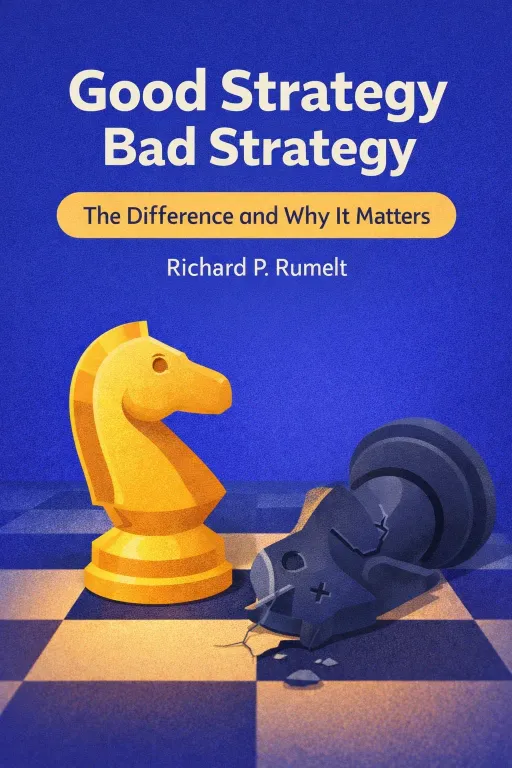
Nova: You're not wrong! That's a brilliant, slightly cynical, but incredibly honest take. And that's exactly why we're diving into the timeless art of strategic thinking today, pulling insights from two absolute titans in the field: Richard Rumelt's "Good Strategy/Bad Strategy" and A. G. Lafley and Roger Martin's "Playing to Win."
Atlas: Ah, the heavy hitters! Rumelt, if I recall, is often considered the 'strategist's strategist,' cutting through all that corporate fluff you just mentioned. And Lafley and Martin brought that hands-on, transformative experience from Procter & Gamble. So, we're talking about the real deal, not just the buzzwords.
Nova: Exactly. Because what Rumelt really highlights, and what so many of us get wrong, is that we often confuse a 'plan' with a 'strategy.' And that, my friend, is a blind spot that can derail even the most ambitious projects.
Plans vs. True Strategy & The Blind Spot
SECTION
Nova: Think about it: a plan is often just a list of goals. "We want to increase market share by 10%." "We need to launch three new products this quarter." These are aspirations, right? They're the 'what.' But a true strategy? That's a coherent action plan specifically designed to overcome a. It's the 'how' and, more importantly, the 'why.'
Atlas: But isn't having goals part of strategy? What’s the real difference for someone trying to lead a team, or even just manage their own career? It feels like semantics at first glance.
Nova: It feels like semantics, but it’s a critical distinction. Without identifying that significant challenge, without a clear diagnosis, our efforts scatter. Imagine a chef who wants to cook a five-star meal. Their 'plan' might be "cook delicious food." But their 'strategy' would be: "My challenge is sourcing fresh, seasonal ingredients in winter, so my guiding policy will be to create a menu around root vegetables and preserved fruits, and my coherent actions will involve collaborating with local farms and experimenting with fermentation techniques."
Atlas: Oh, I like that. So, it's not just about what you to achieve, but what specific you're trying to clear? Give me an example of a team that had a 'plan' but no 'strategy.' Because that sounds like so many projects I've seen.
Nova: Absolutely. Rumelt is brilliant at dissecting what he calls "bad strategy." He says it often includes fluff, a failure to face the problem, and just a jumble of objectives. I saw this firsthand with a promising tech startup. Their plan was "grow users by 50% and launch new features." Sounds good, right? But their wasn't growth; it was user retention in an incredibly saturated market. They had a leaky bucket, and they were just pouring more water in.
Atlas: Ah, the classic leaky bucket syndrome.
Nova: Precisely. Their efforts scattered across developing more features, which users didn't stick around to use, and marketing campaigns that attracted new users who then churned. There was no coherent action plan to overcome the core challenge of retention. They were busy, incredibly busy, but their impact was fading because they were solving the wrong problem.
Atlas: That sounds like so many projects I've seen, just throwing things at the wall hoping something sticks. All that energy, all that talent, just... dissipating. What's the antidote to that kind of scattershot approach? You can feel the burnout from here.
The 'Kernel' of Good Strategy & The Three Pillars
SECTION
Nova: The antidote, Atlas, is what Rumelt calls the 'kernel' of a good strategy. It's incredibly elegant in its simplicity, yet profoundly powerful. It has three parts: a diagnosis, a guiding policy, and coherent actions.
Atlas: Okay, diagnosis makes sense – figure out what's actually wrong. Like your leaky bucket. But 'guiding policy' and 'coherent actions' – how are those different from just... 'doing stuff'? I mean, people are always ‘doing stuff.’
Nova: That’s a great question, because that's where the strategy truly comes alive. The diagnosis is the 'what's going on here?' The guiding policy is the 'how are we going to approach this challenge?' It's the overall method or framework. It sets the boundaries and channels your energy. For example, if your diagnosis is 'declining market share due to low-cost competitors,' your guiding policy might be 'we will not compete on price; we will differentiate through superior innovation and customer experience.'
Atlas: Right, so it's a specific philosophical stance or a chosen path, not just a vague intent.
Nova: Exactly. And then, the coherent actions are the specific steps you take that with that guiding policy, reinforcing each other. They're not just random tasks; they're mutually supportive. Think of a struggling retail chain that diagnosed declining foot traffic because online shopping was more convenient. Their 'guiding policy' wasn't to try and beat Amazon on price or speed. It was to 're-imagine the in-store experience as a community hub.'
Atlas: Ooh, I’m intrigued. So what were their coherent actions?
Nova: Their coherent actions included hosting free workshops on local crafts, setting up a weekly local artisan pop-up market, redesigning their physical spaces to be more lounge-like with coffee bars and reading nooks, and training staff to be 'experience curators' rather than just sales associates. Every action reinforced the idea of the store as a destination, a place for connection, not just consumption.
Atlas: That makes so much more sense. It's not just a to-do list; it's a. Diagnosis leads to a specific way of thinking about the problem, which then dictates what you actually do. It's like building a bridge – you need a clear understanding of the gap, a design principle for the bridge, and then the actual construction steps. It’s a purposeful explorer’s roadmap.
Strategy as Choice: Where to Play, How to Win
SECTION
Nova: That bridge-building analogy leads us perfectly into our third core idea, from Lafley and Martin in "Playing to Win": strategy is ultimately about making choices. Specifically, 'Where will we play?' and 'How will we win?' These aren't just rhetorical questions; they are fundamental, often difficult, decisions that clarify focus and align resources.
Atlas: Choices. That sounds simple, but I bet it's incredibly hard in practice. What kind of 'choices' are we talking about? Like, choosing a market? Or choosing a product? Because for a lot of people, saying 'no' to opportunity feels counterintuitive.
Nova: It is incredibly hard, because it means saying 'no' to seemingly attractive options. 'Where to play' involves defining the specific market segments, geographies, product categories, or customer groups you will target. Lafley and Martin, through their turnaround of Procter & Gamble, showed how ruthless this focus needs to be. P&G had been dabbling in too many areas. They had to decide: where can we compete?
Atlas: So, they had to shrink to grow, in a way? Narrow their focus?
Nova: Exactly. And then 'how to win' is about identifying a sustainable competitive advantage in that chosen arena. Are you going to win by being the lowest cost provider? By offering superior innovation? Unparalleled customer service? A software company, for instance, might initially try to be everything to everyone – consumer apps, enterprise solutions, custom development. But a strategic choice might be to 'play' in the enterprise HR software space, and 'win' by offering unparalleled customization and white-glove service, even if it means a smaller client base.
Atlas: So, it's about saying 'no' to a lot of things so you can say a powerful 'yes' to a few. That's a huge shift from the 'try to do everything' mentality that I think a lot of us, especially in fast-moving fields, fall into. It sounds scary, but also incredibly liberating, especially for teams feeling spread thin and ineffective. It really aligns resources.
Synthesis & Takeaways
SECTION
Nova: It’s absolutely liberating. When you synthesize these ideas, strategy isn't this vague aspiration or a dusty document. It's a focused, coherent attack on a defined problem, driven by a clear diagnosis, a guiding policy, and mutually reinforcing actions. And it's all underpinned by the courage to make decisive choices about where you'll play and how you'll win. Without this clarity, even the hardest work can be wasted, leading to exactly what you described earlier, Atlas: a lot of effort with little impact.
Atlas: It really boils down to intentionality, doesn't it? Not just working hard, but working hard on the things, in the way, with a clear understanding of what you're trying to achieve and how you're going to get there. It gives you a compass for your purpose, not just a random map.
Nova: Exactly. It's about moving from being a busy bee to a strategic architect. And for anyone listening who feels their efforts are scattered, that deep question from the books is critical: What is the single biggest challenge your team or project faces right now, and what's your specific, focused plan to overcome it?
Atlas: That's a powerful question to sit with. And it’s not just for big corporations; it applies to personal projects, career paths, even family goals. It's about cultivating that strategic mindset in every aspect of life, finding that deep understanding, that real-world impact.
Nova: Absolutely. Because strategy, at its heart, is about purpose and impact. It’s about building something meaningful that truly moves the needle. And that's a journey worth taking, a journey for the resilient achiever and the strategic cultivator. This is Aibrary. Congratulations on your growth!