

Beyond the Blueprint: Mastering the Intangibles of Project Leadership.
Golden Hook & Introduction
SECTION
Nova: You know, Atlas, it’s fascinating how many brilliant people, especially in high-stakes fields like building and innovation, confuse ambition with strategy. They'll have these grand, audacious goals, but then wonder why their projects feel like a ship without a rudder.
Atlas: Oh man, that’s going to resonate with anyone who’s ever stared at a beautiful project proposal that, deep down, they knew was just a wish list with a fancy cover. It’s like saying you want to climb Everest, but your 'strategy' is just 'buy warm clothes.' Good luck with that.
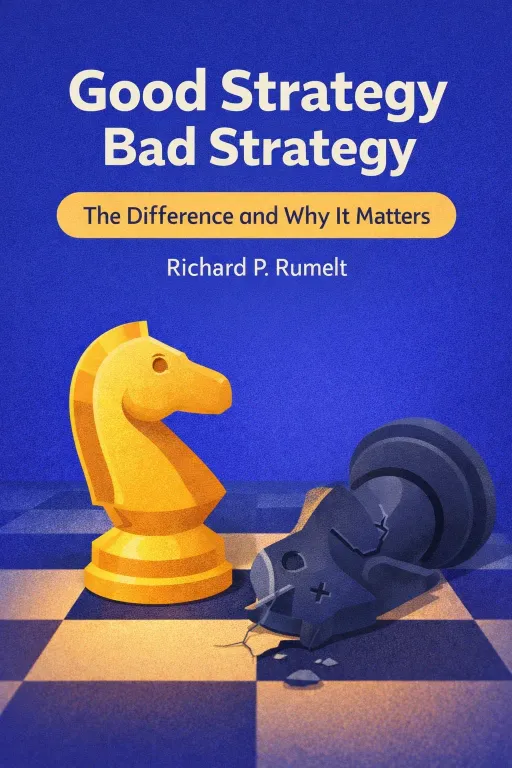
Nova: Exactly! And that common blind spot is precisely what we’re dissecting today. We’re diving into two seminal works that redefine what it means to lead effectively, moving beyond mere blueprints to mastering the intangibles of project leadership. We’re talking about Richard Rumelt's groundbreaking book, "Good Strategy/Bad Strategy," and Stanley McChrystal's revolutionary "Team of Teams."
Atlas: Oh, I've heard those titles thrown around, especially in circles discussing complex projects. What makes these two so essential?
Nova: Well, Rumelt was a business school professor who became renowned for his critical analysis of what work in strategy, challenging decades of fluffy business advice. His insights cut through the noise, offering clarity when most leaders are drowning in buzzwords. And McChrystal? He’s a four-star general who led special operations in Iraq. He faced an enemy so adaptive and decentralized that traditional military hierarchies were failing. He literally had to rethink leadership from the ground up, making his insights on adaptive teams incredibly battle-tested and vital for today’s fast-moving environments.
Atlas: So, we’re talking about a professor who calls out bad strategy and a general who rebuilt his command structure because the old way just wasn’t cutting it. That’s a powerful combination. It sounds like they’re both saying the same thing: the old rules of leadership, especially in complex, multi-stakeholder environments, just don't apply anymore.
Nova: Precisely. And it all starts with understanding that crucial blind spot.
The Blind Spot – Goals vs. Strategy
SECTION
Nova: Many project leaders, especially those driven by impact and innovation, often mistake a passionate ambition or a detailed list of goals for a true strategy. They’ll say, "Our strategy is to be the market leader in sustainable construction technology," or "Our strategy is to expand into three new international markets this year."
Atlas: Right, like that’s a strategy! But wait, for someone building, someone driven by impact, isn't ambition exactly what you need? How do you even differentiate? Isn't having big goals a good thing?
Nova: Absolutely, ambition and goals are crucial. They provide direction, but they aren't the. Imagine you’re an architect. You have the ambition to design the most eco-friendly skyscraper in the city. Your goals are to use renewable materials, achieve net-zero energy, and get it built by 2028. But that isn't your strategy for you'll overcome the challenges of new regulations, supply chain issues for niche materials, or integrating novel energy systems without budget overruns.
Atlas: So, the blind spot is thinking the 'what' is the 'how.' I imagine a lot of our listeners, especially those leading large-scale projects, have felt this. You have the grand vision, you have the targets, but the execution feels scattered, like everyone’s pulling in slightly different directions.
Nova: Exactly. It's like having a GPS that tells you your destination is "the tallest building on Earth," but offers no map, no traffic updates, no terrain analysis. You just start driving, hoping for the best. Rumelt argues this leads to scattered efforts, wasted resources, and ultimately, a lack of real progress. For instance, I recall a massive urban development project, let's call it 'MegaCity Alpha', that aimed to be a "smart, sustainable, and interconnected hub." Their ambition was sky-high. Their goals included dozens of metrics for smart tech integration, green spaces, and community engagement. But the 'strategy' document was essentially just a re-listing of these goals with vague statements like 'leverage synergies' or 'maximize stakeholder value.'
Atlas: Oh, I like that, 'leverage synergies.' That's a classic. What happened to 'MegaCity Alpha'? Sounds like it was doomed from the start.
Nova: It was. Without a coherent strategy, each department interpreted 'smart' or 'sustainable' differently. The tech team prioritised cutting-edge, untested solutions; the construction team prioritised speed and cost; the community engagement team focused on local buy-in. They were all ambitious, all working hard, but their efforts weren't. The project stalled, went massively over budget, and ultimately delivered a fragmented result that was neither truly smart nor sustainable in a unified way. The ambition was there, but the strategic clarity was not.
Atlas: That makes me wonder, how does someone in a high-stakes environment, building new things, avoid falling into that trap? Because when you’re proactive, creating opportunities, it’s easy to get excited about the destination and forget to map the journey.
The Strategic Kernel – Rumelt's Diagnosis, Guiding Policy, Coherent Actions
SECTION
Nova: That's a brilliant question, Atlas, and it's precisely where Richard Rumelt's "Good Strategy/Bad Strategy" offers a lifeline. He says a good strategy isn't a list of goals, but a coherent response to a challenge. He boils it down to what he calls the 'kernel' of strategy, three essential elements.
Atlas: Okay, so if ambition isn't strategy, what? This is where Richard Rumelt's 'Good Strategy/Bad Strategy' gives us an incredibly powerful framework. What are these three elements?
Nova: The first is. This isn't just identifying a problem; it's defining the of the challenge. What are the critical obstacles? What are the underlying forces at play? For our architect aiming for the eco-friendly skyscraper, a diagnosis might be: "The core challenge is integrating cutting-edge, unproven energy capture systems into an existing regulatory framework that doesn't account for them, while simultaneously securing investor confidence in a new market segment."
Atlas: Wow, that’s a lot more specific than "build a green building." That’s a deep dive into the actual friction points. It’s like an architect understanding the specific soil conditions and wind patterns of a site drawing a line, not just saying "I’ll build a tall building here."
Nova: Exactly! The second element is a. This is a coherent approach to overcome that diagnosis. It’s not a goal, but a or that dictates you'll tackle the challenge. For our architect, the guiding policy might be: "Develop a robust, phased regulatory approval strategy in parallel with a modular system design, allowing for iterative testing and investor demonstrations." This policy points the way.
Atlas: Okay, so the guiding policy is the "how we'll approach this." That makes sense. But how does this apply when you're innovating, building something completely new? The 'challenge' isn't always clear when you're forging a new path. Can you really 'diagnose' something that hasn't fully manifested?
Nova: That’s a critical challenge, especially for innovators. The diagnosis in those cases often shifts from "what's wrong" to "what's unknown." It becomes about identifying the and the. So, the diagnosis might be: "The core challenge is proving the viability of this new construction material's long-term durability and cost-effectiveness in diverse climates." Then, the guiding policy would be: "Conduct rigorous, accelerated testing in varied simulated environments, coupled with transparent data sharing with early adopters and regulatory bodies."
Atlas: That’s a great way to reframe it. And the third element?
Nova: The third is. These are specific, coordinated steps that are aligned with your guiding policy. For our architect, this would mean allocating specific R&D budgets for the modular system, engaging legal experts for regulatory navigation, and developing detailed investor communication plans that highlight the iterative testing results. Every action reinforces the policy, which addresses the diagnosis. There’s no wasted motion.
Atlas: That’s a perfect example. So, it's about connecting the dots, ensuring every step serves a larger, well-defined strategic purpose. It's like building on your design foundation, but with a super clear roadmap for tackling the inevitable curveballs of large-scale projects.
Adaptive Leadership – McChrystal's Team of Teams
SECTION
Nova: Even with a brilliant strategy, execution can falter, especially in today's rapidly changing world. This is where Stanley McChrystal's "Team of Teams" becomes essential, showing us how to lead when rigid plans won't cut it. He argues that traditional, top-down hierarchies, designed for predictable environments, are fundamentally ill-equipped to handle modern complexity.
Atlas: Whoa, that sounds like a seismic shift. Traditional hierarchies have been the backbone of pretty much everything for centuries! What makes them so ineffective now?
Nova: McChrystal saw this firsthand leading the Joint Special Operations Task Force in Iraq. They were fighting Al-Qaeda in Iraq, an enemy that was decentralized, highly adaptive, and incredibly fast. His highly trained, traditional military units, despite their immense resources, were struggling because their decision-making process was too slow, too siloed. Information flowed up, decisions flowed down, but by the time a decision was made, the battlefield had already changed.
Atlas: So, the enemy was moving faster than their internal communication. That’s a terrifying thought for any project leader, especially if you’re innovating with new construction technologies or trying to navigate complex international markets where things change on a dime.
Nova: Exactly. McChrystal realized they needed to transform from a "command of teams" to a "team of teams." This involved two key shifts: and. Shared consciousness means everyone, from the top brass to the lowest-ranking operative, has a common understanding of the overall environment, the threats, and the strategic objectives. They achieved this through daily, all-hands intelligence briefings that connected everyone across the globe.
Atlas: Shared consciousness sounds great on paper, but in a large-scale project with hundreds of people, how do you actually that? Isn't it just organized chaos without a clear, top-down structure? Especially if you're navigating new professional landscapes and different etiquette, how do you get everyone on the same page?
Nova: That’s the challenge, and it's where the 'how' becomes crucial. It meant breaking down silos, fostering radical transparency, and cross-pollinating teams. For a construction project adopting new technologies, this might mean regular 'all-hands' virtual meetings where engineers, architects, regulatory specialists, and even marketing teams share their daily challenges and insights, not just project updates. It’s about building trust and understanding across diverse functions and cultures, which is vital when you're looking to navigate American business etiquette or lead global teams.
Atlas: Okay, so it’s about making sure everyone knows not just their piece of the puzzle, but what the whole puzzle looks like, and what everyone else is doing. And then, decentralized execution?
Nova: That’s the natural follow-on. Once everyone has shared consciousness, decision-making can be pushed down to the lowest possible level. Instead of waiting for approval from the top, teams on the ground, who have the most current information and understand the overall strategy, are empowered to make rapid decisions. This drastically speeds up response times and fosters adaptability.
Atlas: So, it’s about trusting your people, giving them the full picture, and then letting them run with it. That’s a bit like giving an architect the overall vision for a building, and then trusting them to innovate within that framework, rather than micromanaging every beam and column. It sounds incredibly empowering, but also a little scary for leaders used to being in control.
Nova: It is. It requires a fundamental shift in leadership mindset – from a "hero leader" who directs everything, to a "gardener leader" who cultivates the environment for teams to thrive and self-organize. It's about letting go of rigid planning and embracing adaptive, insightful problem-solving.
Synthesis & Takeaways
SECTION
Nova: So, what we’ve explored today, Atlas, is that truly mastering the intangibles of project leadership transcends merely having a brilliant blueprint. It's about recognizing that initial blind spot, understanding that ambition isn't strategy. It's about adopting Rumelt's strategic kernel – a clear diagnosis, a focused guiding policy, and coherent actions – to build a robust foundation.
Atlas: And then, it’s about equipping that foundation with the agility of McChrystal’s Team of Teams. It’s about cultivating shared consciousness and empowering decentralized execution, especially when you’re building in rapidly changing, complex environments, whether that’s new tech or new markets. It's really about making your vision resilient.
Nova: Exactly. This isn't just about managing projects; it's about leading people through uncertainty, fostering a culture of adaptability, and ensuring every effort is truly strategic, not just busy. It’s about trusting your instincts, but grounding them in a coherent approach.
Atlas: That’s actually really inspiring. It redefines leadership not as a solitary, top-down effort, but as a dynamic, interconnected process. It makes me wonder, what is the core challenge current project faces, and how would you define a clear guiding policy to address it, moving beyond just listing your goals?
Nova: A powerful question to leave our listeners with. This is Aibrary. Congratulations on your growth!