

Beyond Metrics: Measuring What Truly Matters for Product Success
Golden Hook & Introduction
SECTION
Nova: What if I told you that the more metrics you track, the you might actually understand about your product's true success?
Atlas: Whoa, hold on. That sounds a bit out there! Isn’t more data always better? Every product leader I know lives and breathes by their dashboards. You’re telling me that might be counterproductive?
Nova: Absolutely! It’s a common trap. Many leaders get lost in a sea of numbers, tracking everything from daily active users to conversion rates, yet they still struggle to define what "winning" actually looks like. They mistake activity for impact. Today, we're cracking open two foundational texts that help us cut through that complexity.
Atlas: Okay, so this isn't just about throwing out the data, then. It's about making sense of it, making it.
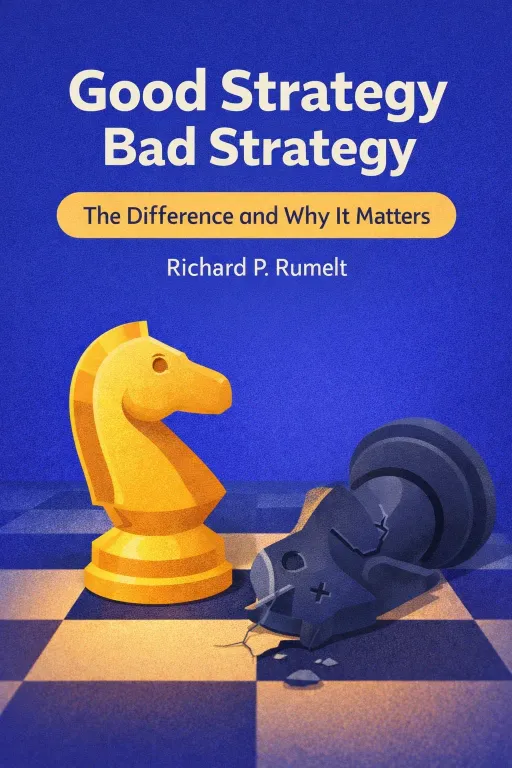
Nova: Exactly. We're diving into "Good Strategy Bad Strategy" by the renowned strategic management professor Richard Rumelt, known for cutting through corporate fluff and defining what genuine strategy truly is. And then, we'll explore "Measure What Matters" by legendary venture capitalist John Doerr, who famously brought the OKR framework to Google, fundamentally shaping its explosive growth and revolutionizing how companies measure success.
Atlas: That makes me wonder, how do these insights help someone, especially a product builder or visionary, navigate that confusion and actually drive real impact, not just generate more reports?
Nova: That's the core question, isn't it? Because understanding a good strategy looks like, and then having a robust system to if you're actually executing it, is the difference between aimless wandering and purposeful progress.
The Anatomy of a Good Strategy: Beyond Buzzwords
SECTION
Nova: So, let's start with Rumelt. He argues that a good strategy isn't just a list of goals or a vision statement. It has a coherent 'kernel.' It’s like a doctor diagnosing an illness.
Atlas: Okay, so you’re saying it’s not just saying "we want to grow market share by 20%." That’s a, not a strategy.
Nova: Precisely! Rumelt would call that a "bad strategy" because it lacks the kernel. The kernel has three parts: first, a – understanding the nature of the challenge. What’s going on? Why is engagement low? Is it confusing onboarding? A lack of perceived value?
Atlas: That makes sense. You can’t just say "fix it" without knowing is broken and. It’s like a mechanic not bothering to diagnose the strange rattling noise in your car, and just telling you to drive faster.
Nova: A perfect analogy! Second, a – this is your overall approach to overcome the diagnosed challenge. If the diagnosis is confusing onboarding, the guiding policy might be "simplify the first-time user experience to highlight core value immediately." It's not a detailed plan, but a clear direction.
Atlas: Ah, so it’s the "how we're going to tackle this specific problem" part, not just the "what we want to achieve." That immediately feels more pragmatic for someone who's actually building something.
Nova: And then, third, – these are the specific, coordinated steps that implement your guiding policy. If your guiding policy is to simplify onboarding, your coherent actions might be: "A/B test a new tutorial flow," "reduce sign-up steps," "implement in-app contextual help." These actions are designed to work together, not in isolation.
Atlas: I see. So, it's about connecting the 'why' to the 'how,' explicitly, with concrete steps. Because I imagine a lot of product teams fall into the trap of just listing a bunch of features or initiatives without that underlying diagnosis and guiding policy. They’re just building, not strategically building.
Nova: Exactly. Rumelt is famous for his incisive critique of what he calls "fluff" – vague, high-level statements that sound strategic but offer no real direction. He’s a highly respected academic who really pushed for genuine strategic thinking, making his work foundational for anyone serious about strategy.
Atlas: So, for a builder or visionary, this framework is crucial for ensuring their grand vision isn't just a dream, but something with a clear, actionable path. Because without that diagnosis and guiding policy, even the most ambitious goals can just dissolve into busywork.
Operationalizing Impact: The Power of OKRs
SECTION
Nova: And once you have that crystal-clear strategy, that coherent kernel from Rumelt, the next challenge is making it happen, and more importantly, measuring if it happening. That's where John Doerr's "Measure What Matters" and the OKR framework come in.
Atlas: Okay, so once I know my good strategy is, how do I actually it and if it's working? Hold on, this sounds like just another way to track metrics. How do OKRs prevent us from falling back into that 'sea of metrics' problem, especially for someone who values efficiency and impact?
Nova: That’s a critical question, and it's where OKRs truly shine. Doerr introduces two core components: and. An Objective is you want to achieve – it should be ambitious, qualitative, and inspiring. Think "Launch an amazing new product feature that delights users."
Atlas: So, the Objective is the big, exciting goal. But how do you measure "delights users"? That sounds a bit vague, like some of that "fluff" Rumelt warned about.
Nova: That's where come in. Key Results are you'll know if you've achieved your Objective. They must be measurable, quantitative, and challenging, but achievable. For "Launch an amazing new product feature that delights users," Key Results might be: "Achieve a 50% increase in feature adoption within the first month," "Maintain a Net Promoter Score of 70+ from early adopters," or "Reduce customer support tickets related to this feature by 30%."
Atlas: I see! So, the Key Results force you to define "delight" in concrete, measurable terms. It's about measuring, not just activities. That’s a major distinction. And how does this ensure alignment and focus across a team, especially in a fast-paced environment?
Nova: That’s one of the "superpowers" of OKRs. They force focus by limiting the number of Objectives and Key Results. You can't have twenty Objectives. Typically, it's 3-5 Objectives per quarter, each with 3-5 Key Results. This forces teams to prioritize what truly matters. And by making them public and cascaded throughout the organization, everyone knows what everyone else is working on, creating incredible alignment. Doerr famously brought this system to Google when it was a small startup, and it helped them scale their ambitious goals across thousands of employees, becoming a cornerstone of their explosive growth.
Atlas: That’s actually really inspiring. So, it’s not just about tracking data, it’s about using data to validate if your ambitious objectives are being met. And the "stretch" aspect – the idea that you aim for 100% but 70% is still a win – keeps teams motivated to aim high, not just tick boxes. It resonates with that visionary drive, pushing for impact beyond mere maintenance.
Nova: Exactly. It's about ambition, not just hitting targets. OKRs encourage you to think bigger and measure true progress towards those big goals, not just busyness. It’s a pragmatic framework for leaders who want to optimize for real impact.
Synthesis & Takeaways
SECTION
Nova: So, bringing it all together: Rumelt's "Good Strategy Bad Strategy" gives you the blueprint, the deep understanding of what a truly effective strategy looks like – clear diagnosis, guiding policy, and coherent actions. It's your North Star.
Atlas: And Doerr's "Measure What Matters" provides the GPS and the dashboard. It’s the pragmatic system that translates that North Star into measurable, impactful steps, showing you if you're actually making progress towards your strategic destination.
Nova: Precisely. True product success isn't about tracking; it's about measuring to your clearly articulated strategy. It’s about intentionality and focus, not just activity.
Atlas: For someone looking at their product goals right now, perhaps feeling overwhelmed by a dashboard full of numbers, what's one immediate action they can take based on this? A tiny step to reclaim clarity?
Nova: Review your current top product goal. Can you articulate its core challenge – the diagnosis? Can you state your guiding policy – your approach to solve it? And can you identify just truly measurable Key Result for this quarter that would tell you if you're making meaningful progress on that guiding policy?
Atlas: It's about being deliberate with your strategy and your measurement, not just busy. It's about impact over activity, always.
Nova: What if the biggest barrier to your product's success isn't a lack of data, but a lack of clarity in your strategy and how you measure its true impact?
Atlas: That’s a thought to chew on.
Nova: This is Aibrary. Congratulations on your growth!