

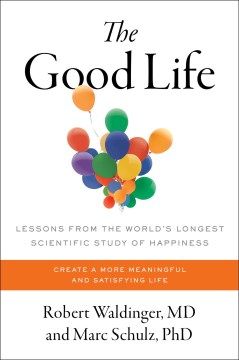
Good Life
Lessons from the World's Longest Scientific Study of Happiness
Introduction
Nova: What if I told you that the single most important factor in whether you'll be happy and healthy at age 80 has nothing to do with your cholesterol levels, your career achievements, or how much money you've saved? According to the longest scientific study of human happiness ever conducted — spanning 85 years and counting — the answer is something far simpler and, honestly, far more human.
Nova: : Okay, Nova, you've got my attention. What's the magic ingredient? Please don't say kale.
Nova: Not kale. Relationships. Warm, connected, reliable relationships. That's the central finding of "The Good Life" by Robert Waldinger and Marc Schulz, a book built on the Harvard Study of Adult Development. It started in 1938 — during the Great Depression — tracking 724 men. Some were Harvard sophomores, others were boys from disadvantaged Boston neighborhoods. And since then it has expanded to include spouses and over 1,300 descendants.
Nova: : So this isn't some pop-psychology blog post dressed up as science. This is decades of actual data.
Nova: Exactly. Blood draws, brain scans, in-person interviews every 15 years, questionnaires every two years — the works. They tracked这些人 through war, career changes, marriages, divorces, parenthood, and aging. And the finding that kept rising to the top, over and over, was that the quality of your relationships is the strongest predictor of a long, happy, healthy life. Not your IQ. Not your social class. Not your genes.
Nova: : That sounds almost too simple. I mean, everyone kind of knows friends and family matter. What makes this study different?
Nova: What's different is that most of us don't act like we know it. We spend eleven hours a day on screens. We tell ourselves we'll invest in friendships "later," after the big project, after the kids are grown. And then, as Waldinger and Schulz found, when people reach their 70s and 80s and look back, their biggest regret isn't a failed business deal — it's not spending enough time with the people they loved.
Nova: : Oof. That hits close to home. So what does the book actually teach us about fixing that?
Nova: That's exactly what we're going to explore today. From the science of loneliness to the concept of social fitness, from the WISER model for handling emotional challenges to the remarkable stories of people who turned their lives around in their 70s — this is the blueprint for a good life. And spoiler alert: it's never too late to start.
Key Insight 1: Why This Study Matters
The 85-Year Study That Rewrote Happiness
Nova: Let's start with what makes this study so extraordinary. It began in 1938 with two groups. The first was 268 Harvard College sophomores — among them a young John F. Kennedy and future Washington Post editor Ben Bradlee. The second group was 456 boys from inner-city Boston, many from troubled, disadvantaged families.
Nova: : Two completely different starting points. Privileged elite students versus kids who had to fight for everything.
Nova: Exactly, and that's what makes the data so powerful. Despite those differences, the same pattern emerged in both groups. Good relationships predicted good lives. Period. The study is now on its fourth director — Waldinger is the current one — and it has followed the original participants' children too. By the way, of the original Harvard cohort, only 19 are still alive, all in their mid-90s.
Nova: : So they've basically watched entire lives unfold from start to finish. That's extraordinary.
Nova: It is. And here's the thing Waldinger himself admits: when they first crunched the numbers, they didn't believe the results. They thought, okay, it makes sense that happy relationships make you happier emotionally. But how could the quality of your marriage predict whether you'd get coronary artery disease or type 2 diabetes? They assumed cholesterol levels at age 50 would be the better predictor. They were wrong.
Nova: : Wait — relationship satisfaction at age 50 predicted physical health at age 80 better than cholesterol? That sounds like something a greeting card company would make up.
Nova: I know, but it's been replicated by other research groups now. Waldinger said his team spent the last decade trying to figure out the mechanism. Their best hypothesis? It's about stress. When you have a bad day and you go home to a partner or a friend who really listens, you can literally feel your body calm down. The fight-or-flight response deactivates. But if you don't have anyone like that, your body stays in a low-level chronic stress state — higher circulating stress hormones, more inflammation — and that gradually wears down multiple body systems.
Nova: : So loneliness is physiologically corrosive. That's terrifying.
Nova: It is. In fact, Waldinger says loneliness has a similar physiologic fingerprint to smoking half a pack of cigarettes a day or being obese. And chronic loneliness increases your odds of death in any given year by 26 percent.
Nova: : A 26 percent mortality increase. That's not a soft, fuzzy feeling — that's a measurable, deadly risk factor. So how did we get to a world where loneliness is basically a public health emergency?
Key Insight 2: Why Disconnection Is a Crisis
The Loneliness Epidemic Nobody's Talking About
Nova: That's the scary part. The data in the book is staggering. One global survey of 55,000 people found that one in three people of all ages reported often feeling lonely. The loneliest group? Not the elderly — it was 16-to-24-year-olds. Forty percent of them said they felt lonely often or very often.
Nova: : That's wild. You'd think with social media and smartphones, young people would feel more connected than ever.
Nova: That's the paradox, isn't it? Waldinger addresses this directly. He says you can feel close to people online — one-on-one connections can be meaningful even virtually. But scrolling through a thousand Facebook friends' highlight reels? That tends to make people feel worse, not better. The comparison game is brutal. And the book points out that in 2018, the average American spent eleven hours every day interacting with media — TV, radio, smartphones. From age 40 to 80, that adds up to eighteen years of waking life.
Nova: : Eighteen years. That's almost two decades of just consuming content instead of being with people.
Nova: Right. And the U. K. has been so alarmed by this that they literally created a Ministry of Loneliness — a government body dedicated to addressing what's become a major public health challenge. The economic cost there is estimated at over £2.5 billion annually because lonely people are less productive and more prone to employment turnover.
Nova: : But here's what I want to know — is it really loneliness that's the issue, or is it just being alone? Because some people, introverts for instance, genuinely enjoy solitude.
Nova: Great distinction. Waldinger is very clear on this. Loneliness isn't about the number of people in your life. It's the gap between the social contact you want and what you actually have. You could live alone and have two close friends and feel deeply connected. You could be married with a thousand acquaintances and feel desperately lonely. It's subjective. And for introverts, Waldinger says they absolutely need relationships — they just need fewer of them. Maybe one or two solid people. But everybody needs at least one person they could call in the middle of the night if they were sick or scared.
Nova: : That's a powerful litmus test. Who could you call at 3 AM? Some people, even married people, couldn't name anyone.
Nova: Exactly. And that brings us to the concept Waldinger and Schulz spend a lot of time on: social fitness.
Key Insight 3: The Practice of Connection
Social Fitness: Relationships Are Like Muscles
Nova: The authors use the term "social fitness" very deliberately. They want people to think about relationships the same way they think about physical fitness — as a practice. Something you maintain. Because like muscles, neglected relationships atrophy.
Nova: : That analogy works. You don't go to the gym once and say, "Great, I'm fit forever now." But that's kind of how we treat friendships, right? We assume once they're established, they'll take care of themselves.
Nova: Precisely. Waldinger tells this heartbreaking story about a Harvard Study participant — they call him Sterling Ainsley. He was an optimistic guy, Harvard graduate, served in World War II, had a career as a scientist. Technically married but hadn't slept in the same room as his wife in years. He claimed his kids were the most important thing in his life but rarely saw them. When the study director visited him, Sterling mentioned he had an older sister he once adored. Then he paused, frightened, and asked: "Would she still be living?" It had been decades since they'd spoken.
Nova: : Decades. That's a level of drift that feels almost incomprehensible. But also... relatable? Like, life gets busy and suddenly you realize you haven't called your brother in two years.
Nova: That's exactly the point. The drift happens unless we actively resist it. So Waldinger and Schulz offer practical tools. One is a simple relationship audit. Write down the people in your life. Then ask: How often do I see each one? How does each person make me feel — energized or drained? What benefits do I get from each relationship? Some people provide emotional support, some provide fun, some push you out of your comfort zone. No single person can provide everything.
Nova: : That's actually freeing. It takes the pressure off any one relationship to be perfect.
Nova: Right. And they also introduce the WISER model for handling emotional challenges in relationships. W-I-S-E-R: Watch — notice what's happening internally. Interpret — what does this situation mean? Select — choose a response rather than defaulting to your automatic pattern. Engage — act on that choice. Reflect — afterward, think about how it went and what you learned.
Nova: : So instead of snapping at your partner when you're stressed, you pause and make a conscious choice. That sounds simple but incredibly hard to do in the moment.
Nova: It is hard. But the data suggests it's learnable. And the book is full of evidence that people can change their relationship patterns even late in life — which brings us to one of the most hopeful messages in the whole book.
Key Insight 4: The Andrew Dearing Story and Radical Hope
It's Never Too Late
Nova: There's a man in the study they call Andrew Dearing. He had one of the most difficult and isolated lives of any participant. His family moved constantly when he was a child, so he never developed lasting friendships. His struggles with connection continued into adulthood. When he was in his mid-60s, the study asked him to describe his closest friends and what they meant to him. He wrote simply, "no one."
Nova: : "No one." That's devastating.
Nova: It gets worse before it gets better. At 67, health problems forced him to retire from a job that was one of his few sources of pleasure and connection. Around the same time, he ended his marriage. He was lonelier than ever. But then, he decided to start going to a gym near his house. Three months later, he knew everyone at the club. He discovered that a few members shared his love for old movies, and they started getting together to watch films. When the study checked in with him in his 80s and asked how often he left his home to see others, he answered: "daily." Earlier in his life, his answer had been "never."
Nova: : From "no one" to "daily." That's an incredible transformation. What changed?
Nova: One small decision. He walked into a gym. The authors make a huge point of this: small actions create big ripple effects. Waldinger often does this exercise during his talks. He tells the audience to take out their phones and send a text to someone they miss — just a quick "hi, thinking of you." And during the Q&A, people share what they got back: "We already made a dinner date," or "My friend just had surgery and was so glad I reached out."
Nova: : So the barrier isn't actually that high. It's just that first nudge.
Nova: Exactly. And Waldinger stresses that the brain remains plastic throughout life. Old dogs can learn new tricks. They have data showing people finding love for the first time in their 70s and 80s. People who were sure they'd never have decent relationships discovering close friendships. As Waldinger puts it: "If you think it's too late for you, you have to remember you just don't know what's going to happen."
Nova: : That's genuinely hopeful. But let me ask you something. The book is about happiness, yet it's mainly talking about relationships. What about money? Career success? Do those just not matter at all?
Nova: They matter, but only up to a point. The research — including the famous Kahneman and Deaton study — shows that happiness increases with income until your basic needs are met. Once you have financial security, a roof over your head, food, healthcare, and education for your kids, the curve flattens dramatically. You could make 75 million dollars and you wouldn't be much happier. Lottery winners, as Waldinger points out, tend to return to their baseline happiness within a year.
Nova: : So the hedonic treadmill is real. What about the badges of achievement — the fancy title, the Nobel Prize?
Nova: Waldinger is blunt about this. Becoming a Harvard professor or winning a Nobel Prize won't make you happier. The work itself — if it's meaningful — can contribute to your well-being. But the badges? They don't deliver. The book makes a helpful distinction between hedonic happiness — the fleeting pleasure of a good meal or a fun party — and eudaimonic happiness, which Aristotle described as a kind of flourishing. It's the long-term sense of contentment you mean when you say "I'm happy with my life." Both matter, but relationships are the foundation of the eudaimonic kind.
Nova: : So the good life isn't about constant pleasure. It's about meaning, connection, and showing up for people.
Conclusion
Nova: Let's pull this all together. "The Good Life" by Robert Waldinger and Marc Schulz distills 85 years of the Harvard Study of Adult Development into one central message: good relationships keep us healthier, happier, and help us live longer. Not money. Not fame. Not genes. Relationships.
Nova: : And not just romantic relationships — friendships, family ties, workplace connections, even the casual chat with the barista or the mail carrier. All of it contributes to our well-being.
Nova: The book also delivers some sobering data. Loneliness increases your odds of death by 26 percent in any given year. It's as dangerous physiologically as smoking half a pack a day or being obese. And roughly one in three people worldwide reports feeling lonely, with young adults being the loneliest group of all.
Nova: : But the hopeful part — the part that really stuck with me — is that this isn't a fixed fate. The concept of social fitness teaches us that relationships are like muscles. They need regular exercise. A quick text, a phone call, joining a group around something you care about — these are the equivalents of taking a daily walk. Small, sustainable, powerful.
Nova: And the WISER model — Watch, Interpret, Select, Engage, Reflect — gives us a framework for handling the inevitable challenges that come with relationships. Because relationships are messy. They come with disappointment and vulnerability. But as the authors say, a good life is forged from precisely the things that make it hard.
Nova: : Andrew Dearing's story proves it. He went from writing "no one" when asked about his friends to having a daily social life in his 80s. It's never too late. That's not a platitude — it's backed by decades of data.
Nova: So here's your action item, if you want one: right now, think of someone you miss. Someone you'd like to see more of. Send them a text. Make the call. It doesn't have to be profound. Just a "thinking of you" is enough. Waldinger has seen this simple act spark dinner dates, rekindled friendships, and healed old wounds. The data from the longest study of human happiness says it's worth it.
Nova: : And if you're thinking, "I'll get to my relationships later" — the people in the study who reached their 80s want you to know: there isn't as much "later" as you think. The time is now. This is Aibrary. Congratulations on your growth!