

The Habit Architect: Designing Your Day for Automatic Success
Golden Hook & Introduction
SECTION
Atlas: What if I told you that for almost half of your day, you weren't the one in the driver's seat? That 43% of your actions—from how you made your coffee to which route you drove to work—were run by an autopilot you barely knew existed?
kejia li: That's a staggering thought, Atlas. As a leader and an entrepreneur, you operate under the assumption that you're making conscious, high-impact decisions all day. To think that nearly half of that is just... a pre-recorded tape playing... it's both humbling and a little terrifying. It speaks to an illusion of control we all carry.
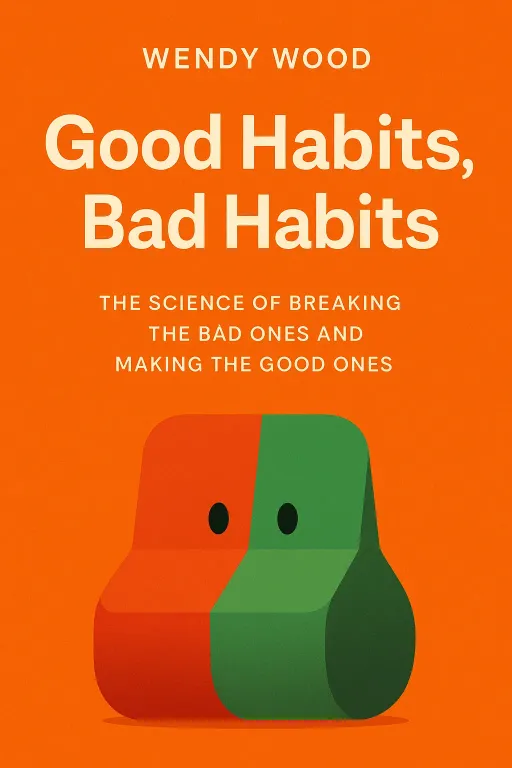
Atlas: Exactly. And that's the rabbit hole we're jumping down today, using Wendy Wood's incredible book, "Good Habits, Bad Habits," as our guide. We're going to explore this with you, kejia, and we'll tackle it from two angles.
kejia li: I'm ready.
Atlas: First, we'll expose the great myth of willpower and reveal who's running the show in our daily lives. Then, and this is the exciting part, we’ll open up the architect's toolkit. We'll explore how to use powerful concepts like 'friction' and 'context' to systematically design the habits you actually want.
kejia li: Moving from a doer to a designer. I love it. Let's get into it.
Deep Dive into Core Topic 1: The Willpower Lie
SECTION
Atlas: Alright, so let's start with that first big idea: the willpower lie. We're all taught that to change, to succeed, we just need more grit, more self-control. But the book argues that's a recipe for failure. And there's no better example of this than a massive public health campaign from the late 80s.
kejia li: I have a feeling this is going to sound familiar.
Atlas: It will. It was called the "5 A Day for Better Health" program. The goal was simple: get Americans to eat five servings of fruits and vegetables daily. The science was clear, and the campaign was huge. We're talking a partnership between the National Cancer Institute and California agribusiness. They put stickers on produce, they ran ads, they had segments on the news, they even sent schoolchildren on supermarket tours.
kejia li: They were tackling the knowledge gap. The assumption is, "If people only knew better, they'd do better."
Atlas: Precisely. And on that front, it was a wild success. In 1991, only 8% of Americans knew the five-a-day rule. By 1997, that number had skyrocketed to 39%. They had successfully informed the public. But here's the kicker.
kejia li: Let me guess. The behavior didn't change.
Atlas: Not one bit. In 1988, before the campaign, 11% of Americans ate five servings a day. A decade and millions of dollars later? Still 11%. The knowledge didn't translate into action because the campaign did nothing to change people's actual, ingrained. The automatic trip to the snack aisle, the routine of what you put in your cart—that was the invisible force they never addressed.
kejia li: That is a perfect, large-scale case study of what we see in education and corporate training all the time. We can run a fantastic workshop on a new software or a new leadership methodology. People leave inspired, they have the knowledge. But on Monday morning, they walk back into the exact same environment, with the same cues, the same pressures, the same friction. And within a week, they've reverted to the old way of doing things.
Atlas: The old habit loop takes over.
kejia li: Exactly. The "5 A Day" campaign was like giving someone a map but not changing the broken-down car they're sitting in. You haven't addressed the operational reality. The book's example of the author's cousin, who publicly announces her diet on Facebook, is the personal version of this. The intention is there, the social pressure is there, but the underlying system of her daily life remains unchanged. So, the effort fails.
Atlas: It’s a system problem, not a person problem. And that's the perfect pivot to our second idea. If willpower and knowledge aren't the answer, what is?
Deep Dive into Core Topic 2: The Architect's Toolkit
SECTION
Atlas: This is where the book gets incredibly practical. It says, stop trying to be a willpower warrior and start being a habit architect. You design the environment, and the behavior follows. The best metaphor for this comes from the world of professional cooking:.
kejia li: "Everything in its place."
Atlas: You got it. The book describes how new culinary students are a total mess. They read a recipe and start cooking, then they realize they need a chopped onion, so they stop, find an onion, chop it, and get back to a now-burning pan. It’s chaotic. There's so much friction.
kejia li: I can picture it. It's inefficient and stressful.
Atlas: But a professional chef? Before they even turn on the stove, they practice. Every ingredient is washed, chopped, and measured. Every bowl, pan, and utensil is laid out in the order it will be used. They have engineered their environment to remove all friction. Their conscious mind isn't wasted on "Where's the salt?" It's free to focus on the high-level skill: the timing, the temperature, the technique. They've designed a system for automatic success.
kejia li: That is the essence of effective leadership and system design. A great leader creates for their team. The data is prepared the meeting. The agenda is crystal clear. The project management tools are set up to be intuitive. You remove the friction of ambiguity and logistics so the team can dedicate 100% of their cognitive energy to creative problem-solving, not just figuring out how to get started.
Atlas: You're building the habit of high performance into the very structure of the work.
kejia li: Yes. You're making the desired path the path of least resistance. If I want my team to collaborate more, I don't just tell them to collaborate. I make the collaborative software the default, I structure meetings around shared problem-solving, I create a physical space that encourages interaction. I architect the context.
Atlas: And the book shows just how powerful that context is, even when it's working against our best interests. This is where the famous "Stale Popcorn" study comes in. It’s brilliant. Researchers went to a movie theater and gave moviegoers free popcorn. Half got fresh, delicious popcorn. The other half got popcorn that was five days old, stale, and tasted, in their words, like "styrofoam packing peanuts."
kejia li: Okay, so this is a test of whether people will eat bad food.
Atlas: It's a test of habit. They also asked the moviegoers if they were regular popcorn-eaters at the movies. Here's what happened. For people who have a strong movie-popcorn habit, they took a bite of the stale stuff, recoiled, and stopped eating. Makes sense, right?
kejia li: Of course. The reward was negative.
Atlas: But the people who had a strong, established habit of eating popcorn at the movies? They kept eating the disgusting, stale popcorn. They ate almost as much of it as the people who got the fresh stuff. Their hands just kept going from the bag to their mouth, on autopilot.
kejia li: Wow. So the context—the dark theater, the big screen, the bag in their lap—was so powerful that it completely overrode their actual sensory feedback. The habit was stronger than the fact that the reward was gone, or even negative.
Atlas: The habit loop was running itself. The context the reward. It's a chilling demonstration of how our second self can take over, for better or for worse. It shows that if you build a strong enough routine, it becomes incredibly resilient.
kejia li: That's the ultimate goal for a positive habit, and a critical warning for a negative one. It means the initial work of setting up the right context, of creating that for your life, pays dividends long after you've stopped thinking about it. The system runs itself.
Synthesis & Takeaways
SECTION
Atlas: So, let's bring it all together. The big shift Wendy Wood proposes is moving from a mindset of self-discipline to one of system-discipline. Stop blaming your lack of willpower. Start looking at the design of your day.
kejia li: It's a profound reframe. It’s not about being a better person; it's about being a better architect. It's empowering because it gives you tangible levers to pull. You can't just 'get more willpower,' but you absolutely can change your environment.
Atlas: Which brings us to the final, actionable takeaway. For everyone listening, and for you, kejia, as you think about your own routines and the ones you help shape for others: What is one piece of friction you can add to a bad habit, or remove for a good one, in your daily routine tomorrow?
kejia li: That’s the perfect question. It forces you to be a practical architect. For me, it's simple and immediate. I have a bad habit of scrolling on my phone before bed, which I know hurts my sleep. The willpower-based approach is to just 'not do it,' which fails. The architect's approach? I'm going to move my phone charger out of my bedroom and into the kitchen.
Atlas: Adding friction.
kejia li: A huge amount of friction. Now, to use my phone in bed, I'd have to get up and go to another room. It's a small change, but it makes the bad habit harder and makes the good habit—picking up the book on my nightstand—the path of least resistance. It's designing for the outcome I want. And that, I think, is the core lesson of this entire book. Design the life you want to live, one small piece of friction at a time.
Atlas: Perfectly said. Stop fighting. Start designing.









