Decoding Good Energy: A Systems Approach to Cellular Health
12 minGolden Hook & Introduction
SECTION
Socrates: Riyad, you work in tech. You wouldn't run a multi-million dollar marketing campaign on a buggy, outdated operating system, right?
Riyad: Absolutely not. You'd be fired. You need a stable, optimized platform to get results. Anything less is just asking for failure.
Socrates: So why are so many of us running our own lives on one? We feel sluggish, our focus is shot, we're dealing with brain fog... It feels like our personal OS is full of bugs.
Riyad: That's a powerful way to put it. It’s something I think about a lot, especially with the demands of the tech industry. We optimize everything—our code, our marketing funnels, our workflows—but often neglect the most important system of all: our own bodies. My interest in self-care comes from that exact feeling.
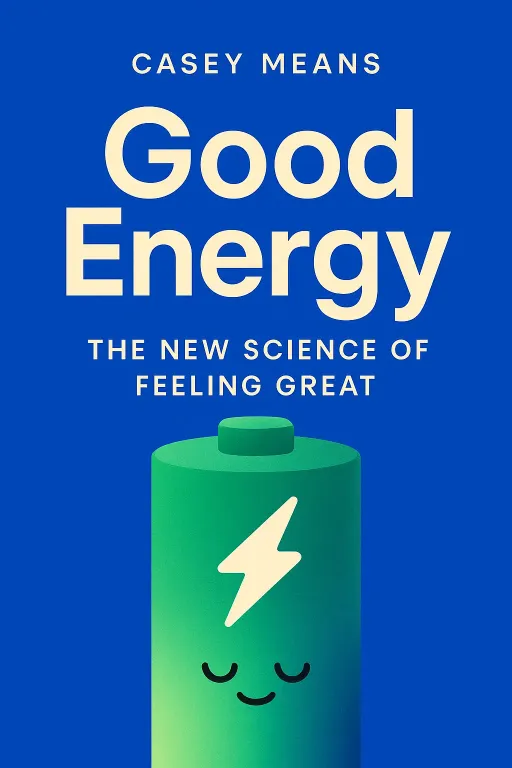
Socrates: Well, that's the perfect entry point for the book we're discussing today, "Good Energy" by Dr. Casey Means. She argues that most of our modern health problems aren't complicated mysteries, but rather the result of a fundamental mismatch between our biology and our environment. Today, we're going to dive deep into this from two perspectives. First, we'll diagnose the 'broken system' of modern healthcare and why it fails to fix our energy crisis. Then, and this is where your background gets really interesting, we'll explore how you can become your own 'health admin' by using personal data to debug your own biology.
Riyad: I love that framing. Moving from a passive user to an active admin of your own health. I'm ready.
Deep Dive into Core Topic 1: The Broken System
SECTION
Socrates: Great. So let's start with that 'broken system.' Dr. Means calls it 'siloed health.' What she means is that modern medicine has become hyper-specialized. You have a heart problem, you see a cardiologist. A skin problem, a dermatologist. A gut problem, a gastroenterologist. But they rarely talk to each other.
Riyad: It sounds exactly like a poorly managed software project. You have a front-end team, a back-end team, a database team... and if they aren't in constant communication, working from the same architectural plan, the user ends up with a disjointed, buggy product. No one is looking at the system as a whole.
Socrates: That is precisely her point. And she illustrates this with a devastating story about a patient she calls Sarah. Sarah was a 36-year-old woman suffering from intractable migraines for over a decade. They were so bad she was on disability and largely housebound.
Riyad: Wow, for a decade? That's brutal.
Socrates: It is. And get this: in the past year alone, she had seen eight different medical specialists. A neurologist for the migraines, a psychiatrist for the resulting depression, a cardiologist for hypertension, even a palliative care specialist. She was on a cocktail of different medications, each prescribed by a different doctor to treat a different symptom.
Riyad: So each specialist was just patching their little corner of the problem. No one was looking for a root-cause bug that might be affecting the entire system.
Socrates: Exactly. Dr. Means, who was a chief resident at the time, reviewed Sarah's massive medical file and found something astounding. Despite all the specialists, all the expensive tests, all the prescriptions... no one had ever suggested she try a simple migraine elimination diet. No one had asked the fundamental question: could something you're eating be causing the inflammation that's triggering these headaches?
Riyad: That's unbelievable. It's like a user complaining that an app crashes every time they upload a photo, and instead of checking the photo upload code, the support team just tells them to restart their phone, clear their cache, and reinstall the app over and over. They're just managing the symptoms, not fixing the underlying issue.
Socrates: That's the perfect analogy. Dr. Means realized she was part of a system that was excellent at 'managing' disease but terrible at creating health. Sarah's migraines, her depression, her hypertension—they weren't necessarily eight separate problems. They were likely different manifestations of one core issue: systemic inflammation, or what Dr. Means calls 'Bad Energy.' The system was siloed, and Sarah was falling through the cracks.
Riyad: It highlights a total failure of systems thinking. And it's frustrating because, in tech and marketing, we're obsessed with root-cause analysis. If a campaign fails, we don't just tweak the ad copy; we analyze the entire funnel, from the audience targeting to the landing page experience, to find the core breakdown. It seems so obvious to apply that same logic to our health.
Socrates: Obvious, yet revolutionary in the context of our current healthcare model. And if that's the problem—a fragmented system that isn't designed to find the root cause—then the solution can't be to just find a better doctor. The solution, Dr. Means argues, has to come from us.
Deep Dive into Core Topic 2: The Empowered User
SECTION
Socrates: And that naturally leads us to our second core idea: becoming the empowered user, or the 'admin' of your own health, through what she calls 'bio-observability.'
Riyad: Okay, 'bio-observability.' I like the sound of that. It implies having a dashboard for your own body.
Socrates: You've nailed it. It's about using accessible tools to get real-time data on your own biology. The book gives another powerful example with a woman named Emily. Emily was pregnant and, like all pregnant women, had to do the standard test for gestational diabetes at 24 weeks. It involves drinking a super sugary drink and having your blood drawn an hour later.
Riyad: Right, a single data point in time. A snapshot.
Socrates: Exactly. So, Emily does the test, and her doctor calls a few days later and says, "Great news, your results are normal! You're fine." But here's the twist: Emily, being a data-savvy person, was also wearing a Continuous Glucose Monitor, or CGM. It's a small sensor that tracks your blood sugar 24/7.
Riyad: Ah, so she had the snapshot from the lab, but she also had the live, streaming data. The real-time analytics. This is where it gets good.
Socrates: It does. Because when Emily looked at her own CGM data from the day of the test, it told a completely different story. After she drank that sugary drink, her blood sugar didn't just go up and come down nicely. It skyrocketed into the official range for gestational diabetes and stayed high for hours. The single snapshot the lab took had missed the peak. The official test said she was fine, but her own, real-time data was screaming, "No, you're not! There's a problem here!"
Riyad: That is incredible. It's the difference between looking at a monthly sales report and watching a live dashboard of user activity on your website. The monthly report might say 'sales are okay,' but the live dashboard could show you that 90% of users are abandoning their cart at the final step. That's the actionable insight! The lab test gave her a false sense of security, but her own data gave her the power to act.
Socrates: That's the key word: power. She didn't argue with the doctor. She just took her data and immediately changed her diet and lifestyle to manage her blood sugar. She protected herself and her baby because she trusted her own data over the flawed, single-snapshot system. She became the admin of her own health.
Riyad: This resonates so deeply with me. In marketing, we say, "In God we trust; all others must bring data." We A/B test everything—headlines, images, button colors—because we know that assumptions are dangerous. You have to test and see what the data says. It's wild that we apply that rigor to getting someone to click a button, but we don't apply it to our fundamental well-being.
Socrates: And it's more critical than ever. Dr. Means cites a shocking statistic: a 2022 study found that only 6.8% of American adults have optimal metabolic health. That means over 93% of us are already in the danger zone on at least one key marker. We can't afford to wait for the yearly snapshot from our doctor to tell us there's a problem.
Riyad: So the message is that the tools are now available for us to create our own health dashboards. We don't have to be passive recipients of a diagnosis. We can be proactive analysts of our own biological data, spotting trends and making adjustments in real-time, just like we would with any other complex system we're responsible for.
Synthesis & Takeaways
SECTION
Socrates: Exactly. And that really synthesizes the two core ideas from "Good Energy" we've discussed. First, we're operating within a 'siloed' healthcare system that's designed to manage symptoms, not create health. And second, the way out is through 'bio-observability'—becoming empowered admins who use personal data to understand and optimize our own unique biology.
Riyad: It’s a powerful mindset shift. It’s moving from being a passenger in a car that seems to be breaking down, to getting in the driver's seat, opening up the hood, and actually learning how the engine works. It's about taking ownership and applying the same analytical curiosity we use in our professional lives to our personal health. It's not just self-care; it's smart self-management.
Socrates: Beautifully put. So, to leave our listeners with something tangible, something beyond the theory—what's a simple first step? If someone listening wants to start their journey to becoming their own 'health admin,' what's the first experiment they can run?
Riyad: I think it has to be simple and data-driven. Based on what we've discussed, the most immediate feedback loop is food and energy.
Socrates: I agree. So here is a simple challenge, a call to action for everyone listening. For just one week, run your first personal A/B test. On one day, have a lunch that's heavy in refined carbs—like a big pasta dish or a sandwich on white bread. And on another day, have a lunch that's centered on protein, healthy fat, and fiber—like a big salad with salmon and avocado. Don't change anything else. Just observe.
Riyad: And be the analyst. Ninety minutes after each meal, check your personal dashboard. How's your energy? How's your focus? Do you feel sharp and ready to go, or are you fighting the urge for a nap and another cup of coffee?
Socrates: That's your first data point. It's not about a doctor telling you what to do. It's about you, listening to your own system and letting the data guide you. That's the first step to creating Good Energy. Riyad, this has been a fantastic discussion. Thank you for bringing such a sharp, analytical perspective.
Riyad: The pleasure was all mine. It’s given me a whole new framework for thinking about health. It's not just about feeling good; it's about running a better system.