Ethical Leadership is a Trap: Why You Need Principled Foresight.
Golden Hook & Introduction
SECTION
Nova: What if I told you that trying to be a "good" leader—focused purely on ethical intentions—is actually a trap? That it could lead to worse outcomes, not better?
Atlas: Whoa, that's a bold claim, Nova. Most of us are to be more ethical. How can that possibly be a trap? That sounds like a contradiction.
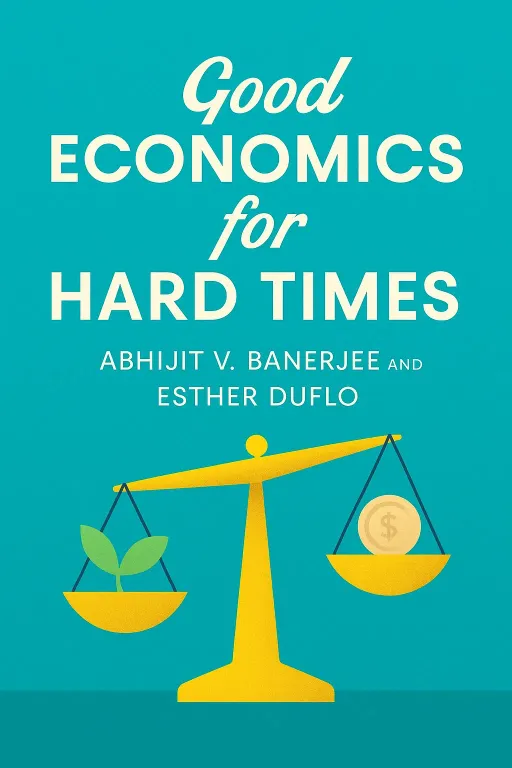
Nova: Well, Atlas, that's exactly what we're unpacking today. The title of our discussion is "Ethical Leadership is a Trap: Why You Need Principled Foresight." And we're drawing insights from two absolute titans in their fields: "Good Economics for Hard Times" by Nobel laureates Abhijit V. Banerjee and Esther Duflo, and Donella H. Meadows' foundational "Thinking in Systems." Both argue that good intentions, while admirable, aren't enough when you're dealing with complex human systems.
Atlas: Okay, so good intentions aren't the whole story. You're saying we need something more. Lay it on me.
The Ethical Trap: When Good Intentions Go Awry
SECTION
Nova: The core idea here is what we're calling "The Blind Spot." Many leaders chase ethical ideals without truly understanding their practical, real-world effects. This isn't about malicious intent; it's about a lack of systemic vision. You see the surface-level intention, but you miss the intricate web of systems at play.
Atlas: I imagine a lot of our listeners are nodding along, thinking about their own initiatives. What do you mean by "unintended consequences" in this context? Can you give me an example?
Nova: Absolutely. Banerjee and Duflo, in "Good Economics for Hard Times," are brilliant at illustrating this. They show how well-meaning policies often fail not because they're bad ideas, but because they don't account for human behavior and systemic complexity. Take the idea of providing free textbooks to children in developing countries. Sounds unequivocally good, right?
Atlas: Of course! Education is key. That's a no-brainer ethical move.
Nova: It seems that way. But in some cases, what happened was that parents, now freed from the expense of textbooks, shifted their limited resources away from other educational investments, like private tutoring or even nutritious food, assuming the school would now provide everything. Or, the free books, once distributed, weren't maintained, or they were hoarded by teachers, or they simply disappeared into a dysfunctional distribution system. The intention was to improve education, but the systemic reality was far more complicated, sometimes leading to no net gain, or even a decrease in overall educational support from the family.
Atlas: Wait, so giving free books can actually educational outcomes? That feels profoundly counter-intuitive to every leader trying to do the right thing. It's like you're trying to solve one problem, but you're accidentally creating five others you didn't even see.
Nova: Exactly. It's not about the goodness of the heart; it's about the efficacy of the hand. Simple answers rarely solve complex problems. You can have the purest ethical intentions, but if you don't understand the existing incentives, the human psychology, and the intricate feedback loops in that system, your intervention can fizzle out or, worse, backfire.
Atlas: So, it's not about you're trying to do good, but you're doing it, and what hidden factors you're missing. I can see how that would be a blind spot for many leaders, especially when they're under pressure to make decisive, "good" choices.
Principled Foresight: Navigating Systems with Intentional Impact
SECTION
Nova: That's a perfect segue, Atlas, because the answer isn't to stop trying to do good, but to get smarter about we do it. And that brings us to Donella Meadows and "Thinking in Systems." She argues that true ethical leadership comes from understanding how actions ripple through interconnected systems, not just from good intentions.
Atlas: So, it's about seeing the whole forest, not just the trees? But for a leader facing daily pressures, how do you even begin to these leverage points, especially when you're trying to move fast? It sounds like a lot of extra work.
Nova: It's a shift in mindset, Atlas. Meadows teaches us that interventions in complex systems can have delayed, non-obvious, and sometimes counter-intuitive results. Understanding "leverage points" is key—these are the places in a system where a small shift can produce large changes. Think of it like steering a massive ship: you don't push on the bow; you turn the rudder.
Atlas: Can you give us an example where understanding these leverage points made a real difference? Something that illustrates this "principled foresight" in action?
Nova: Certainly. Consider a classic example in environmental policy: reducing plastic waste. A simple ethical approach might be to ban plastic bags. But a systems thinker might look deeper. They might realize that the real leverage point isn't just banning plastic, but incentivizing the creation of, or designing systems for circular economies where waste is a resource. A small shift in how products are designed, or how waste is managed at the municipal level, can have a far greater, more sustainable impact than a blanket ban that might just shift the problem to another material or create new logistical challenges. It’s about asking: Where can we make a change that ripples through the entire system for lasting positive effect?
Atlas: That makes perfect sense. It's not just about stopping a bad thing, but about creating a better system that prevents the bad thing from happening in the first place. For our listeners who are trying to lead ethically, are we saying "ethical" isn't enough? That you need "principled foresight" specifically?
Nova: Exactly, Atlas. "Ethical" sets your compass, but "principled foresight" gives you the map and the navigation tools. It's the difference between to go north and actually how to get there, avoiding all the hidden pitfalls. It’s Nova's take that ethical leadership this systemic understanding. Without it, you're navigating a complex world with only half the map.
Synthesis & Takeaways
SECTION
Atlas: So, the deep question for our listeners becomes: Where in your current work might a well-intentioned decision lead to an unforeseen, negative systemic outcome? How can you apply this "principled foresight" to uncover those blind spots?
Nova: Start by mapping out the stakeholders, the resources, the feedback loops. Ask yourself: "Who benefits, who loses, and how might this change things beyond the immediate goal?" It’s about embracing complexity, not shying away from it. It’s about proactively looking for those leverage points.
Atlas: That's actually really inspiring. It's not just about avoiding failure; it's about creating genuinely impactful, sustainable change. It's about moving from simply "trying to do good" to "actually doing good, effectively."
Nova: Precisely. It's about elevating your leadership from reactive ethics to proactive, principled foresight.
Atlas: Absolutely. This has been a true eye-opener. I feel like I'm seeing the world through a new lens.
Nova: Thank you for joining us on this journey of insight today. We love challenging conventional wisdom and providing tools for deeper reflection.
Atlas: And we'd love to hear your thoughts on where you've seen well-intentioned decisions go awry, or where principled foresight has truly made a difference. Share your insights with the Aibrary community.
Nova: This is Aibrary. Congratulations on your growth!