

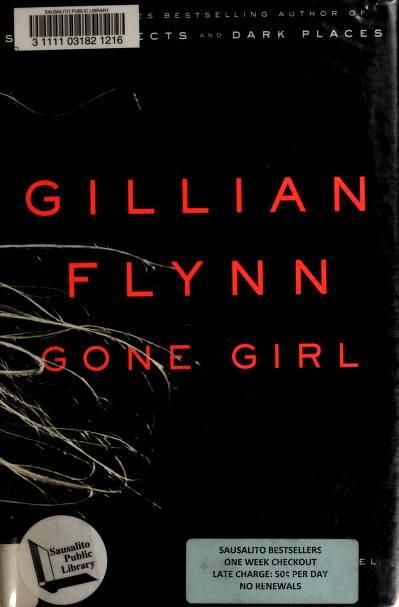
Gone Girl
Introduction
Nova: Imagine this: your wife disappears on your fifth wedding anniversary. There are signs of a struggle in your living room. The police find a diary she left behind, detailing years of your abuse. The media crucifies you. And here's the thing, you didn't do it. But nobody believes you. That's the nightmare Nick Dunne wakes up to in Gillian Flynn's Gone Girl, a book that didn't just become a bestseller, it rewired the DNA of the psychological thriller. I'm Nova.
Nova: : And I'm. So let me get this straight, this is the book that spent 37 weeks at number one on the New York Times bestseller list, sold over 20 million copies worldwide, and basically created an entire subgenre of domestic suspense?
Nova: Exactly. Published in June 2012, Gone Girl became a cultural earthquake. It launched a thousand imitators, inspired a David Fincher film that made 369 million dollars at the box office, and introduced phrases like "Cool Girl" into the everyday lexicon. But here's what fascinates me: a decade later, the book still holds up. It's not just a page-turner. It's a scalpel-sharp dissection of marriage, media, and the performances we all put on.
Nova: : I've heard the term "Gone Girl twist" thrown around so much that it's almost become a punchline. But before we get to that, what's the actual setup?
Nova: Let's take it from the top. Nick Dunne and Amy Elliott Dunne are a gorgeous, clever New York couple, both magazine writers, who lose their jobs in the Great Recession. They relocate to Nick's dying hometown of Carthage, Missouri, where he opens a bar with his twin sister Go. On the morning of their fifth anniversary, Amy vanishes. The novel alternates between Nick's present-day narration and excerpts from Amy's diary, chronicling their relationship from fairy-tale romance to something deeply sinister.
Nova: : So for the first half of the book, we're reading Amy's diary entries that paint Nick as a violent, terrifying husband, while Nick in the present seems shifty and is hiding something, namely, an affair with his 23-year-old student. The evidence piles up. We're basically convinced Nick did it.
Nova: And then, right at the midpoint, Flynn pulls the rug out. Part Two begins, and we're suddenly inside Amy's head in the present tense. She is very much alive. She has staged her own disappearance. Every single diary entry was fabricated. The pregnancy was fake. The abuse was fake. She spent an entire year meticulously planning to frame her husband for murder because he cheated on her and, in her view, wasted her life.
Nova: : It's such a brilliant structural betrayal. We spent 200 pages trusting the diary, which feels like the most intimate, truthful form of narrative, and it was all a performance. That's when you realize this book isn't really a whodunit. It's a who-is-who.
How Flynn Weaponizes Narrative Structure
The Anatomy of the Twist
Nova: Let's talk about why that twist works so devastatingly well. Gillian Flynn didn't just write alternating perspectives, she weaponized the very idea of storytelling. Nick and Amy were both writers by trade. Nick was a journalist. Amy wrote personality quizzes for women's magazines. They both understand narrative. They both know how to shape a story to make themselves the hero.
Nova: : And Amy's weapon of choice is the diary. There's something almost sacred about a diary in literature. We're conditioned to believe the diary tells the truth because who would lie to their own journal?
Nova: Exactly. Flynn exploits that readerly trust completely. But here's the extra layer: Amy didn't just write a fake diary. She wrote it with a specific audience in mind, the police and the media. She knew exactly which details would be most damning. She created a forensic narrative. She even planted the burned diary in Nick's father's old house, knowing investigators would find it. Every detail is designed.
Nova: : What gets me is that even after the twist, Flynn doesn't let you off easy by making Amy a cartoon villain. You understand her rage. Nick really did cheat on her. He really was a neglectful, emotionally absent husband. He drained her trust fund to open his bar. He moved her to a town she hated. And he was planning to divorce her, walking away consequence-free while she had sacrificed everything.
Nova: That's the uncomfortable genius of the book. Amy Dunne is a psychopath who slits her ex-boyfriend's throat with a box cutter, but she's also eerily lucid about the casual cruelties women endure in relationships. You find yourself in this queasy space where you're horrified by her actions but nodding along with her grievances. Flynn herself has said she wanted to acknowledge female anger as a viable emotion, something that should be dealt with and appreciated rather than dismissed.
Nova: : And Nick, let's be honest, is no prize either. He's got a deep streak of misogyny. In the novel he thinks things like, "Women are crazy. No qualifier: not some women, not many women. Women are crazy." He cheats on his wife with a student young enough to be in his class. He's lazy, self-pitying, and obsessed with being liked. Flynn once said in an interview that marriage is sort of like a long con, because you put your very best self on display during courtship, but your spouse never sees the real you until you're deep into the marriage.
Nova: And that's the central metaphor. Both Nick and Amy were conning each other from the start. Nick played the charming, ambitious New York writer. Amy played, well, the Cool Girl.
The Monologue That Became a Cultural Flashpoint
The Cool Girl and the Gender Wars
Nova: Let's read a piece of the most famous passage in the book. Amy, reflecting on what she did to win Nick, writes: "Being the Cool Girl means I am a hot, brilliant, funny woman who adores football, poker, dirty jokes, and burping, who plays video games, drinks cheap beer, loves threesomes and anal sex, and jams hot dogs and hamburgers into her mouth like she's hosting the world's biggest culinary gang bang while somehow maintaining a size two. Cool Girls never get angry. They only smile in a chagrined, loving manner and let their men do whatever they want."
Nova: : That monologue hit so hard it became a cultural diagnosis overnight. Flynn told Vulture that she was inspired by watching Cameron Diaz in There's Something About Mary. Here's this beautiful woman who's also a doctor, loves golf, drinks real beer, eats hot dogs, and just wants a guy to take her to a football game. And Flynn thought, "Wow, that's a cool girl." Then she thought, "Oh right, she's been invented by guys."
Nova: The Cool Girl monologue split readers. Some saw it as a razor-sharp feminist critique of the impossible performance women are asked to put on. Others argued it was itself misogynistic, suggesting that any woman who genuinely enjoys those things must be faking it to impress men. It became one of the most debated passages in 21st-century popular fiction.
Nova: : And that debate mirrors the larger controversy around the book itself. Is Gone Girl a feminist novel or a misogynistic one? Because on one hand, you have this brilliant critique of gendered expectations. On the other, your central female character is a lying, manipulative murderer who fakes abuse allegations, which is an incredibly dangerous trope.
Nova: Flynn has pushed back hard on the idea that writing about awful women means you dislike women. She told TIME magazine, "It feels so old-fashioned to think because you write about awful women that you don't like women. To me it's worse to only write about good women." And the Culture Carve retrospective on the novel makes a really useful distinction: Amy Dunne is not a feminist character, but Gone Girl is arguably a feminist book. The difficulty is separating the two.
Nova: : The book is also deeply interested in how misogyny isn't just something men do to women, it's internalized by women too. Amy's mother built an entire publishing empire on a fictionalized, perfected version of her daughter called Amazing Amy. The real Amy could never compete with the fictional one. She learned early that being yourself is never enough, you have to perform.
Nova: And that connects to what Flynn has said about why readers connected with Gone Girl so fiercely. She told The Hollywood Reporter that the acknowledgment of female anger, as something legitimate, something that should be appreciated rather than pathologized, was one of the reasons so many people, especially women, felt seen by this book. Even if Amy's expression of that anger is, you know, criminal.
What Gone Girl Is Really About
Marriage, Media, and the Recession
Nova: Beyond the gender politics, Gone Girl is also a scalding portrait of the Great Recession's impact on American life. Both Nick and Amy lose their magazine jobs. They drain Amy's trust fund. They move to a McMansion development in Missouri that's mostly abandoned due to foreclosures. The local mall is described as "two million square feet of echo."
Nova: : It's such a specific texture of economic despair. Nick and Amy aren't just unhappy because they're terrible people, though they are, they're also casualties of forces bigger than themselves. The recession stripped away the lives they'd built, and without that scaffolding, the marriage collapses.
Nova: Exactly. Flynn worked at Entertainment Weekly for a decade before being laid off herself, so she knew this world intimately. And the novel is also a blistering satire of the 24-hour news cycle and true-crime media culture. Once Amy disappears, the media descends. Nick is tried in the court of public opinion before any actual charges are filed. There's a character, Ellen Abbott, who's clearly modeled on Nancy Grace, a cable news host who rushes to convict Nick on air.
Nova: : The book was published in 2012, right in the middle of the true-crime boom. Casey Anthony, Scott Peterson, these cases had trained the public to see every missing wife story as a husband-murderer story. Nick even acknowledges this himself. He knows that in almost every case of a wife's disappearance, the husband is guilty. And that cultural expectation becomes Amy's most powerful weapon.
Nova: Flynn said she was fascinated by how we consume tragedy, how we cast heroes and villains and become deeply invested in these narratives. Scott and Laci Peterson were certainly a reference point. They were a good-looking couple, as Flynn noted, but as she said, "They're always good-looking couples. That's why they end up on TV." The novel is about the selection and packaging of tragedy as entertainment.
Nova: : And the ending, let's talk about the ending because it's so deliberately unsatisfying. Amy returns, kills Desi, stages herself as the victim, and comes home to Nick. He knows everything. The detective knows everything. But they can't prove it. Amy inseminates herself with Nick's stored sperm, gets pregnant, and essentially holds the child hostage. Nick destroys his tell-all manuscript and commits to playing the perfect husband for the rest of his life.
Nova: It's a deeply unsettling conclusion. There's no justice, no catharsis. Just two people locked in a performance of a happy marriage, both fully aware it's a prison, both fully aware the other knows. Nick and Amy each write competing memoirs. Hers is called "Amazing." His is called "Psycho Bitch." And the final line of the novel belongs to Amy, who claims the last word, literally. Flynn has cited Rosemary's Baby and Who's Afraid of Virginia Woolf as influences, works that also end in unease rather than resolution.
Nova: : It's the anti-romance. Instead of "boy meets girl, boy loses girl, boy gets girl back," Flynn deliberately flips it to "boy loses girl, boy meets girl, boy gets girl back or vice versa." The question of who possesses whom is left deliberately, chillingly open.
How One Book Reshaped an Entire Industry
The Gone Girl Effect
Nova: It's hard to overstate what Gone Girl did to the publishing industry. The book didn't just succeed, it rewired the market. Before 2012, publishers operated on the assumption that men wouldn't read books with female protagonists, and women only wanted to read about characters they could root for. Gone Girl detonated both those ideas.
Nova: : The numbers are staggering. Between June 2012 and 2022, more than 680 books with the word "girl" in the title were published, with a total market value of nearly 240 million dollars. We got The Girl on the Train, The Woman in the Window, Luckiest Girl Alive, The Other Black Girl. "For fans of Gone Girl" became the most ubiquitous blurb in publishing.
Nova: And it's not just the titles. Gone Girl launched the entire domestic suspense renaissance. These are thrillers centered on interpersonal mysteries, often set in the home, featuring unreliable female narrators, anti-heroines, and twist-upon-twist plotting. Authors like Megan Abbott, Laura Lippman, Paula Hawkins, and Jessica Knoll all operate in the space that Gone Girl carved out.
Nova: : The book also opened the floodgates for the "unlikable female character." Layne Fargo, author of Temper and They Never Learn, has said that Gone Girl is basically the formative text for writers exploring female anti-heroes. Sascha Rothchild, creator of the novel Blood Sugar, said flatly, "Without Flynn's Amy Dunne, there would never have been my Ruby Simon." Flynn gave permission for female characters to be messy, angry, complicated, and sometimes monstrous.
Nova: But the imitation wave also had diminishing returns. As Esquire noted in its 10th anniversary retrospective, the knockoffs grew increasingly one-dimensional while the twists became more and more deranged. Astral projection, face blindness, secret triplets. It got so saturated that Netflix eventually released a parody called The Woman in the House Across the Street from the Girl in the Window.
Nova: : The irony is that when Crown originally published Gone Girl, the galley didn't use any comparison marketing at all. No "for fans of" language. It was completely original, and that's why it worked. Stephen King called it "a plot Agatha Christie could have conceived" elevated by "Franzen-like prose." That's not a combination you can replicate with a formula.
Nova: And the film adaptation only amplified the phenomenon. David Fincher's 2014 movie, with Flynn writing the screenplay herself, earned Rosamund Pike an Oscar nomination and made 369 million dollars worldwide. Ben Affleck was brilliantly cast as Nick, a handsome leading man with just enough of a smarmy edge that you could believe him capable of either innocence or guilt. Flynn has since mostly transitioned to screen work, writing Widows and showrunning Utopia. She's published only a short story and a comic since Gone Girl.
Nova: : Which makes Gone Girl feel even more singular in retrospect. She captured something so specific to that post-recession, true-crime-obsessed moment, and she did it with a book that works equally well as a beach read and as the subject of a university literature seminar. That's vanishingly rare.
Conclusion
Nova: So what makes Gone Girl endure, a decade and 20 million copies later? I think it's that the book refuses to give easy answers. It doesn't tell you who to root for. It doesn't offer justice or closure. It leaves you in the same uncomfortable position as Nick Dunne: trapped in a beautiful house with someone you know is capable of anything, smiling for the cameras.
Nova: : And it asked questions that we're still wrestling with. What do we owe each other in a marriage? How much of ourselves do we perform for partners, for the public, for the pages of our own diaries? Can female anger ever be expressed without being pathologized? The book's refusal to resolve these questions is exactly why it's still relevant.
Nova: The "Cool Girl" monologue in particular has taken on a life of its own. In the years since the book's publication, we've seen Me Too, the overturning of Roe v. Wade, an entire cultural reckoning with the kinds of performances women are expected to give. If anything, as Esquire noted, Amy's unrelenting anger about casual sexism now feels almost quaint given everything that's happened since. There's still so much room for well-rounded anti-heroines who bubble with murderous rage.
Nova: : If you haven't read Gone Girl, or if you only know it through the movie or the cultural chatter around it, the book rewards a deep read. Flynn's prose is precise and caustic. The structure is airtight. Every detail pays off. And the ending will sit with you for days. It's one of those rare novels that genuinely earns its place in the cultural conversation.
Nova: And if you have read it, maybe it's time for a reread. You'll notice entirely different things when you know the twist. The clues are all there from page one, hiding in plain sight. Just like Amy herself.
Nova: : Just like Amy. This is Aibrary. Congratulations on your growth!