

The Esoteric Trap: Why You Need Historical Context for Ancient Wisdom.
Golden Hook & Introduction
SECTION
Nova: What if the very shortcut you're taking to ancient wisdom is actually leading you further away from its true power? We're talking about the seductive trap of instant mysticism versus the profound journey of historical context.
Atlas: Oh, I love that. Because honestly, the internet is flooded with "ancient secrets revealed in five minutes!" It's so tempting to just grab the shiny, mystical bit and run with it, isn't it? It feels like the fastest path to that deep, spiritual experience we're all looking for.
Nova: Absolutely, Atlas. And that's exactly the "blind spot" we're dissecting today. Many of us approach esotericism, these ancient wisdom traditions, purely seeking that immediate, mystical hit. But in doing so, we're overlooking something absolutely critical: their deep, intricate historical and philosophical roots. It's like trying to appreciate a complex symphony by just listening to one catchy chorus. You miss the entire movement, the composer's intent, the cultural impact.
Atlas: That's a great analogy. So, what you're saying is by chasing the quick spiritual high, we're actually bypassing the very thing that gives these traditions their true weight and meaning? It sounds almost counter-intuitive to a "seeker" like me.
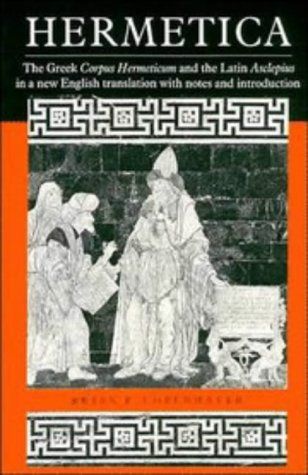
Nova: Precisely. And that's why we're turning to some truly illuminating work today. We're looking at texts like, masterfully translated and analyzed by Brian Copenhaver, and by Kurt Rudolph. These aren't just academic tomes; they're our guides to understanding the profound intellectual currents that shaped these ancient esoteric traditions, revealing a depth that's often missed.
Atlas: Okay, so you’re saying Copenhaver and Rudolph aren't just cataloging beliefs, but meticulously tracing the complex intellectual DNA of these ideas? Why is that so crucial for someone like me, who's driven by a quest for meaning, rather than just historical facts?
The Esoteric Blind Spot & Misinterpretations
SECTION
Nova: It’s crucial because without that DNA, without that historical genesis, we're essentially making things up as we go, projecting our modern ideas onto ancient systems. Think about it this way: imagine someone today picks up an ancient Egyptian text, sees a symbol, let's say the Ankh, and immediately interprets it as a generic "life force" or "spiritual energy" through a purely modern self-help lens. They might even try to "manifest" with it.
Atlas: Right, I've seen that. It's everywhere online. "Unlock your inner power with this ancient symbol!"
Nova: Exactly. But what they're missing are centuries of rich, nuanced understanding: the Ankh's specific role in Egyptian funerary rites, its connection to the Nile's flooding, its theological implications within a polytheistic pantheon, its relationship to specific deities, and how its meaning evolved over millennia. They're missing the profound philosophical debates, the cultural influences, and the prior religious concepts that gave that symbol its true power and context. It’s a complete disconnection from its original intellectual environment.
Atlas: Whoa. So the "shortcut" isn't just less fulfilling, it's actively leading to misinterpretation? That sounds rough, but why is that shortcut so tempting in the first place? Is it just our modern impatience, or something deeper?
Nova: I think it's a combination. There's a natural human desire for immediate understanding and transformation, especially when we're seeking spiritual insight. In our fast-paced world, we're conditioned to look for instant gratification. But with ancient wisdom, that desire creates a blind spot. It leads to reductionism, where complex, multi-layered philosophical systems are flattened into simplistic platitudes. It turns millennia of intellectual and spiritual inquiry into a shallow self-help slogan.
Atlas: That makes sense. So, if I'm interpreting an ancient text through my 21st-century mindset, I'm not actually engaging with the wisdom; I'm just seeing my own reflection. Can you give me a clearer example of a common modern interpretation of an esoteric concept that's wildly different from its historical meaning? Something that really highlights this danger?
Nova: Absolutely. Take the concept of "karma." In many modern New Age interpretations, it's often simplified to a cosmic vending machine: "Do good, get good; do bad, get bad." It's a very transactional, almost retributive, idea. But historically, particularly in the Vedic and Buddhist traditions, karma is an incredibly complex web of cause and effect, intention, action, and consequence that plays out over multiple lifetimes, involving intricate philosophical considerations about consciousness, reincarnation, and liberation. It's not just about immediate reward or punishment; it's about the subtle imprints of action on the soul and the universe. The modern interpretation completely strips away that depth and nuance.
Unlocking Ancient Wisdom with Historical Context (Hermeticism & Gnosticism)
SECTION
Nova: And that brings us perfectly to the solution for this blind spot: rigorous historical and philosophical inquiry. This is where scholars like Brian Copenhaver and Kurt Rudolph become indispensable. They don't just tell you people believed; they show you and those beliefs emerged.
Atlas: Okay, so how does knowing the historical context actually my understanding? How does knowing, say, that Hermeticism came from Alexandria, change my spiritual experience or my quest for direct knowledge?
Nova: It changes everything, Atlas. Take Copenhaver's work on. When you read his meticulously researched text, you discover that Hermetic thought isn't some ethereal, timeless mysticism floating in a vacuum. He reveals its precise origins in ancient Alexandria, a melting pot where Greek philosophy, particularly Platonism, blended with ancient Egyptian religious ideas. You see how these intellectual currents weren't just random; they were a sophisticated synthesis responding to the needs and questions of that specific era.
Atlas: So it's not just about the ideas themselves, but the intellectual arguments and cultural forces that birthed them?
Nova: Exactly! Copenhaver shows how Hermeticism influenced Renaissance esotericism, figures like Giordano Bruno, and even early modern science. Knowing this prevents us from misattributing its concepts or seeing it as a simplistic "magic system." Instead, it reveals a profound philosophical lineage, a sophisticated attempt to understand the cosmos and humanity's place within it, deeply embedded in intellectual history. It adds layers of meaning you'd never grasp if you just cherry-picked its maxims.
Atlas: That's a great way to put it. It transforms it from a collection of mystical sayings into a living, evolving intellectual tradition. What about Rudolph's work on Gnosticism then? How does tracing its diverse movements and relationship with early Christianity illuminate its quest for direct knowledge?
Nova: Rudolph's is a masterclass in this. He doesn't present Gnosticism as a single, monolithic, easily definable belief system. Instead, he meticulously traces the diverse Gnostic movements, illustrating their incredibly complex relationship with early Christianity, Hellenistic philosophy, and even older Persian religious ideas. He unpacks their unique cosmologies – the idea of a distant, unknowable true God, a lesser creator deity, and the spark of divinity trapped within material bodies.
Atlas: So by showing the diversity and the precise historical arguments, does he make Gnosticism more accessible or more confusing for someone seeking "gnosis" – that direct knowledge?
Nova: He makes it more and infinitely more profound. When you understand the specific historical debates Gnostics were engaging in with proto-orthodox Christians, or how they reinterpreted Platonic ideas, their quest for direct knowledge, for "gnosis," takes on a whole new dimension. It's not just a vague feeling; it's an intense philosophical and spiritual striving within a very specific intellectual and religious landscape. Rudolph helps us see their unique understanding of salvation through knowledge, not faith, within its proper historical framework. It's about revealing the of their intellectual quest, not reducing it to a soundbite.
Atlas: Wow, that gives me chills. So, what you're both saying is that these texts provide the critical historical and philosophical framework needed to truly appreciate the sophistication and enduring impact of ancient esoteric traditions. It's not about stripping away the mystery, but enriching it with context.
Synthesis & Takeaways
SECTION
Nova: Precisely, Atlas. The profound insight here is that historical context isn't a barrier to mystical experience or spiritual understanding; it's the very key that unlocks the true depth and sophistication of ancient wisdom. It transforms vague mysticism into a rich, intellectual, and deeply meaningful journey. It allows us to engage with these traditions on their own terms, respecting their original genius, rather than imposing our own.
Atlas: It really shifts my perspective. My initial desire for immediate answers, that "seeker" impulse, actually blinds me to the deeper, more rewarding journey of understanding. It's about trusting the process, dedicating time to truly immerse myself in these complex texts, rather than just skimming for the "good parts."
Nova: Exactly. So, for all of you out there, we want to leave you with this deep question: How might a deeper dive into the historical genesis of an esoteric idea change your understanding of its core message today? Embrace that journey of discovery. Dedicate specific time each week to truly immerse yourself in one complex text. Let it unfold.
Atlas: That's powerful. It’s a reminder that true wisdom often lies in the layers, not just the surface. It's about the intellectual rigor that elevates spiritual pursuits.
Nova: Absolutely. That’s all for this episode of Aibrary. This is Aibrary. Congratulations on your growth!