

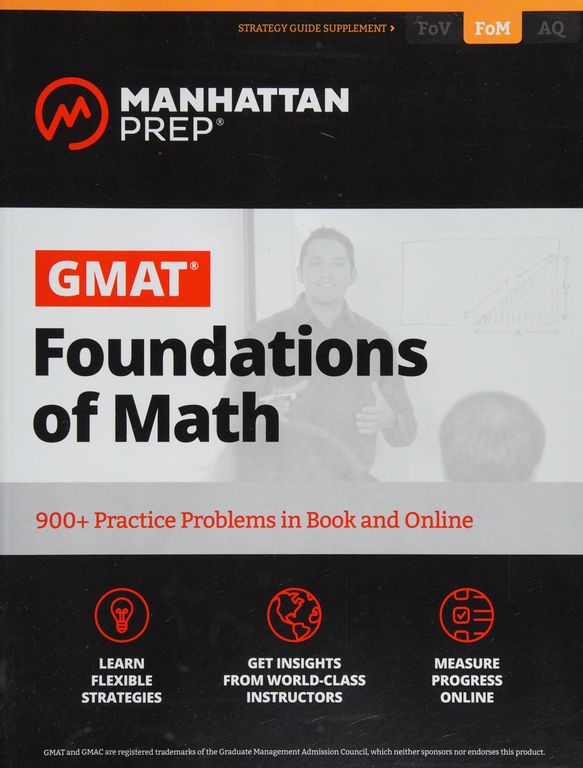
GMAT foundations of math
Introduction
Nova: Picture this. You've decided to apply to business school. You're excited, you're motivated, you've got your target programs picked out. Then you open a GMAT prep book and the very first problem makes your palms sweat. Fractions? Exponents? When was the last time you even thought about long division? If that sounds familiar, you are exactly the person Manhattan Prep had in mind when they wrote GMAT Foundations of Math.
Nova: : And I have to admit, Nova, I've been that person. You crack open a test prep book and suddenly you're staring at quadratic equations like they're written in a foreign language. It's not that you can't learn it — it's that the book assumes you already remember it.
Nova: Exactly. And that's the gap this book fills. GMAT Foundations of Math isn't a GMAT strategy guide. It's not going to teach you the clever shortcuts or the advanced reasoning tricks. What it does — and this is what makes it so interesting — is re-teach you the math you probably learned in middle school and high school but haven't used in five, ten, maybe fifteen years.
Nova: : So it's basically math rehab. A safe space to remember what a numerator is before someone asks you to solve a data sufficiency problem about ratios.
Nova: That's the perfect way to put it. And here's a surprising stat: the book contains over 900 practice problems in its sixth edition, and the newer GMAT Focus edition still packs more than 500. These aren't GMAT-level problems — they're deliberately simpler. The whole point is to build confidence and fluency with the fundamentals before you ever face a real GMAT question.
Nova: : Alright, I'm intrigued. Let's dig into what this book actually covers and who really needs it.
What This Book Is and Isn't
The Prep Before the Prep
Nova: Let's start with the most important thing to understand about this book, because it's also the most commonly misunderstood. GMAT Foundations of Math is not designed to prepare you for the GMAT. I'll say that again — it is not a GMAT prep book.
Nova: : Wait, what? It literally has GMAT in the title.
Nova: I know, and that trips people up. The book's actual purpose, as Manhattan Prep describes it, is to get you ready to prepare for the GMAT. Think of it as the warm-up before the workout. You wouldn't walk into a gym after years of sitting on the couch and immediately try to deadlift 300 pounds. This book is your stretching routine.
Nova: : So it's the prequel. The origin story before the main event.
Nova: Exactly. And Manhattan Prep is very upfront about this. The company's flagship product is a set of strategy guides — originally ten volumes, now consolidated — that teach you GMAT-specific content and strategies. Those books assume you already understand basic arithmetic, algebra, and geometry. Foundations of Math exists for the people who need to rebuild that base first.
Nova: : That actually makes a lot of sense. I remember looking at GMAT forums and seeing people ask, "Should I get Foundations of Math or All the Quant?" And the answer always seemed to be, "Well, it depends."
Nova: Right, and the answer really comes down to one question: when you see a problem involving fractions, exponents, and basic algebra, do you freeze up? If yes, start with Foundations. If you think "oh yeah, I remember this," then you can probably jump straight into All the Quant. One GMAT Club user put it bluntly: "If you have no problems with the five quant books, then you don't need the foundation book. It's for people who are really rusty."
Nova: : And how rusty is "really rusty"? Like, what's the baseline?
Nova: The book literally starts with "Quick-Start Definitions" — defining what digits are, what place value means, how a number line works. It explains that the symbol ">" means "greater than" and "<" means "less than." It walks you through adding and subtracting positive and negative numbers from scratch. If you're someone who hasn't done math since high school and that was a decade ago, this is exactly where you need to begin.
Nova: : So it's genuinely starting from zero. Not assuming anything.
Nova: Not a thing. And that's actually its superpower. There's no shame in needing that level of review. In fact, Manhattan Prep's own student services team has said that the book "brings in a few core concepts that are not covered in the other material, but are important foundational blocks." So even if you think you remember the basics, there might be gaps you don't know you have.
Nova: : That's a really good point. Sometimes you don't know what you don't know until someone asks you to do it.
Inside the Book's Structure
A Tour Through Ten Chapters
Nova: Let's walk through what's actually inside this book, because the structure is really thoughtful. It's ten chapters, and they build on each other in a very intentional sequence.
Nova: : Give me the roadmap.
Nova: Chapter one is Arithmetic — and this is the big one. It covers the absolute fundamentals: basic numbers, greater than and less than, adding and subtracting positives and negatives, multiplying and dividing, distributing and factoring, fractions and decimals, divisibility, even and odd integers, exponents and roots, and variable expressions. It also introduces PEMDAS — the order of operations — which is one of those things everyone learned but many people misremember.
Nova: : I still have to sing the PEMDAS song in my head sometimes. Please excuse my dear Aunt Sally.
Nova: You and millions of others. Then chapter two dives deeper into Divisibility — factors, multiples, prime numbers, all the building blocks of number properties that the GMAT loves to test. Chapter three covers Exponents and Roots in detail. Chapter four is all about Fractions.
Nova: : Fractions deserve their own chapter. I respect that.
Nova: They absolutely do. And then chapter five connects Fractions, Decimals, Percents, and Ratios — teaching you to move fluidly between these four ways of expressing parts of a whole. This is huge for the GMAT because the test constantly asks you to translate between these formats.
Nova: : That's actually one of the things that makes the GMAT tricky, right? A problem will give you information as a fraction but ask for the answer as a percent, and you have to make that translation in your head.
Nova: Exactly. Then the book moves into algebra territory. Chapter six covers Equations and systems of equations. Chapter seven tackles Quadratic Equations — factoring, FOIL, all of that. Chapter eight goes Beyond Equations into Inequalities and Absolute Value, which are concepts that trip up a lot of test-takers.
Nova: : Absolute value still makes me pause every single time.
Nova: You're not alone. Chapter nine is Word Problems — and this is where the book teaches you a four-step process to turn words into math. That's a skill that matters not just for the GMAT but for real business scenarios. And finally, chapter ten covers Geometry: circles, triangles, quadrilaterals, and the coordinate plane.
Nova: : Now, I've heard that geometry was removed from the GMAT Focus Edition. Is that chapter still relevant?
Nova: Great question. For the GMAT Focus Edition, which launched in November 2023 and fully replaced the classic GMAT in February 2024, geometry is no longer tested. Manhattan Prep has updated the book accordingly — the newer editions note that you can skip the geometry chapter if you're taking the Focus Edition. But the book is still used for the Executive Assessment, where some geometry concepts remain relevant.
Nova: : So the book has adapted. That's good to know.
The Target Audience
Who Should Pick Up This Book
Nova: So the big question: who is this book actually for? Let's break it down into a few clear profiles.
Nova: : I like this. Give me the personas.
Nova: Persona one: the career changer who hasn't touched math in over five years. Maybe you studied humanities, you've been working in marketing or communications, and now you want an MBA. The last time you solved for x was in high school. This book is absolutely for you.
Nova: : That's a huge chunk of MBA applicants, honestly.
Nova: It really is. Persona two: the non-native English speaker who understands math concepts but needs to learn them in English, with English terminology. The GMAT tests math in English, and if terms like "integer," "numerator," or "quadratic equation" aren't part of your everyday vocabulary, this book builds that fluency.
Nova: : That's an angle I hadn't considered. It's not just about the math — it's about the language of math.
Nova: Exactly. Persona three: anyone who took a diagnostic test and scored below the 30th percentile on quant. That's a clear signal that the fundamentals aren't solid yet. And persona four: people who have the Manhattan Prep strategy guides but find themselves getting lost in the explanations, thinking "how did they get from this step to that step?"
Nova: : I've been there. You're reading a solution and there's a jump that the author thinks is obvious, but you're completely lost.
Nova: That's exactly when you need to back up and fill the gaps with Foundations of Math. Now, who should skip this book? If you scored above the 50th percentile on a quant diagnostic, or if you're working through the main strategy guides without any confusion about the underlying math, you probably don't need it. One GMAT Club reviewer said it plainly: "I bought it, and it was not worth it for me. The concepts are very rudimentary, fifth-grade level stuff."
Nova: : So it's a tool with a very specific job. Use it if you need it, skip it if you don't.
Nova: And here's something interesting: Manhattan Prep actually offers a free diagnostic test specifically designed to tell you whether you need this book. It's called the Math Readiness Assessment, and it's available on their website. So you don't have to guess — you can test your way into the right starting point.
Nova: : That's smart. No ego involved, just data.
Nova: Right. And the book itself includes four online readiness assessments that you take during and after your studies, so you can track whether you're actually ready to move up to GMAT-level material. It's a very structured, almost course-like approach to self-study.
Practice, Pedagogy, and Online Tools
The Learning Experience
Nova: Let's talk about how the book actually teaches you, because the pedagogy here is worth understanding. Every chapter follows the same pattern: you get a concept explanation, then immediately you get "Check Your Skills" questions to test whether you absorbed it.
Nova: : So it's not just reading and hoping it sticks. It's active recall.
Nova: Exactly. And the book explicitly tells you: if you find these questions challenging, reread the section and try again. Don't just look at the answer and move on. Wrestle with it. Then at the end of each chapter, there are "Chapter Review: Drill Sets" — longer problem sets that mix together everything from that chapter.
Nova: : How many practice problems are we talking about total?
Nova: The sixth edition boasts over 900 practice problems in the book and online combined. The newer GMAT Focus edition has over 500. Either way, that's a lot of reps. And these problems are deliberately simpler than GMAT questions — the goal is to build automaticity with the basics so that when you face a real GMAT problem, your brain isn't wasting energy on the arithmetic.
Nova: : That's actually a really important point. On a timed test like the GMAT, you can't afford to be computing basic fractions from scratch. It has to be automatic.
Nova: That's the whole philosophy. Build the foundation so solid that the basics become second nature, freeing up your mental bandwidth for the strategic thinking the GMAT actually tests. Now, beyond the book itself, there's a significant online component. When you register your book, you get access to Manhattan Prep's online platform, which includes a Foundations of Math Question Bank with hundreds of additional practice problems.
Nova: : And those come with detailed explanations?
Nova: Yes, every problem has a step-by-step solution. You also get those four Math Readiness Assessments I mentioned, plus five free Interact lessons — these are interactive video lessons taught by Manhattan Prep instructors, where the content adapts based on the choices you make.
Nova: : So it's almost a hybrid between a book and a mini course.
Nova: That's a great way to describe it. And here's something that surprised me: the ebook version of GMAT Foundations of Math is actually available for free. Manhattan Prep made it free so that people could try before they buy the physical copy or the full online access.
Nova: : Wait, the entire ebook is free?
Nova: According to Simon and Schuster's page, yes — the ebook version is fully available for free. The physical book and the online resources beyond the ebook are what you pay for. That's a pretty generous approach, and it tells you Manhattan Prep is confident that once you see the quality, you'll want the full package.
Nova: : That's honestly impressive. Most test prep companies guard their content pretty tightly.
Nova: It is. And it aligns with Manhattan Prep's origin story — the company was founded in 2000 by Zeke Vanderhoek, a Yale graduate and Teach for America alumnus, on the belief that test prep should be real education, not just tricks and gimmicks. That philosophy runs through this book.
Conclusion
Nova: So let's bring it all together. GMAT Foundations of Math is a book with a very clear and humble mission: it doesn't promise to get you a 700-plus score. It promises to get you ready to start studying for a 700-plus score.
Nova: : Which, when you think about it, is actually a more honest promise than most test prep books make.
Nova: It really is. The book covers ten chapters from basic arithmetic through geometry, with hundreds of practice problems, built-in skills checks, and online assessments. It's designed for people who need to rebuild their math foundation from the ground up — career changers, non-native English speakers, and anyone whose diagnostic score says "you need to go back to basics."
Nova: : And the key insight is: there's no shame in starting here. In fact, starting here might be the smartest decision you make in your GMAT journey.
Nova: Absolutely. Too many test-takers jump straight into advanced strategy guides, get discouraged, and give up. This book exists to prevent that. It's the bridge between "I'm terrible at math" and "I'm ready to tackle the GMAT." And with the free ebook version available, there's really no barrier to at least checking if it's right for you.
Nova: : So the actionable takeaway is: take a diagnostic test first. If your quant score is below the 30th percentile, or if you find yourself confused by the basic math in strategy guides, get this book. Work through it chapter by chapter, do all the practice problems, take the readiness assessments, and don't move on until you're solid.
Nova: That's exactly right. And remember — the GMAT isn't really a math test. It's a reasoning test that uses math as its language. If you're still translating that language in your head, you'll never get to the reasoning. This book makes the language fluent so you can focus on what actually matters.
Nova: : Build the foundation, then build the house. Makes sense to me.
Nova: This is Aibrary. Congratulations on your growth!